Test for Single Proportion and Hypothesis in Applied Statistics
Master statistical hypothesis testing through single proportion analysis, covering one-tail and two-tail tests with practical applications and numerical examples.
Towards a Mathematical Theory of Pre-Reflective Self-Consciousness: From Metamathematics to the Projective Consciousness Model
Explore mathematical approaches to modeling pre-reflective self-consciousness, examining theories from metamathematics to projective geometry and their implications for understanding subjective experience.

Homogeneous Spaces and Pre-reflective Self-consciousness in Agent Models
Delve into mathematical perspectives on pre-reflective self-consciousness through homogeneous spaces, group actions, and their implications for understanding agent-environment relationships and introspection.
Integrating Multimodal Sensory Information through the Projective Consciousness Model - A Framework for Spatial Perception and Action Planning
Explore how the Projective Consciousness Model explains multimodal sensory integration, spatial perception, and action planning through 3D projective geometry and embodied cognition principles.

Solving a Harvard University Entrance Exam Problem
Master advanced mathematical problem-solving techniques through a detailed walkthrough of a challenging Harvard entrance exam question, focusing on higher mathematics and the Lambert W function.
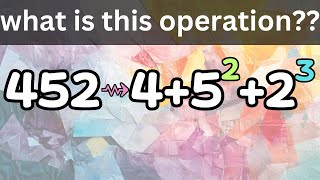
Creative Digit Sum Problem - Advanced Mathematical Challenge
Explore an innovative mathematical challenge involving digit sums, featuring a unique problem-solving approach and creative numerical analysis techniques.
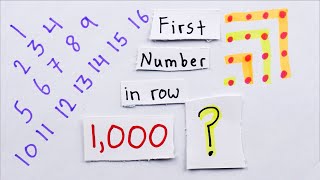
Number Theory Problems: Finding Patterns in the 1000th Row
Explore engaging number theory problems involving triangular patterns, consecutive integer sums, and pattern recognition through three concise mathematical challenges.
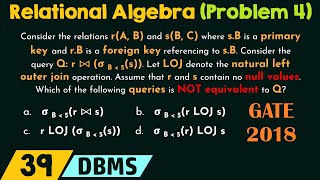
Relational Algebra - GATE 2018 Solved Problem - Part 4
Master relational algebra problem-solving techniques through a detailed walkthrough of a GATE 2018 examination question with step-by-step solutions.

Finite Automata as a Tool for Modeling Psychological Phenomena
Explore how finite automata can effectively model psychological theories, focusing on stress and cognitive processes through clear mathematical frameworks and comparative analysis techniques.
Exact Lagrangians in Cotangent Bundles with Locally Conformally Symplectic Structure
Explore advanced concepts in locally conformally symplectic geometry, examining Lagrangian topology, Hamiltonian dynamics, and connections to contact geometry through theoretical frameworks and practical examples.

Exploring Minor Planets and the Story of Planet Pi
Explore the fascinating connection between asteroid classification numbers and Pi through Matt Parker's engaging mathematical journey through the solar system.
How EIP-4844 Will Affect the L2 Rollups
Dive into the impact of EIP-4844 on Layer 2 rollups and blockchain scalability, exploring key technical implications and future developments for Ethereum's ecosystem.
Introducing RAM to the World Computer
Dive into the innovative concept of implementing RAM architecture for blockchain-based world computing systems, exploring technical challenges and potential solutions for decentralized memory management.
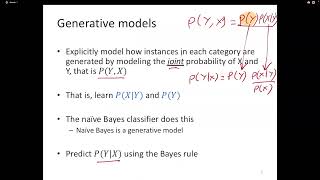
Discriminative and Generative Models in Machine Learning - Lecture 24B
Explore the key distinctions between discriminative and generative models in machine learning, focusing on their unique approaches and practical applications.
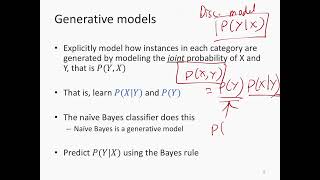
Generative and Discriminative Models in Machine Learning - Lecture 27B
Explore the fundamental differences between generative and discriminative models in machine learning through a concise high-level introduction to these essential modeling approaches.

Linear Models and Their Geometry in Machine Learning - Lecture 5
Explore the fundamental concepts and geometric principles behind linear classifiers, a cornerstone of machine learning algorithms and classification techniques.
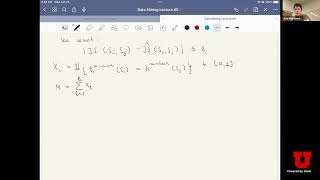
Data Mining: Choosing k for MinHashing - Spring 2023
Delve into advanced min hashing concepts, exploring PAC learning, Central Limit Theorem, and Chernoff-Hoeffding Inequality to optimize k-value selection for accurate Jaccard similarity estimates.

Thrifty Shadow Estimation: Re-using Quantum Circuits and Bounding Tails
Explore statistical efficiency improvements in quantum shadow estimation through circuit reuse techniques, focusing on Haar random unitaries and practical implementations for near-term quantum computing.

Almost Qudits in the Prepare-and-Measure Scenario
Delve into quantum communication challenges when encoding information in carriers that nearly match standard qudits, exploring impacts on semi-device-independent protocols and dimension testing.

Refuting Spectral Compatibility of Quantum Marginals
Delve into quantum marginal problem's spectral compatibility through a mathematical framework using symmetry-reduced semidefinite programming hierarchy for detecting incompatible spectra in quantum states.

Performance and Limitations of QAOA at Constant Levels on Large Sparse Hypergraphs and Spin Glass Models
Delve into quantum algorithm analysis, exploring QAOA's performance limitations on large hypergraphs and spin glass models through theoretical frameworks and mathematical proofs.