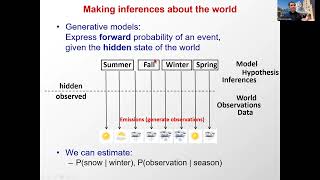
Expression Analysis, Clustering, and Classification in Machine Learning - Lecture 2
Comprehensive exploration of machine learning concepts, from basic principles to advanced techniques, with applications in gene expression analysis and text clustering.
Tensors, State-Sum Topological Field Theories and the Evaluation of Extruded Graphs
Explore three-dimensional topological field theories, tensor network models, and graph evaluations in relation to state-sum constructions and surface defects.
Thermalization of Quantum Memories - A Tensor Networks Approach
Explore thermalization of quantum memories using tensor networks, focusing on 2D Kitaev's quantum double models and their Gibbs state representation as PEPS.
Minimization Problems for the Axisymmetric Neo-Hookean Energy
Explore minimization problems for axisymmetric neo-Hookean energy, focusing on existence of minimizers, energy concentration, and bounds for relaxed energy in critical Sobolev cases.
Non-interpenetration in Thin-film Models of Elastic Solids
Explore non-interpenetration in thin-film models for elastic solids, focusing on dimension reduction, membrane regimes, and suitable conditions for preventing material penetration.
Finite Crystallization via Stratification in Two-Dimensional Square Lattices
Explore new techniques for proving 2D crystallization in square lattices using stratification methods and bond graph analysis for finite particle systems.
The Expression Problem and Lenses - Functional Programming Concepts
Explore functional programming concepts like the Expression Problem and Lenses with Tony Morris. Learn advanced techniques to enhance code flexibility and maintainability.
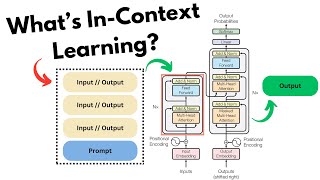
In-Context Learning in Deep Learning - How It Works in Large and Small Language Models
Explore in-context learning in LLMs: definition, significance, Bayesian framework, and implementation. Gain insights into this surprising capability of language models and its implications for AI.
Probabilistic Inference in Language Models via Twisted Sequential Monte Carlo
Explore advanced probabilistic inference techniques for language models using Twisted Sequential Monte Carlo, enhancing LLM capabilities and safety measures.
Reliable Machine Learning in Healthcare
Explore reliable machine learning techniques for healthcare applications, focusing on survival models, dependent censoring, and covariate shift detection to enhance medical decision-making.
What Is ChatGPT Doing? Understanding Large Language Models - Episode 2
Explore the inner workings of ChatGPT and large language models, understanding their token-by-token generation process and the complexities behind their seemingly intelligent outputs.

Global Optimization in Wolfram Language: Solving Nonlinear and Nonconvex Problems
Explore advanced global optimization techniques in Wolfram Language for solving complex nonlinear and mixed-integer problems with real-world examples.
Machine Learning Models for Single Cell and Regulatory Genomics - CGSI 2023
Explore machine learning models for single-cell and regulatory genomics, focusing on recent research and applications in computational biology.
Machine Learning via Graph Signal Processing for Complex Biological Data
Explore machine learning techniques using graph signal processing for analyzing complex biological data, focusing on geometric scattering networks and their applications in computational genomics.
Classical and Quantum Subjectivity in Uncertainty and Belief Systems
Explore uncertainty in subjective logic, from Markov networks to quantum quasiprobabilities, gaining insights on computational irreducibility and belief spaces.
Efficiently Exploring Combinatorial Perturbations From High Dimensional Observation
Explore efficient methods for analyzing combinatorial perturbations in high-dimensional data, focusing on innovative approaches and practical applications.
Metric Flow Matching for Smooth Interpolations on the Data Manifold
Explore Metric Flow Matching for smooth interpolations on data manifolds. Learn about conditional paths, Riemannian metrics, and geodesic interpolants. Discover applications in LiDAR navigation and cellular dynamics modeling.
Exploring Random Quantum Circuits: A New Implementation Method
Discover a novel method for constructing random quantum circuits, comparing its properties to traditional approaches and exploring its potential for quantum hardware implementation.
Computational Conversations - Do We Use the Maths We Learned in School? - Episode 8
Explore the relevance of school mathematics in computational careers through reflections on useful skills and modern perspectives from industry experts.
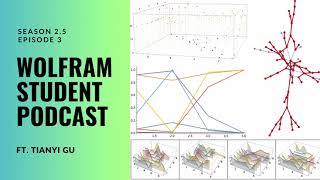
Analyzing the Temperature-Varied Syntactic Structures of GPT 3.5
Explore how temperature affects grammatical structures in AI-generated text, applying graph theory to language and comparing human vs. machine writing.

Score Matching via Differentiable Physics
Explore score matching via differentiable physics for inverse problems. Learn about combining physics operators with stochastic differential equations to generate plausible trajectories towards given end states.