Building Efficient Learning Algorithms: A Computational Regularization Perspective - Lorenzo Rosasco
Explore efficient learning algorithms through a computational regularization lens. Unify algorithmic tricks in least squares learning for accuracy and resource efficiency.
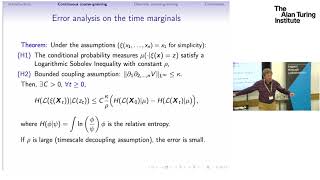
Coarse-Graining Stochastic Dynamics
Explore techniques for simplifying complex stochastic systems through coarse-graining, enabling practical computation and accurate prediction in various scientific fields.
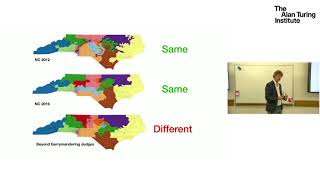
Understanding the Geopolitical Structure of the USA
Explore statistical approaches for analyzing geopolitical structures in the USA, combining data analysis with complex systems modeling to uncover crucial features and patterns.
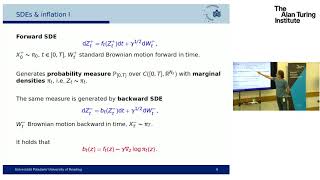
Learning Models by Making Them Interact
Explore new approaches to data-driven modeling of complex systems, combining statistical inference, high-throughput computation, and physical laws for more accurate predictions in various scientific fields.
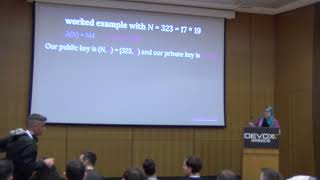
Asymmetric Cryptography - A Deep Dive
Explore asymmetric cryptography's foundations, evolution, and future. Uncover RSA and ECDSA algorithms, their limitations, and post-quantum implications in this mathematical journey through digital security.

0/1 Knapsack Problem Using Least Cost Branch and Bound - Design and Analysis of Algorithms
Learn to solve the 0/1 Knapsack problem using Least Cost Branch and Bound method, with a step-by-step example demonstrating the algorithm's application in Design and Analysis of Algorithms.
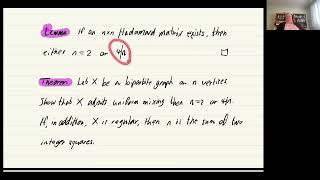
Algebraic Graph Theory and Quantum Computing - Lecture 11
Explore the intersection of algebraic graph theory and quantum computing, delving into advanced mathematical concepts and their applications in quantum information science.
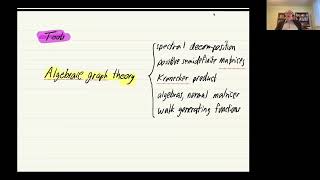
Algebraic Graph Theory and Quantum Computing - Lecture 1
Explore the intersection of algebraic graph theory and quantum computing, delving into advanced mathematical concepts and their applications in quantum information science.
Algebraic Graph Theory and Quantum Computing - Lecture 30
Explore the intersection of algebraic graph theory and quantum computing, delving into advanced mathematical concepts and their applications in quantum information science.
Algebraic Graph Theory and Quantum Computing - Lecture 32
Explore connections between algebraic graph theory and quantum computing, focusing on applications and theoretical insights in this advanced mathematical field.
Algebraic Graph Theory and Quantum Computing - Lecture 13
Explore connections between algebraic graph theory and quantum computing, delving into mathematical concepts that bridge these fields and their practical applications.
Generative Techniques for Music AI
Explore diverse techniques for AI music generation, from symbolic AI to deep learning, covering optimization algorithms, complex systems, and statistical methods. Gain insights into key approaches and their applications.
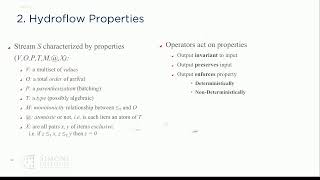
Logic and Algebras for Distributed Computing - Applications and Open Questions
Exploring connections between distributed computing and formal program representations, unifying logic and algebra-based approaches for practical language design and theoretical proofs.
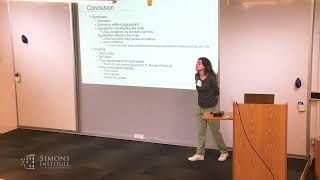
Direct Access for Conjunctive Queries with Aggregation
Explore efficient algorithms for simulating sorted query answers with aggregation, examining tractability for various aggregate functions and lexicographic ordering scenarios.
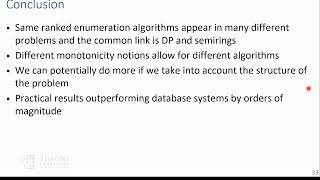
Any-k: Ranked Enumeration for Dynamic Programming
Explore efficient algorithms for ranked enumeration in dynamic programming, focusing on semiring-based optimization problems and their applications to database query evaluation.
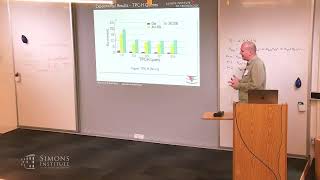
Approximating Certain and Possible Answers Beyond Sets
Explore techniques for modeling uncertainty in databases using semiring-annotated relations, enabling efficient approximations of certain and possible answers for complex queries.
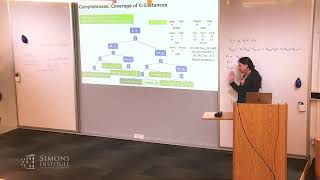
Understanding Queries by Conditional Instances
Explores methods for generating representative database instances to illustrate query satisfaction, aiding in query debugging and comprehension through abstraction and characterization.
Machine Learning for LHC Theory - Lecture 1
Explore machine learning applications in high-energy physics, focusing on LHC theory. Learn key concepts and techniques for analyzing complex particle collision data and uncovering new physics insights.

The Startling Reason Entropy and Time Only Go One Way
Explore the fascinating connection between entropy, probability, and the unidirectional flow of time. Discover why natural phenomena tend towards lower energy states and how this relates to the universe's increasing disorder.
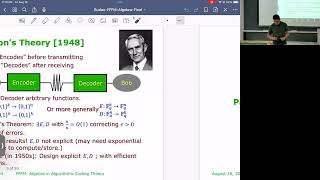
Algebra in Algorithmic Coding Theory
Explore algebraic techniques in algorithmic coding theory, focusing on error-correcting codes and their applications in computer science and information theory.
SYK III: Entanglement, Non-equilibrium Dynamics and Thermalization - Lecture 3
Explore entanglement, non-equilibrium dynamics, and thermalization in quantum systems. Delve into advanced concepts of quantum information theory and their applications in many-body physics.