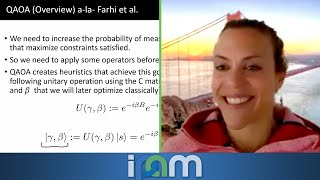
Quantum Approximate Optimization Algorithm and Local Max-Cut - IPAM at UCLA
Explore quantum optimization algorithms, focusing on QAOA's application to LocalMaxCut. Discover insights on quantum supremacy and the performance comparison between local algorithms and QAOA on various graph instances.
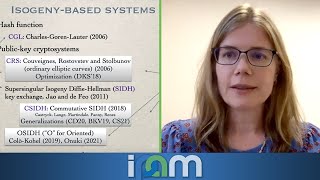
Classical and Quantum Algorithms for Isogeny Problems
Explore classical and quantum algorithms for isogeny problems in post-quantum cryptography, focusing on computational challenges, path finding in isogeny graphs, and reductions to other problems in elliptic curve cryptography.
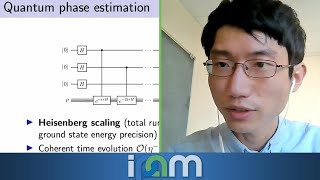
Heisenberg-Limited Ground State Energy Estimation for Early Fault-Tolerant Quantum Computers
Explore Heisenberg-limited ground state energy estimation for early fault-tolerant quantum computers, featuring a simplified circuit and classical post-processing for improved efficiency.
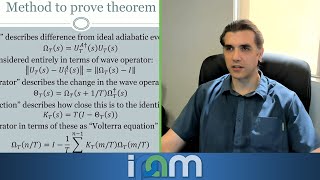
Optimal Scaling Quantum Linear Systems Solver via Discrete Adiabatic Theorem
Explore optimal quantum linear systems solver using discrete adiabatic theorem, achieving linear complexity in condition number and precision, with simplified implementation and constant factor analysis.
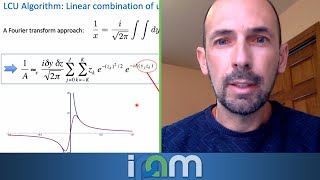
The Quantum Linear Systems Problem - IPAM at UCLA
Explore quantum algorithms for solving linear systems, including improved methods and complexity analysis, with a focus on potential exponential speedups and verification challenges.
Fast Algorithms for Quantum Signal Processing - IPAM at UCLA
Explore fast algorithms for quantum signal processing, focusing on optimization techniques, energy landscapes, and phase factor structures in quantum singular value transformation.
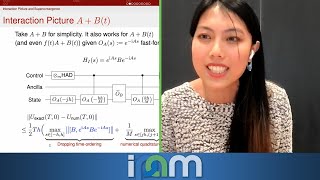
Time-Dependent Hamiltonian Simulation of Highly Oscillatory Dynamics - IPAM at UCLA
Explore highly oscillatory dynamics in quantum systems, focusing on efficient simulation algorithms for time-dependent Hamiltonians with applications in various scientific fields.
Wasserstein Distributionally Robust Optimization - Theory and Applications in Machine Learning
Explore Wasserstein distributionally robust optimization theory and its applications in machine learning, focusing on data-driven decision-making under uncertainty and statistical learning.
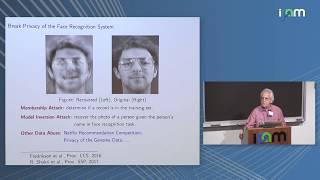
Trustworthy Deep Learning
Explore robust, accurate, efficient, and private deep learning with theoretical guarantees, drawing insights from differential equations for trustworthy AI applications.
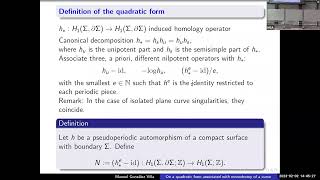
Quadratic Forms in Surface Automorphisms and Singularity Theory
Explore pseudo-periodic surface automorphisms, quadratic forms, and their applications in singularity theory. Gain insights into Milnor fibers and monodromy automorphisms.
Spectrum of Singularities
Explore hypersurface singularity spectra: definition, properties, and computational techniques. Learn about Thom-Sebastiani theorem, semicontinuity, and applications in algebraic geometry.
Machine Learning and Neural Networks: Simple and Multiple Linear Regression - Day 5
Learn simple and multiple linear regression techniques for machine learning and neural networks, covering key concepts and practical applications.
Deep Learning Applications by Rina Panigrahy
Explore deep learning applications, from basic concepts to advanced techniques. Learn about neural networks, optimization methods, and real-world uses in image and speech recognition.
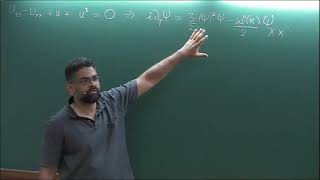
Perturbation Methods for Nonlinear PDEs - Lecture 3
Explore advanced perturbation techniques for nonlinear PDEs, focusing on multiple scales, asymptotic analysis, and the interplay between linear waves and nonlinearity in various scientific contexts.
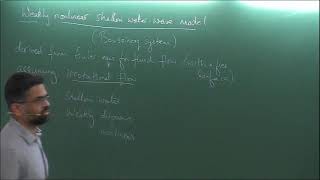
Perturbation Methods for Nonlinear PDEs - Lecture 4
Explore perturbation methods for nonlinear PDEs, focusing on shallow water waves and damped KDV models. Learn unified approaches to adapt linear equation techniques to nonlinear contexts.
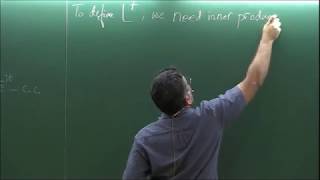
Perturbation Methods for Nonlinear PDEs - Lecture 2
Explore perturbation methods for nonlinear PDEs, focusing on nonlinear oscillators and periodic solutions. Learn techniques like inner products, perturbation series, and 2Pi periodicity to tackle complex equations.
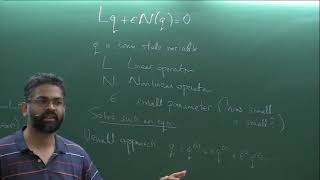
Perturbation Methods for Nonlinear PDEs - Lecture 1
Explore perturbation methods for nonlinear PDEs, focusing on adapting linear equation techniques. Learn unified approaches through examples from cold atoms, water waves, and atmospheric science.
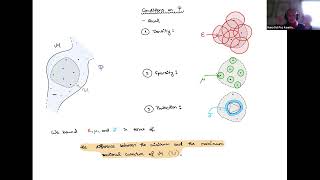
Curvature Variation Based Sampling for Delaunay Triangulations of Manifolds
Explore adaptive sampling for Delaunay triangulations of Riemannian manifolds, focusing on curvature variation and quality bounds for successful triangulation. Learn about geometric realizations and manifold triangulation techniques.
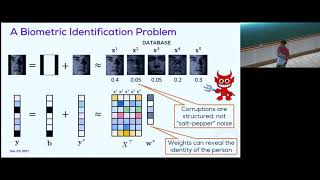
Robust Regression by Purushottam Kar
Explore robust regression techniques for learning and estimation in algorithms and optimization, focusing on practical applications and theoretical foundations.
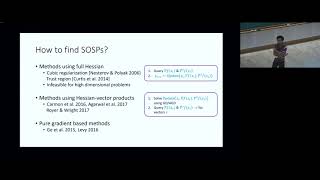
How to Escape Saddle Points Efficiently? by Praneeth Netrapalli
Explore efficient methods for escaping saddle points in non-convex optimization, focusing on perturbed gradient descent and its applications in various algorithmic settings.
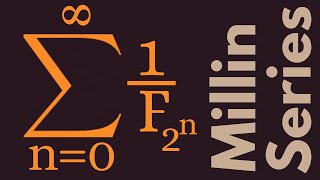
The Millin Series - A Nice Fibonacci Sum
Explore the Millin series, involving reciprocals of 2^nth Fibonacci numbers, using Catalan's identity and the golden ratio to derive its closed form.