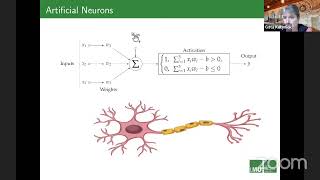
The Mathematics of Artificial Intelligence
Explore the mathematical foundations of AI, its impact on problem-solving in mathematics, and the challenges in developing reliable AI systems. Gain insights into generalization, explainability, and AI applications in inverse problems and PDEs.
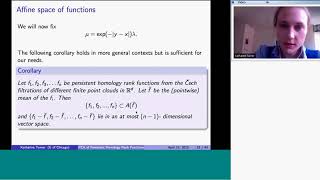
Katharine Turner - PCA of Persistent Homology Rank Functions with Case Studies
Explore persistent homology rank functions through PCA, featuring case studies and insights into topological data analysis techniques.
The Arithmetic of Quadratic Twists of Elliptic Curves
Explore quadratic twists of elliptic curves, Selmer groups, and L-values. Delve into the congruent number problem and progress on the BSD conjecture. Gain insights into advanced number theory concepts.
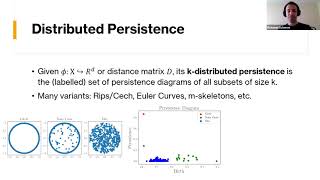
Dimensionality Reduction via Distributed Persistence - DIPOLE
Explore dimensionality reduction with DIPOLE, a novel approach combining local metric and global topological preservation for improved data visualization and analysis.
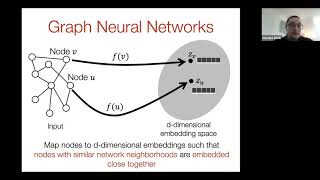
Graph Representation Learning and Its Applications to Biomedicine
Graph representation learning techniques for biomedical applications, focusing on SubGNN for disentangled subgraph embeddings and their use in predicting disease treatments and safe drug combinations.

Understanding, Interpreting and Designing Neural Network Models Through Tensor Representations
Explore tensor representations for neural networks, enhancing interpretability, expressive power, generalization, and robustness in deep learning models through spectral methods and innovative architecture design.
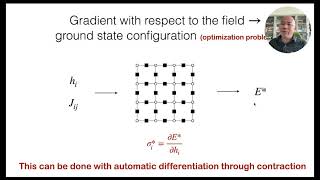
Tropical Tensor Networks
Unified tensor network approach for spin glasses using tropical algebra, enabling ground state energy computation, optimal configuration identification, and solution counting. Combines graphical models and quantum circuit simulation.
David Gross: Stabilizer Formalism & Quantum Error Correction Through the Lens of Tensors
Explore advanced quantum error correction techniques, focusing on the stabilizer formalism and its applications in quantum fault tolerance, using tensor-based approaches and group theory.
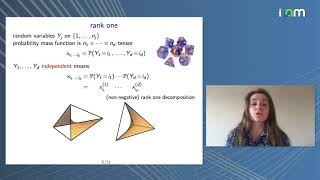
Tensors in Statistics and Data Analysis
Explore tensors in statistics and data analysis, covering probability tensors, biological measurements, and signature tensors for time-series data. Learn about decompositions and algebraic properties in this comprehensive overview.
Task-Driven Network Discovery via Deep Reinforcement Learning on Embedded Spaces
Explore task-driven network discovery using deep reinforcement learning on embedded spaces. Learn about improving network observability and optimizing data collection for accurate analysis.
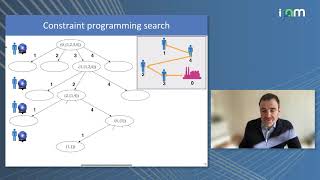
Combining Reinforcement Learning and Constraint Programming for Combinatorial Optimization
Explore a hybrid approach combining reinforcement learning and constraint programming for solving complex combinatorial optimization problems, with applications in various fields.
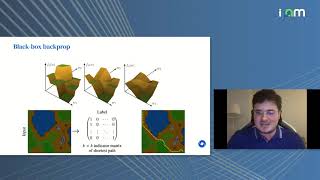
Reasoning on Natural Inputs
Explore neural algorithmic reasoning for natural inputs, bridging classical algorithms with deep learning to solve real-world problems more effectively in reinforcement learning environments.
Can ML Help in Solving Cargo Capacity Management Booking Control Problems
Explore ML applications in cargo capacity management, focusing on booking control problems and predicting solution costs for discrete optimization in revenue management.
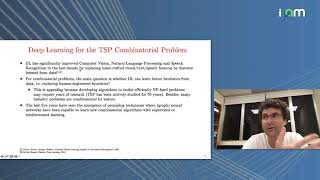
The Transformer Network for the Traveling Salesman Problem
Explore how Transformer networks can tackle the Traveling Salesman Problem, improving upon existing heuristics with promising results for combinatorial optimization challenges.
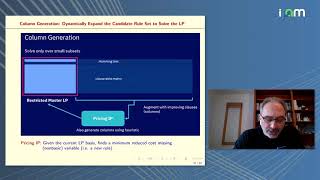
Fair and Interpretable Decision Rules for Binary Classification
Explore fair and interpretable decision rules for binary classification using Boolean rule sets in DNF, with a focus on maximizing accuracy while maintaining group fairness constraints.
Oscillator-to-Oscillator Codes Do Not Have a Threshold
Explores limitations of oscillator-to-oscillator codes in quantum information, proving they lack a threshold property for error correction when using constant squeezing and maximum likelihood decoding.
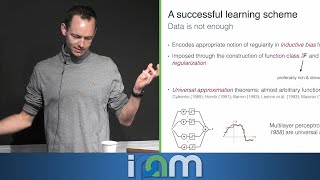
Machine Learning Basics: A Speedrun - IPAM at UCLA
Speedrun through machine learning fundamentals, covering key concepts like inductive bias, regularization, and kernel methods for both linear and nonlinear regression.
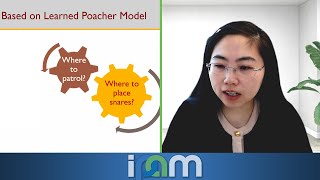
Machine Learning and Game Theory for Social Impact
Explore machine learning and game theory applications in security, sustainability, and food rescue, featuring real-world deployments and innovative solutions for societal challenges.
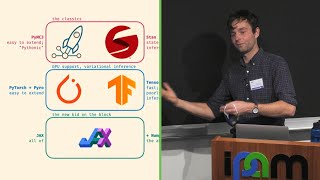
Methods for Scalable Probabilistic Inference - IPAM at UCLA
Explore scalable probabilistic inference methods for astrophysics, focusing on Gaussian Processes for time series analysis and open-source tools to accelerate Bayesian inference with large datasets.
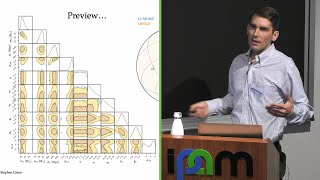
Real-Time Gravitational-Wave Parameter Estimation Using Machine Learning
Explore machine learning for real-time gravitational-wave parameter estimation, covering Bayesian inference, neural networks, and simulation-based techniques to enhance speed and accuracy in astrophysical data analysis.
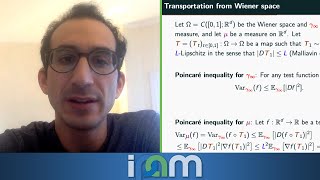
The Brownian Transport Map - IPAM at UCLA
Explore Lipschitz transport maps between probability measures, focusing on the Brownian transport map's construction, properties, and applications to Euclidean functional inequalities.