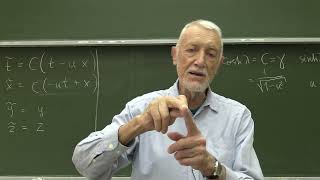
Lorentz Transformation of the Electromagnetic Field - Continued - Lecture 11
Explore advanced concepts in electromagnetic field transformations through Lorentz equations, building on previous knowledge in theoretical physics and relativity.
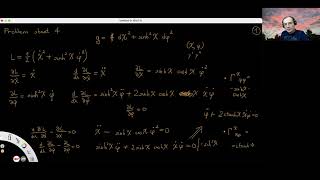
Gravitational Waves: Theory and Interactions - Lecture 13
Explore gravitational waves, their linear approximation, polarizations, and interactions with matter in this graduate-level physics lecture on theoretical aspects of gravitational wave physics.
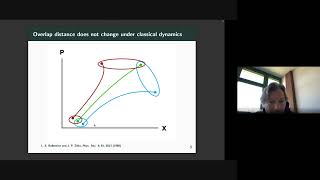
Detection of Quantum Chaos with Quantum Hamming Distance
Explore quantum chaos detection using Quantum Hamming Distance, uncovering state sensitivity in quantum theory and challenging traditional beliefs about quantum evolution.
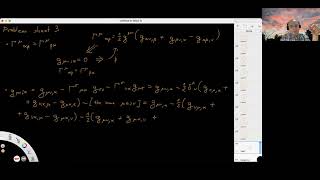
Christoffel Symbols, Linearized Gravity, and Newtonian Approximation - Lecture 11
Explore linearized gravity and Newtonian approximation in general relativity, with problem-solving sessions and corrections to previous material.
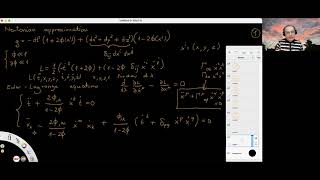
Riemann Tensor in General Relativity - Lecture 9
Explore the Riemann tensor through Christoffel symbols, geodesics, 2-sphere geometry, and Rindler spacetime in this advanced graduate-level physics lecture.
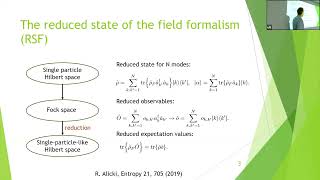
Mesoscopic Description of Entanglement of Bosonic Fields and Its Open Evolution
Explore mesoscopic descriptions of entanglement in bosonic fields, focusing on simplified models that capture non-classical phenomena for photonic quantum computing and communication.
Nonequilibrium: From Heat Conduction to Turbulence and Life - Rothschild Lecture
Explore nonequilibrium phenomena from heat conduction to turbulence, with insights on mathematical approaches and potential applications to life systems.
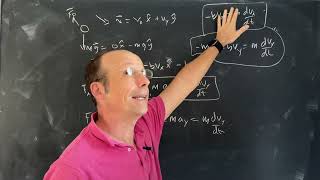
Classical Mechanics: Comparing Fall Times of Dropped and Launched Balls
Explore the impact of air resistance on falling objects through a comparative analysis of dropped and horizontally launched balls using various drag models.
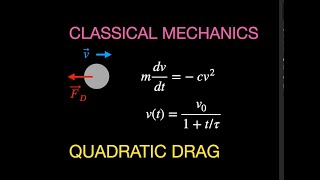
Classical Mechanics: Linear Motion with Quadratic Drag
Explore linear motion with quadratic drag in classical mechanics, deriving velocity and position functions over time using Python simulations.
Classical Mechanics: 2D Projectile Motion with Linear Drag
Explore 2D projectile motion with linear drag, analyzing range and velocity for specific scenarios like a tiny ice ball launch. Includes Python code demonstration.
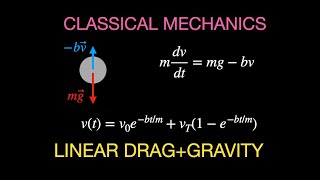
Classical Mechanics: Falling Object with Linear Drag
Explore falling objects with linear drag, analyzing velocity and position over time. Includes Python modeling for practical application.
Physics Lab: Using Data to Plot Linear Functions
Learn to create linear graphs for physics labs using Vernier's Graphical Analysis software, enhancing data visualization and analysis skills.
Classical Mechanics: Pendulum in Polar Coordinates - Python Modeling
Explore pendulum motion using polar coordinates and Newton's second law, with Python implementation for practical modeling.
Classical Mechanics: Jump Start with Simple Harmonic Motion - Mass on a Spring
Explore simple harmonic motion through mass-spring systems, including realistic scenarios and numerical calculations using Python.
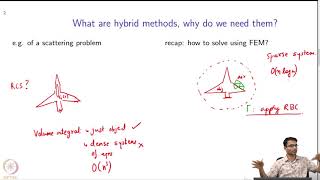
Applications of Computational Electromagnetics: Hybrid Methods - Motivation
Explore hybrid methods in computational electromagnetics, focusing on their motivations and applications in solving complex electromagnetic problems.
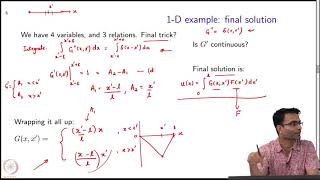
Introduction to Green's Function: 1-D Example - Alternate Representation
Explore alternate representations of Green's Function in 1-D, focusing on practical applications and problem-solving techniques in mathematical physics.
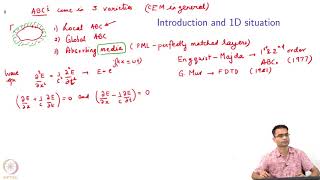
FDTD: Materials and Boundary Conditions - Absorbing Boundary Conditions 1D
Explore absorbing boundary conditions in 1D for FDTD simulations of materials, enhancing understanding of electromagnetic wave propagation and computational techniques.
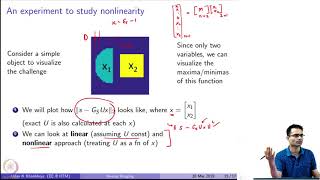
Applications of Computational Electromagnetics: Inverse Problems and Non-Linearity
Explore inverse problems and non-linearity in computational electromagnetics, focusing on practical applications and advanced techniques for solving complex electromagnetic challenges.
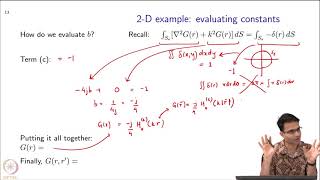
Introduction to Green's Function: 2-D Example - Evaluating Constants - Part 2
Explore advanced concepts in Green's Function for 2D problems, focusing on evaluating constants in the second part of this mathematical analysis.
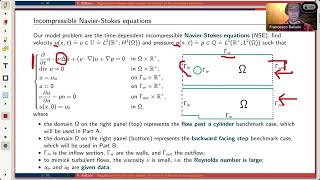
Regularized Reduced Order Models for Control of Navier-Stokes Equations
Explore regularized reduced order models for controlling Navier-Stokes equations in convection-dominated flows, focusing on evolve-filter-relax and approximate deconvolution techniques for numerical stabilization.
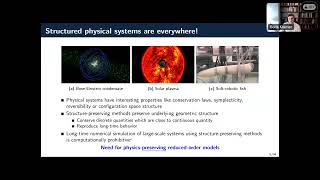
Structure-Preserving Learning of High-Dimensional Lagrangian and Hamiltonian Systems
Explore structure-preserving learning for high-dimensional Lagrangian and Hamiltonian systems, focusing on reduced-order models in mechanics, robotics, and wave propagation for enhanced stability and predictive accuracy.