On the Uniqueness Problem for Spacetime Extensions
Explore uniqueness conditions for Lorentzian manifold extensions, analyzing boundary agreement and presenting recent findings on necessary conditions and non-uniqueness mechanisms.
Quantum Field Theory on Low-Regularity Spacetimes
Explore quantum field theory on low-regularity spacetimes, focusing on massless scalar fields, Cauchy problems, Green operators, and physical states in a mathematically rigorous framework.
Gromov-Hausdorff Theory for Lorentzian Spaces
Explore Gromov-Hausdorff distance for bounded Lorentz-metric spaces, addressing stability in geometric conditions and its relevance to Einstein equations and cosmic censorship.
Remarks on the Cosmological Constant as an Initial Condition for Milne-like Spacetimes
Explore Milne-like spacetimes and their implications for the cosmological constant, early universe expansion, and inflationary scenarios in this advanced physics lecture.
Causal Evolution of Measures and Continuity Equation in Spacetime Geometry
Explore causal evolution of measures in spacetime, examining alternative descriptions and their relationships through probability measures, causal curves, and continuity equations in globally hyperbolic settings.
Causal Set Kinematics: Reconstructing Spacetime Geometry from Random Posets
Explore causal set quantum gravity, reconstructing spacetime geometry from random posets. Learn dimension estimation, topology, and geometric invariants in discrete orders.
Supertranslation Invariance and Covariance of Lorentz Charges in General Relativity
Explore supertranslation invariance and covariance of Lorentz charges in general relativity, addressing key problems and presenting new covariant formulas for flux calculations.
CFT Explorations of BMS-Like Algebras
Explore conformal field theoretic realisations of BMS-like algebras and their BRST complexes in semi-infinite cohomology.
Asymptotic Structures at Timelike Infinity from Projective Geometry
Explore asymptotic structures at timelike infinity using projective geometry in this advanced physics lecture by Jack Borthwick.
The Matsuno-Gill Model on the Sphere - Extended Analysis and Applications
Explore the extended Matsuno-Gill model on a sphere, analyzing its parameters and solutions across different damping and rotation rates. Gain insights into planetary-scale fluid dynamics.
Modeling Density-Driven Flows in the Presence of Chaotic Advection
Explore a hybrid kinematic-dynamic model for density-driven flows, combining traditional Stommel Box and chaotic advection approaches to study oceanic feedback processes.
Mathematical Fluid Dynamics of Atmospheric and Oceanic Flows
Explore mathematical fluid dynamics for atmospheric and oceanic flows, focusing on thin-shell approximation in rotating spherical coordinates and perturbation theory for atmospheric modeling.
Propagation of Errors in Measurements - Part 2
Explore error propagation in mathematical operations involving measured values, including sums, differences, products, and functions.
Propagation of Errors in Measurements - Part 1
Explore error propagation in measurements, including sum, difference, product, and functional relationships between values.
Falsifiability and Reproducibility in Research - Part 1
Explore falsifiability in theoretical research and reproducibility in experimental research, crucial concepts for scientific integrity and progress.
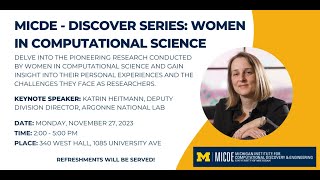
Exploring the Dark Universe - Challenges in Cosmology
Explore the Dark Universe with Dr. Katrin Heitmann, delving into cosmology's exciting phase, dark matter, dark energy, and challenges in data interpretation using supercomputer simulations.
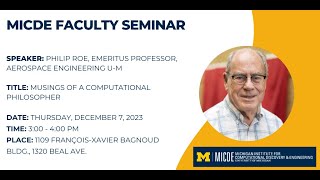
Musings of a Computational Philosopher - Exploring Accuracy in Compressible Flow Algorithms
Explore computational fluid dynamics through philosophical lens. Delve into accuracy, information flow, and innovative algorithms for compressible flow problems. Gain insights from an emeritus professor's decade-long research.
Particle-Laden Flows: Simulations and Data-Driven Modeling
Explore particle-laden flows through simulations and data-driven modeling techniques, gaining insights into complex fluid dynamics and engineering applications.
Does Having a Big Brain Make You Smarter?
Explore the mathematical approach to brain size and intelligence, examining scaling laws and statistical principles in humans and animals to uncover connections between brain size and cognitive abilities.
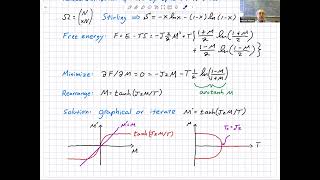
Introduction to the Cluster Variation Method (CVM) for Alloys
Explore Kikuchi's cluster variation method for Ising models and alloys, learning entropy approximations and applications to binary and high entropy alloys.
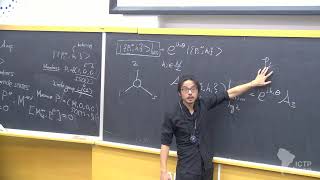
Amplitudes and Applications - Class 1
Explore amplitudes and their applications in particle physics through an in-depth lecture series, focusing on advanced concepts and cutting-edge research.