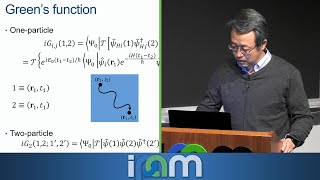
Low Rank Approximation in Electron Excitation Calculations - IPAM at UCLA
Explore low rank approximation techniques for efficient electron excitation calculations, focusing on the Interpolative Separable Density Fitting method and its applications in quantum mechanics.
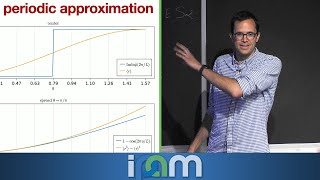
Localization Methods - Perspectives on Initialization and Optimization - IPAM at UCLA
Explore Wannier localization in quantum mechanics, its mathematical formulation, challenges, and new approaches for efficient orbital localization in condensed matter systems.
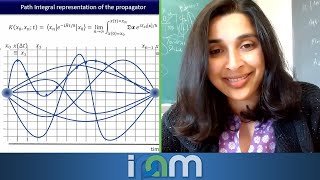
Quantum Dynamics from Classical Trajectories - IPAM at UCLA
Explore semiclassical approximations in quantum mechanics, focusing on a novel approach for complex chemical systems and addressing challenges in path space sampling and prefactor evaluation.

Systematically Improvable Models from Alchemical Perturbations - IPAM UCLA
Explore systematic improvements in quantum models using alchemical perturbations, connecting chemical spaces and simplifying material design through novel approaches and fundamental constraints.
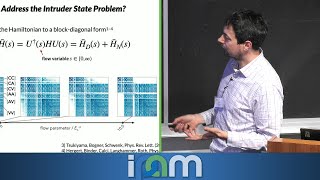
Many-Electron Effective Hamiltonians from Similarity Renormalization Group
Explore many-electron effective Hamiltonians using similarity renormalization group, focusing on bond-breaking reactions, spin states, and excited states of molecules with near-degenerate electronic structures.
Splitting Numbers and Signatures
Explore number theory and topology with a focus on splitting numbers, linking number bounds, and signature results in this advanced mathematical lecture.

From Connected and Autonomous Vehicles Control to Vehicular Traffic Control
Explore innovative traffic control strategies, from individual vehicle management to large-scale systems, addressing technological advancements and methodological challenges in road traffic management.
Arctic Curves for Ice Models
Explore arctic curves in statistical mechanics, focusing on the six-vertex model with ice point and domain-wall boundary data. Learn about the geometric tangent method for locating arctic boundaries.
Topology and the Electromagnetic Responses of Quantum Materials
Explore electromagnetic responses in quantum materials, focusing on topological insulators, Weyl semimetals, and quantized effects. Gain insights into Berry phases, anomalous Hall effect, and circular photogalvanic effect.

Dynamics of 2+1-dimensional Quantum Field Theory - Lecture 2
Explore advanced concepts in 2+1D quantum field theory, focusing on symmetries, topology, and duality. Gain insights into recent developments and their applications across physics disciplines.
Entanglement in Theories of Gravity by Suvrat Raju
Exploración de la entropía de entrelazamiento en teorías de gravedad, examinando su definición, paradojas y nuevas perspectivas en el contexto de la teoría cuántica de campos y la gravedad.
Large Deviations of Markov Processes - Part 1
Explore large deviation theory in statistical physics, covering Markov processes, dynamical observables, and advanced mathematical concepts. Gain insights into recent developments and applications in nonequilibrium systems.

The Visions of Shamans and Saints - Dynamic Instabilities in Neuroscience by Bard Ermentrout
Explore neural patterns, from motor activity to brain imaging, and their connections to paleolithic art and hallucinations. Discover mechanisms behind spatial and temporal patterns in neuroscience.
Introduction to Gene Genealogies and Coalescent Processes by John Wakeley
Explore gene genealogies and coalescent processes in population genetics, covering inference of human population history from genome sequences and SNP-difference data analysis.
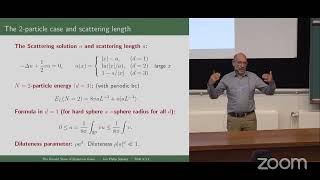
Jan Philip Solovej: The Ground State of Quantum Gases
Explore quantum gases' ground state, thermodynamic limits, and Bogolubov approximation in this mathematical physics lecture, bridging theory and experimental verification.
Fractal Uncertainty Principle and Quantum Chaos
Explore quantum chaos and fractal uncertainty principle in wave equations, with applications to eigenfunctions, Schrödinger equation, and hyperbolic surfaces. Gain insights beyond classical/quantum correspondence.
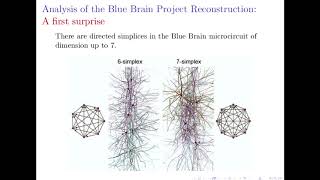
Ran Levi - Bedlewo: Topological Analysis of Neural Networks
Explore topological analysis of neural networks using algebraic topology techniques on biologically accurate digital reconstructions, revealing structural and functional insights into brain connectivity.
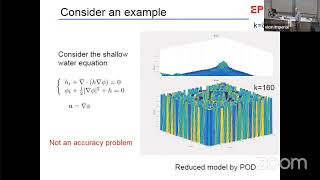
Structure-Preserving Model Order Reduction of Hamiltonian Systems
Explore structure-preserving model order reduction for Hamiltonian systems, focusing on symplectic geometry and reduced basis algorithms. Learn about extensions to nonlinear problems and applications in plasma physics.
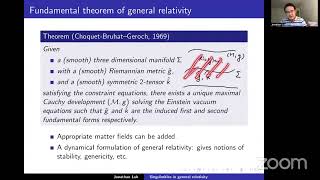
Jonathan Luk- Singularities in General Relativity
Explore singularities in general relativity, from fundamental concepts to advanced topics like Schwarzschild and Kerr spacetimes, cosmic censorship, and gravitational collapse.
Elchanan Mossel: Combinatorial Statistics and the Sciences
Explore combinatorial statistics, broadcasting on trees, and their applications in biology and network analysis, with insights into phylogenetic inference and community detection.
Sylvie Méléard- Multiscale Eco-Evolutionary Models- From Individuals to Populations
Exploring eco-evolutionary models from individual to population scales, focusing on small population effects, mutation dynamics, and long-term behaviors using stochastic processes and mathematical approximations.