Pose Estimation, Temperature, Noise, and Biological Temperature Sensors via Cryo-EM
Explore pose estimation, temperature, noise, and heterogeneity in cryo-EM for understanding biological temperature sensors, with focus on TRP channels and advanced analytical techniques.
Machine Learning to Improve the Exchange and Correlation Functional in DFT
Explore machine learning approaches to improve exchange and correlation functionals in density functional theory, discussing physically informed methods and their advantages in quantum mechanics.
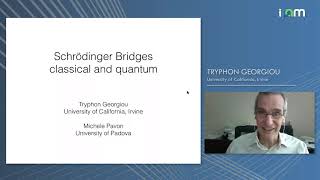
Schrödinger Bridges - Classical and Quantum
Explore Schrödinger bridges in classical and quantum contexts, their applications to Markov chains and quantum channels, and their solutions for probability distributions and state evolutions.
Gravitational Wave Parameter Estimation with Compressed Likelihood Evaluations
Explore advanced techniques for efficient gravitational wave parameter estimation, focusing on Reduced Order Quadratures (ROQs) to accelerate likelihood evaluations and improve Bayesian inference in GW astronomy.
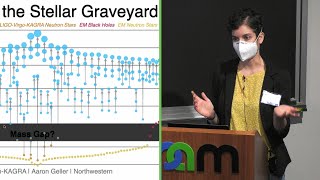
Black Hole Astrophysics With Gravitational-Wave Catalogs - IPAM at UCLA
Explore black hole astrophysics through gravitational-wave data, uncovering insights on mass distribution, spin, and redshift evolution. Learn about pair-instability mass gap and formation-to-merger time delays.
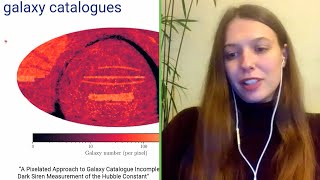
Cosmology with Dark Sirens - Attempting to Solve the Hubble Constant Tension
Explore gravitational waves for cosmology, focusing on dark sirens and galaxy catalogs to address Hubble constant tension. Learn challenges in GW-based cosmological parameter estimation.
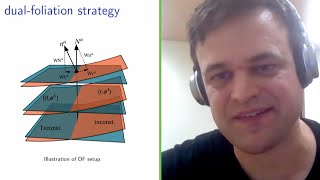
Dual-Frame Generalized Harmonic Gauge on Hyperboloidal Slices - IPAM at UCLA
Explore advanced techniques in general relativity, focusing on including future null-infinity in computational domains for cosmic censorship studies and gravitational wave astronomy applications.
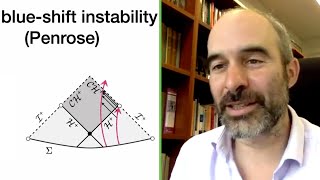
Strong Cosmic Censorship Versus Λ - IPAM at UCLA
Explore the strong cosmic censorship conjecture in general relativity, its challenges with non-zero cosmological constant, and implications for black hole physics and determinism.
Binary Black Hole Mergers in Cubic Horndeski Theory - IPAM at UCLA
Explore binary black hole mergers in cubic Horndeski gravity, examining non-linear effects and comparing results to general relativity. Gain insights into alternative gravity theories and their implications for astrophysical phenomena.
Seeing Through Space-Time - IPAM at UCLA
Explore inverse problems in spacetime structure, light observation sets, and cosmic microwave background, delving into mathematical challenges in gravitational wave astronomy.
Helvi Witek - Introduction to Numerical Relativity, Part 2 - IPAM at UCLA
Explore advanced concepts in numerical relativity, including 3+1 spacetime decomposition, Einstein's equations, and stable simulation techniques for gravitational wave research.
Taming the Dynamical Sign Problem in Diagrammatic Algorithms for Open Quantum Systems
Explore diagrammatic algorithms for open quantum systems, focusing on balancing dynamical sign problems and error amplification in numerical integration through partial resummation techniques.
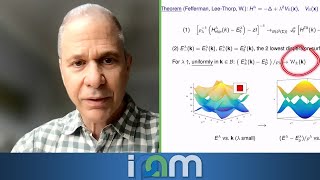
Discrete Honeycombs, Rational Edges and Edge States - IPAM at UCLA
Explore tight binding models, graphene edges, and edge states in quantum mechanics. Discover classifications, proofs, and formulas for zero energy states and dispersive edge curves.
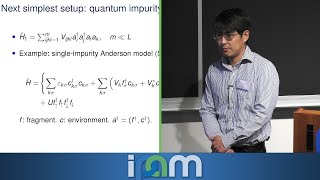
Quantum Impurity and Quantum Embedding Theory - IPAM at UCLA
Explore quantum impurity and embedding theories, from non-interacting systems to advanced concepts like DMET and DMFT, enhancing understanding of quantum many-body problems.
A Mathematical Introduction to Quantum Embedding Theory - IPAM at UCLA
Explore quantum embedding methods for strongly-correlated materials, focusing on computational challenges at the single-particle level and recent optimization approaches.
Randomized Methods for Quantum Many-Body Problems - A Mathematical Primer
Explore randomized methods for quantum many-body problems, focusing on Monte Carlo techniques to approximate ground and excited states in large systems. Learn about VMC and FCIQMC algorithms.
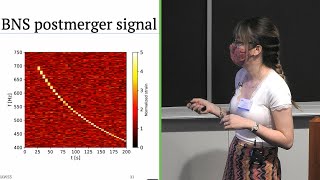
Power Spectral Density Uncertainty and Gravitational-Wave Parameter Estimation
Explore power spectral density uncertainty in gravitational-wave parameter estimation, its impact on Bayesian analysis, and methods to incorporate this uncertainty for more accurate results in compact binary coalescence detection.
Waveform Systematics in the Gravitational-Wave Inference of Tidal Parameters
Exploración de sistemáticas en formas de onda para inferir parámetros de marea y ecuación de estado en señales de ondas gravitacionales de sistemas binarios de estrellas de neutrones.
Conditional Probability Density Functional Theory - IPAM at UCLA
Explore conditional probability density functional theory for electronic structure calculations, addressing challenges in DFT and offering insights into ground-state correlations and warm dense matter simulations.
Error Bounds for Properties in Planewave Electronic Structure Calculations
Explore error bounds in planewave electronic structure calculations, focusing on ground state density matrix and interatomic forces estimation. Learn efficient approximation methods and see numerical results for materials systems.
Convergence of the Planewave Approximations for Quantum Incommensurate Systems
Explore quantum incommensurate systems through rigorous analysis of Schrödinger operators' spectrum distribution, focusing on density of states characterization and planewave approximation methods with novel energy cutoffs.