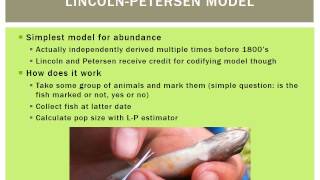
Introduction to Mark-Recapture Studies and Closed Population Models
Learn about mark-recapture models and closed population studies, including Lincoln-Petersen and Schnabel estimators, to understand wildlife population dynamics and estimation techniques.
Statistical Physics and Computation in High Dimension
Explore probability, geometry, and computation in high dimensions through statistical physics, focusing on key concepts and applications in complex systems analysis.
Spectral Decomposition of Atomic Structures in Heterogeneous Cryo-EM
Innovative approach to recover 3D atomic structures of flexible macromolecules from cryo-EM data, combining biological knowledge with spectral analysis to estimate conformational variations.
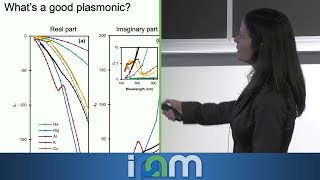
Electron and Optical Microscopy of Magnesium Nanoparticles - IPAM at UCLA
Explore advanced microscopy techniques for analyzing magnesium nanoparticles, including tomography, electron diffraction, and hyperspectral optical spectroscopy, with insights on plasmon resonances and photothermal effects.
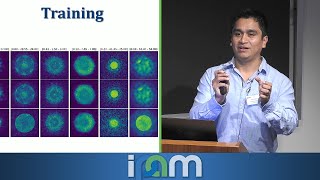
Application of Machine Learning to Electron Microscopy Data - IPAM at UCLA
Explore machine learning applications in electron microscopy, focusing on data modeling and neural networks for distortion compensation in experimental datasets.
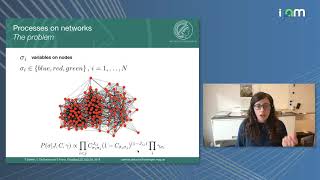
Matrix Product States for Modeling Dynamical Processes on Networks
Explore matrix product states and dynamic message-passing algorithms for modeling network dynamics, reducing computational complexity from exponential to polynomial in system size and duration.
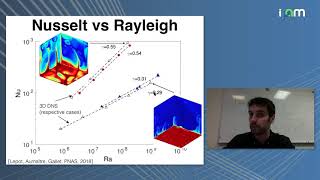
Heat Transport Efficiency Beyond the So-Called 'Ultimate' Regime
Explores innovative approaches to thermal convection, challenging traditional Rayleigh-Bénard models with radiative heating techniques to achieve more efficient heat transport in turbulent flows.
Uncertainty-Aware Machine Learning Models of Many-Body Atomic Interactions
Explore symmetry-aware machine learning models for atomic interactions, focusing on E(3)-equivariant neural potentials and Bayesian force fields for improved accuracy in materials modeling.

Nuclear Matter EOS Constraints from Gravitational Waves by Wolfgang Kastaun
Explore gravitational wave observations as a tool for understanding nuclear matter equation of state, focusing on measurable aspects, model-agnostic studies, and implications for neutron star properties.
Integrability in Planar AdS/CFT - Yangian Symmetry and Applications - Lecture 1
Explore Yangian symmetry in AdS/CFT correspondence, focusing on N=4 supersymmetric Yang-Mills theory and its applications to scattering amplitudes, correlation functions, and Wilson loops.
Topology in Statistical Physics - Lecture 1
Explore topology's role in statistical physics, from Maxwell's equations to magnetic monopoles. Learn about topological quantum numbers and path integral formulation in this advanced lecture.
Statistical Physics of Rare Events and Large Deviations - Lecture 1
Explore statistical physics of rare events and large deviations, covering mathematical foundations, equilibrium concepts, coin toss problems, blackbody radiation, and applications in physics and beyond.
Nonequilibrium Response Theory - Lecture 1
Explore nonequilibrium response theory, covering fluctuations, linear response, and the fluctuation-dissipation theorem. Gain insights into equilibrium and dynamic responses in statistical physics.
Numerical Relativity - Mathematical Formulation by Harald Pfeiffer
Explore mathematical formulation of numerical relativity, focusing on simulating binary black hole coalescence, gravitational waves, and advanced computational techniques in astrophysics.
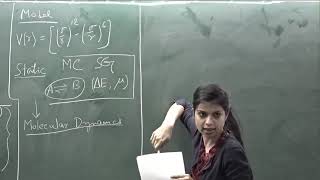
Surface Critical Dynamics and Casimir Forces in a Binary Fluid by Sutapa Roy
Explore critical dynamics and Casimir forces in binary fluids through molecular dynamics simulations, focusing on surface properties, scaling behavior, and correlation functions in confined fluid systems.
Exotic Patterns in Faraday Waves
Explore exotic patterns in Faraday waves through advanced numerical simulations and theoretical analysis. Discover fascinating phenomena like quasipatterns, superlattices, and dynamic pattern evolution in vibrated fluid layers.
Drift, Inbreeding, and Ne
Explore genetic drift, inbreeding, and effective population size through probability theory, distributions, and evolutionary concepts. Gain insights into population genetics and its applications in evolutionary biology.
Topological Phases of Quantum Matter
Explore topological phases in quantum matter, from quantum Hall effect to topological insulators and superconductors. Learn about edge states, bulk-boundary correspondence, and current frontiers in this fascinating field of physics.
Modular Theory and Quantum Field Theory - Lecture 1
Explore modular theory in quantum field theory, covering observables, operators, and superselection sectors. Gain insights into correlation functions and state sewing in QFT.
Magnetic Reconnection - Plasmoid Instability in an Experimentally Accessible Regime by Pallavi Bhat
Explore magnetic reconnection and plasmoid instability in the semi-collisional regime, with theoretical and numerical investigations validating its existence at lower, experimentally accessible Lundquist numbers.
Branes and Quivers in String Theory - Lecture 1
Explore connections between string theory, branes, and quivers. Learn about spatial dimensions, brain setups, Coulomb branches, and moduli spaces in this advanced theoretical physics lecture.