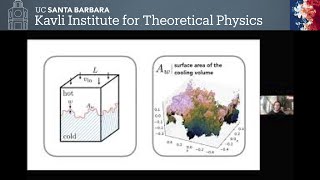
What Does It Mean to Resolve Multiphase Gas - Drummond Fielding
Explore multiphase gas resolution in astrophysics, covering numerical experiments, simulations, and turbulence. Gain insights into fluid dynamics across various cosmic environments and scales.
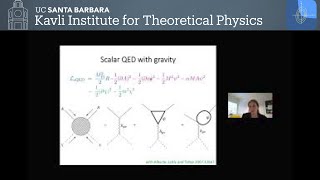
Causality and Positivity with Gravity - Claudia de Rham
Explores causality and positivity in gravitational theories, examining effective field theory bounds, scalar QED, and the interplay between gravity and quantum field theory concepts.
Thermal Dark Energy and Other String Candidates - Susha Parameswaran - EFTBounds
Explores string theory's implications for low-energy physics, focusing on thermal dark energy and other string candidates. Discusses swampland program, Weak Gravity Conjecture, and connections to particle phenomenology.
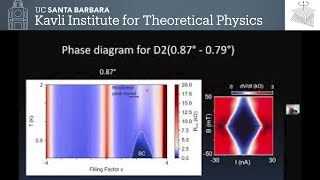
Superconductivity, Correlations and Chern Insulators in Twisted Bilayer Graphene - Stevan Nadj-Perge
Explore superconductivity, correlations, and Chern insulators in twisted bilayer graphene, focusing on recent developments and experimental findings in Moiré materials physics.
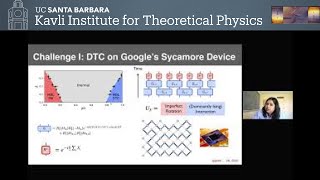
Observation of Time-Crystalline Eigenstate Order on a Quantum Processor - Vedika Khemani
Explore time-crystalline eigenstate order in quantum systems, covering many-body phases, Floquet time crystals, and experimental challenges using Google's Sycamore Device.
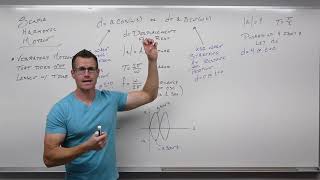
Simple Harmonic Motion in Trig - Precalculus - Trigonometry
Explore the connection between Simple Harmonic Motion and trigonometric functions, understanding its functional models and applications in physics and mathematics.
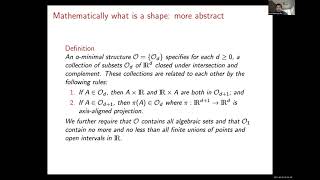
Modeling Shapes and Fields - A Sheaf Theoretic Perspective
Explore topological transforms for shape and field modeling, including Euler Characteristic and Lifted Euler Characteristic. Learn about sheaf theory in shape space construction and its applications in statistical analysis.
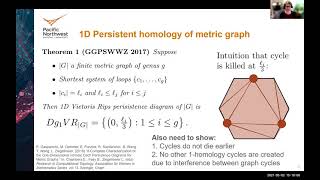
Homology of Graphs and Hypergraphs
Explore topological structures of graphs and hypergraphs, including recent findings on homology and persistent homology, with applications in combinatorial and metric space analysis.
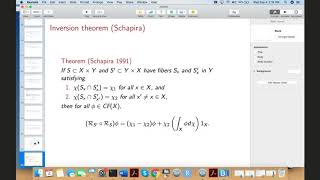
A Fiber Bundle Theory for Shapes
Explore fiber bundle applications in probabilistic modeling for shapes and surfaces, focusing on regression, variable selection, and Gaussian processes in evolutionary biology and biomedicine.
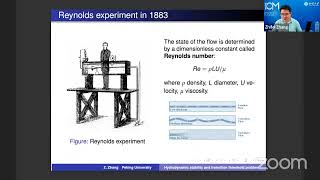
Hydrodynamic Stability at High Reynolds Number and Transition Threshold Problem
Explores hydrodynamic stability theory, focusing on laminar flow instability and turbulence transition at high Reynolds numbers. Discusses key physical effects and recent progress in linear inviscid damping and enhanced dissipation for shear flows.
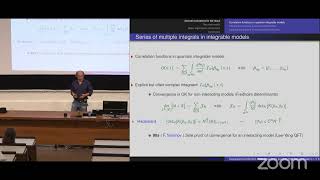
Convergence of the Two-Point Form Factor Series in the 1+1 Dimensional Sinh-Gordon Model
Explores convergence of form factor series in 1+1D Sinh-Gordon model, developing techniques to prove convergence and estimate large-n behavior of n-fold integrals, advancing mathematical foundations of integrable quantum field theories.

Algebraic-Geometrical Methods in the Theory of Integrable Systems
Explore algebraic-geometrical methods in integrable systems theory with renowned mathematician Igor Krichever, delving into advanced mathematical concepts and their applications.
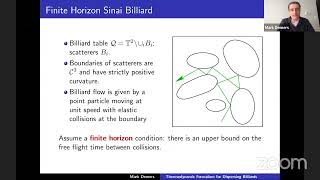
Thermodynamic Formalism for Dispersing Billiards
Explores mathematical billiards in statistical mechanics, focusing on dispersing billiards. Discusses equilibrium states, geometric potentials, and spectral analysis, with insights into SRB measures and maximal entropy.
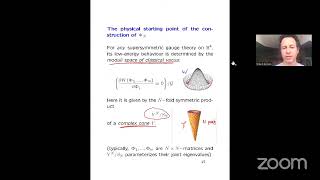
Emergent Complex Geometry and the Gauge/Gravity Duality
Explore emergent complex geometry and gauge/gravity duality with mathematician Robert Berman in this insightful lecture on cutting-edge mathematical physics concepts.
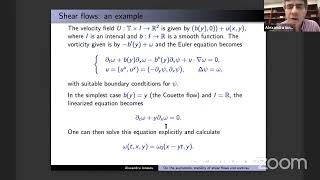
On the Global Stability of Shear Flows and Vortices
Explores recent findings on linear and nonlinear stability of shear flows and vortices in Euler equations, covering monotonic shear flows, point vortices, and smooth decreasing vortices.
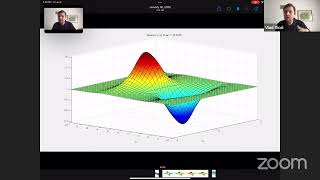
Formation and Development of Singularities for the Compressible Euler Equations
Explore the formation and evolution of singularities in compressible Euler equations, delving into mathematical intricacies and their implications for fluid dynamics.
Introduction to Hydrodynamic Stability by Rama Govindarajan
Explore hydrodynamic stability principles and applications in geophysical phenomena through expert lectures and hands-on research projects. Gain insights into fluid dynamics and complex systems modeling.
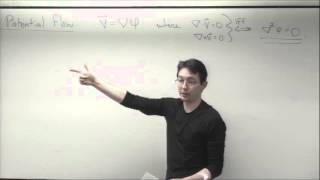
Potential Flow, Stream Functions, and Examples
Explore potential flow, stream functions, and Laplace's equation with practical examples in fluid dynamics. Gain insights into fundamental concepts and their applications.
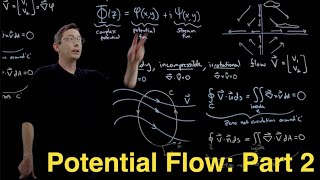
Potential Flow Part 2 - Details and Examples
Explore advanced potential flow concepts, solving Laplace's equation for idealized fluid flows. Learn contour integrals, analyze examples, and understand how PDE solutions establish vector fields.

Gauss's Divergence Theorem
Explore Gauss's Divergence Theorem, a fundamental tool in mathematical physics for deriving conservation laws and translating them into partial differential equations.
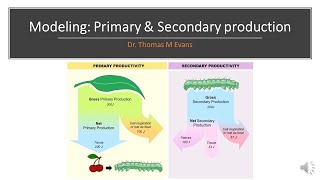
Modeling - Production
Overview of primary and secondary production in stream ecosystems, covering concepts like trophic levels, population growth, and estimation methods for ecological modeling and analysis.