How Fast Is a Neural "Winner-Take-All" When Deciding Between Many Noisy Options?
Explore neural decision-making mechanisms, focusing on the speed and efficiency of "winner-take-all" processes in noisy environments. Gain insights into parallel strategies and canonical circuits.
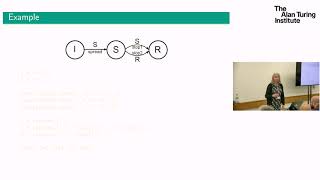
Integrating Inference with Stochastic Process Algebra Models - Jane Hillston, Edinburgh
Explore probabilistic programming for continuous-time systems using ProPPA, an extension of Bio-PEPA. Learn parameter inference methods and applications in biology, ecology, and urban transport.
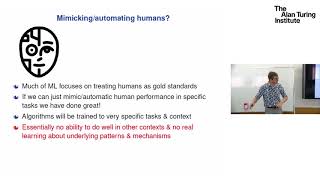
Beyond Tech - Machine Learning in Science & Policy - Professor David Dunson, Duke
Exploring machine learning applications beyond tech, highlighting challenges in science and policy. Discusses fair algorithms, interpretable models, and the need for targeted methods in complex domains.
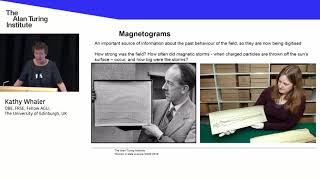
How Big Data Has Transformed and Is Transforming Geophysics
Exploring geophysical advancements: from analog instruments to digital data collection, satellite technology, and machine learning, revolutionizing Earth and planetary studies.
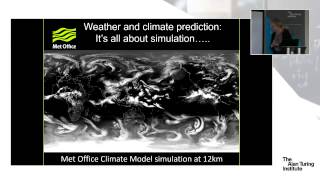
Big Data, Met Office and 21st Century Problems
Explore weather forecasting, climate prediction, and big data analysis at the Met Office. Learn about simulation techniques, ensemble forecasting, and addressing 21st-century environmental challenges.
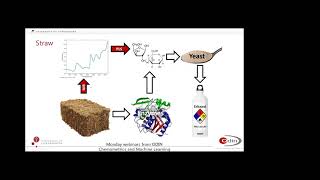
The Cage of Covariance
Explore strategies for handling correlated variables in data analysis, including orthogonalization techniques and predictive component methods.
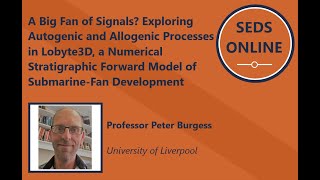
Exploring Autogenic and Allogenic Processes in Lobyte3D
Explore autogenic and allogenic processes in deep-water fan systems using Lobyte3D, a stratigraphic forward model, to investigate signal recording and extraction in sedimentary strata.
Earth Science - Lift and Instability
Explore atmospheric lift mechanisms and stability types, understanding their impact on weather patterns and daily forecasting.
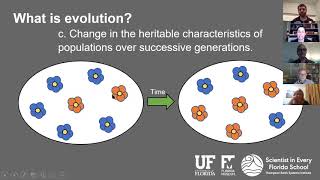
SEFS Webinar - Dr. Durkin - Nature of Science
Explore the nature of science through Dr. Durkin's PhD research, covering evolution, experimental design, and artificial selection in parasitic mites and their attachment to flies.
College Physics 1 - Describing Motion
Explore fundamental physics concepts like position, speed, and velocity, and learn to model motion using diagrams and vectors.
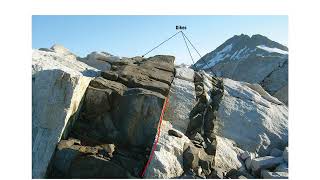
Geologic Time Lecture
Explore Earth's history through geologic principles, fossils, and dating methods. Uncover the secrets of our planet's past and learn to interpret the rock record.
Deriving Classical from Quantum Physics - Ehrenfest's Theorem
Brian Greene explores Ehrenfest's Theorem, revealing how classical physics emerges from quantum mechanics through mathematical derivation, bridging two fundamental descriptions of reality.

Planetary Orbits - Kepler, Newton, and Gravity
Explore planetary orbits through Newton's law of gravitation and Kepler's patterns. Brian Greene explains the basics, touching on conic sections and space dimensionality in this engaging discussion.

Neural Manifolds - The Geometry of Behaviour
Explore the geometry of behavior through neural manifolds, combining topology and neuroscience to understand high-dimensional information in neural circuits. Gain insights into brain function using intuitive explanations.
Electric Potential Calculation Using Double Integral - Part 1
Explore numerical integration to calculate electric potential of charged shapes using Scilab, with code examples and practical applications in physics.
Police Chase Simulation with Obstacles - Episode 7
Explore a physics simulation of a police chase with random obstacles, analyzing motion, probability, and decision-making using Scilab programming.
Pendulum Dynamics - Exploring Different Driving Functions
Explore pendulum behavior with different driving functions. Visualize and analyze changes in motion using Python simulations, including kick, sawtooth, and step functions.
Pendulum Simulation - Breaking Simple Harmonic Motion
Explore pendulum motion beyond simple harmonic approximations through coding, visualizing how small angle assumptions break down as amplitude increases.
Wave Function Evolver: Lennard-Jones Simulation Analysis - Episode 10
Explore Lennard-Jones simulation behavior by modifying potential energy minimum locations. Augment code to analyze changes and generate insights for physics enthusiasts and programmers.
Gravity Simulator - Sun and Earth Orbital Motion - Episode 1
Explore gravitational motion simulation using VPython, focusing on Sun-Earth dynamics. Learn about Euler-Cromer method, indices tracking, and Earth's scale in space.
Bouncy Balls Collision Math - Episode 3
Explore elastic collision math for bouncy balls, covering conservation of momentum, parallel axis, and unit vectors. Practical application in coding physics simulations.