
Quantum Field Theory - What Is a Particle?
Explore the concept of particles as excitations of relativistic quantum fields, from simple harmonic motion to quantum mechanics and field theory, in this accessible introduction to fundamental physics.

Spacetime Atoms and the Unity of Physics - Perimeter Public Lecture
Explore black hole thermodynamics and the concept of spacetime atoms in this lecture by Fay Dowker. Discover how this theory unifies physics and suggests a granular structure of spacetime at microscopic scales.
The Origin of Electromagnetism - An Unsolved Riddle
Explore unit quaternions as a foundation for fundamental physics, challenging conventional theories and proposing new perspectives on space and time.

The End of the Universe - With Geraint Lewis
Journey through cosmic evolution, exploring star deaths, galactic collisions, and the ultimate fate of the universe. Discover the fascinating possibilities for life and matter as we approach the end of time.
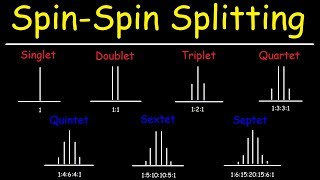
Spin Spin Splitting - N+1 Rule - Multiplicity - Proton NMR Spectroscopy
Comprehensive introduction to spin-spin splitting in proton NMR spectroscopy, covering N+1 rule, multiplicity, signal intensity ratios, and complex splitting patterns using practical examples.
David Chalmers – Consciousness and the Collapse of the Wave Function
Explore the intriguing theory of consciousness collapsing quantum wave functions, combining integrated information theory with quantum collapse dynamics and discussing potential experimental tests.
Quantum Collapse Models and Awareness
Exploring quantum collapse models as a key to understanding awareness, linking quantum physics with consciousness and integrated information theory.
Large Scale Simulations of Information Processing Within the Human Cortex
Explore large-scale simulations of the human cortex, examining emergent internal states and their implications for understanding consciousness and information processing in the brain.
Collapse and the Closure of the Physical
Explore quantum collapse theories and their implications for consciousness, examining physical closure and epistemic asymmetry in scientific theories of mind.
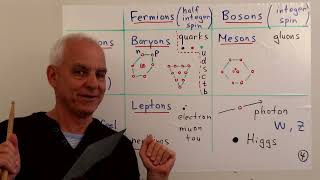
Rethinking Standard Model Numerology
Explore particle physics' Standard Model, focusing on quantum numbers, particle classifications, and novel representations of Baryon and Meson families. Gain insights into the eight-fold way and quark theory.
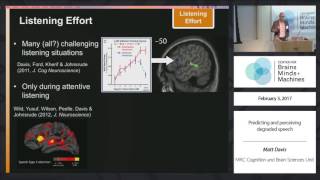
Predicting and Perceiving Degraded Speech
Explore speech perception challenges, cochlear implants, and predictive coding in this talk on improving speech understanding and perceptual learning for degraded speech signals.
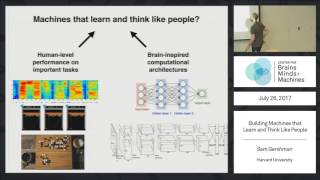
Building Machines that Learn and Think Like People
Explore computational neuroscience and AI inspired by human cognition, covering intuitive theories, compositionality, and learning to learn for more human-like artificial intelligence.
Topological Treatment of Neural Activity and the Quantum Question Order Effect
Explore topological features in neural activity and the quantum question order effect, examining their implications for understanding complex systems and information processing.

Methods for Differential Equations Physics Students Need to Know
Explore five powerful methods for solving differential equations in physics: ansatz, energy conservation, series expansion, Laplace transform, and Hamiltonian flow, with practical applications to harmonic oscillators.

Is There Evidence of Exponential Quantum Advantage in Quantum Chemistry - Quantum Colloquium
Explore theoretical and empirical evidence for exponential quantum advantage in ground-state energy determination for chemical problems, examining state preparation methods and numerical simulations.
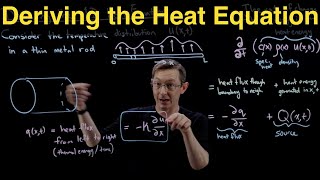
Deriving the Heat Equation - A Parabolic Partial Differential Equation for Heat Energy Conservation
Comprehensive derivation of the heat equation, exploring its mathematical foundations and physical principles in thermal energy conservation and transfer.
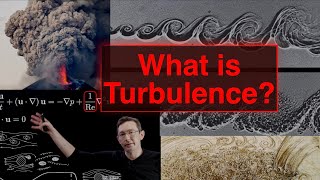
What Is Turbulence? - Turbulent Fluid Dynamics Are Everywhere
Explore the fundamental characteristics of turbulent fluid dynamics, their prevalence in nature and engineering, and the role of Reynolds number in controlling complexity.

Second Order Harmonic Oscillator, Characteristic Equation, Ode45 in MATLAB
Explore second-order harmonic oscillators, characteristic equations, and ode45 in MATLAB through practical examples and hands-on coding for engineering mathematics applications.
Statistical Physics and Computation in High Dimension
Explore high-dimensional statistical physics and computation, covering sampling, minimization, and replica methods with applications in finance and algorithms.
Linkage Disequilibrium - Introduction to Genomics Theory
Explore linkage disequilibrium in genomics, its importance, metrics, and applications. Learn about LD block structure, genetic distance, and how it reveals population history and selection pressures.

Toward Brain Computer Interface - Deep Generative Models for Brain Reading
Explore deep generative models for brain reading, covering GAN implementation, image reconstruction from brain signals, and evolving latent codes using genetic algorithms.