How to Convert a Fraction to a Percent
Learn to convert fractions to percentages through four practical examples. Master this essential math skill with clear, step-by-step guidance suitable for beginners and those seeking a quick review.
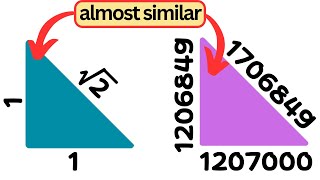
Every Right Triangle is Almost Pythagorean
Explore the concept of "almost Pythagorean" right triangles, uncovering a fascinating mathematical property that extends beyond the classic theorem.

Differential Equations: The Language of Change
Explore dynamical systems and differential equations through intuitive examples. Learn key concepts like state variables, phase portraits, and limit cycles to understand how systems change over time.
Correlation Coefficient - Karl Pearson Product Method Numerical
Learn to calculate correlation coefficients using Karl Pearson's product method through practical numerical examples in statistics and advanced mathematics.
Empirical Bayes and Its Applications: Shrinkage, Hypothesis Testing, and More
Explore Empirical Bayes methods for shrinkage, hypothesis testing, and genomic studies. Learn statistical techniques to estimate and test effects in multiple conditions.

The Prime Constant
Explore the fascinating prime constant with mathematician Matt Parker, uncovering its unique properties and significance in number theory. Gain insights into this hidden mathematical gem.
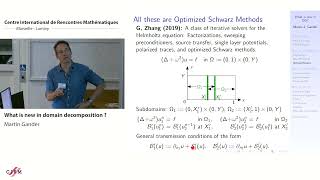
What's New in Domain Decomposition
Explore recent advancements in domain decomposition methods for solving large-scale mathematical problems efficiently and accurately.
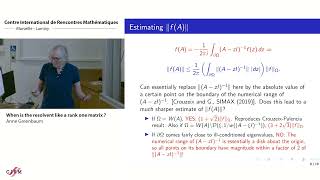
When is the Resolvent Like a Rank One Matrix? - Anne Greenbaum
Explore when the resolvent resembles a rank one matrix in this mathematical analysis of linear algebra concepts and applications.
PDEs and Stencils - SPARSE 2024
Explore PDEs and stencils in computational science, focusing on efficient numerical methods for solving partial differential equations.

Game-Enriched Categories
Explore game-enriched categories as an enhanced approach to modeling programming languages, potentially offering greater flexibility in strategy definition.

Formalizing the ∞-Categorical Yoneda Lemma
Explore the first formalization of ∞-category theory's Yoneda lemma using Rzk, a new proof assistant for synthetic ∞-category theory, paving the way for advanced mathematical proofs.

A Formalization of Complete Discrete Valuation Rings and Local Fields
Explore formalization of complete discrete valuation rings and local fields in Lean, covering theory, proofs, and applications to algebraic number theory and geometry.

Univalent Double Categories - Formalization and Applications in Category Theory
Explore univalent double categories in category theory, their formalization in Coq, and applications in mathematics and computer science.

Perfectly Imperfect: Music, Math and the Keyboard
Explore the mathematical foundations of Western classical music, from Pythagoras to modern microtonal experiments, examining harmony, tuning systems, and rhythmic innovations through keyboard demonstrations.

Learning on Graphs: From Representation to Minimally Supervised
Explore graph representation learning, from shallow to deep embedding, for heterogeneous data. Discover algorithms for temporal and dynamic graphs, and few-shot learning techniques for minimally supervised scenarios.

HOT: Higher-Order Dynamic Graph Representation Learning with Efficient Transformers
Explore higher-order dynamic graph representation learning with efficient Transformers for improved link prediction in rapidly changing graphs. Learn about HOT model's architecture and performance.
Bayesian Inference of Causal Graphs: Current Status and Future Directions
Explore Bayesian inference for causal discovery, examining recent progress, challenges, and assumptions in modeling cause-effect relationships from observational data.
Robust and Sample-Efficient Simulation-Based Inference
Explore robust and sample-efficient methods for simulation-based inference, addressing model misspecification and computational limitations in scientific and engineering applications.
Functional Priors for Bayesian Deep Learning
Explore functional priors for Bayesian deep learning, focusing on imposing Gaussian process priors on neural networks through Wasserstein distance minimization.
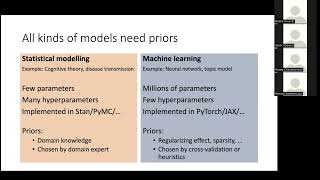
Better Priors for Everyone - Choosing Prior Distributions in Bayesian Modeling
Explore techniques for choosing effective prior distributions in Bayesian modeling, including prior elicitation and automatic selection methods for improved statistical inference.

Parameter Estimation and Interpretability in Bayesian Mixture Models
Explore posterior contraction in Bayesian mixture modeling, examining parameter estimation and model interpretability under correct and misspecified conditions. Gain insights into tradeoffs between expressiveness and interpretability.