Dunkl Operators, Random Matrices and Hurwitz Numbers
Explore probabilistic aspects of Dunkl operators, including radial Dunkl processes, reflected Brownian motion in Weyl chambers, and connections to Hurwitz numbers and generalized Bessel functions.
Dominated Representations, Intersections and Large Deviations
Explore hyperbolic metrics, dominated representations, and counting measures in groups, examining their connections to mean distortions and growth rates.
Mathematical Foundation of Various MCMC Methods
Explore advanced MCMC methods for combinatorial optimization, including multi-spin flip techniques. Compare mathematical and numerical results to evaluate efficiency in different contexts.
Point-Counting and the Zilber-Pink Conjecture - Lecture 3
Explore the Zilber-Pink conjecture, its relation to classical conjectures, and point-counting strategies for proving cases, focusing on curves in modular curve powers.
A Possible Way to Read and Interpret Euclid's Elements
Explore a novel approach to reading Euclid's Elements, focusing on fundamental theorems in Books I and II as a guide to understanding Euclidean geometry and its philosophical implications.
The Gödel Translation: History and New Directions
Explore the Gödel translation's history, its impact on intuitionistic and modal logic, and future research directions in this advanced mathematical seminar.
Frege's Definition of Real Numbers is Consistent
Explore Frege's consistent definition of real numbers as ratios of magnitudes. Uncover how slight modifications to his original work could have preserved this groundbreaking mathematical concept.
Geometric Inequalities Between Intrinsic and Extrinsic Curvature Invariants
Explore geometric inequalities between intrinsic and extrinsic curvature invariants in Riemannian manifolds, focusing on Nash's Theorem and recent developments in the field.
Formalization of Infinity Category Theory
Explore ∞-category theory's formalization, unifying mathematics, computer science, and physics. Learn synthetic reasoning and the Yoneda Lemma in this advanced mathematical seminar.
Revised GCH or Would Cantor Have Understood - A Contemporary Perspective on the Continuum Hypothesis
Explore the Continuum Hypothesis and its philosophical implications in set theory. Examine contemporary perspectives on Cantor's famous postulate and its generalized form.
Remarks about Cantor's Theorem
Explore Cantor's Theorem and its implications for infinite cardinalities. Examine the historical context, compare proofs, and discover applications to paradoxical mathematical situations.
Topology in 1930s America - A Tale of Two Camps
Explore the rivalry between point-set and combinatorial topology camps in 1930s America, examining their approaches, key figures, and impact on the mathematical research community.
What are Statistical Modeling Assumptions About? - An Answer From Perspective Pluralism
Explore statistical modeling assumptions through perspective pluralism. Gain insights into the philosophical foundations of statistical methods and their implications for scientific research.
From HoTT to HOTT - Exploring Homotopy Type Theory
Explore the evolution from Homotopy Type Theory (HoTT) to Higher-Order Type Theory (HOTT) in this insightful lecture by Michael Shulman.
Mathematical Truth and the Necessity of the Infinite
Explore mathematical truth and the infinite with Harvard's Hugh Woodin in this thought-provoking lecture on foundational concepts and philosophical implications.
Barry Mazur and the Infinite Cheese of Knowledge - A Mathematical Documentary
Explore the life and insights of influential mathematician Barry Mazur in this intimate documentary, capturing his wit, profound approach to mathematics, and enduring impact on the field.
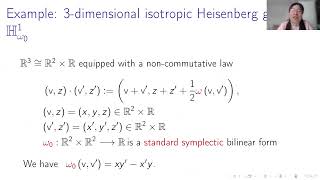
Logarithmic Sobolev Inequalities on Homogeneous Spaces
Explore logarithmic Sobolev inequalities on homogeneous spaces with sub-Riemannian structures. Discover how constants depend on Lie group geometry and remain independent of dimension in certain cases.
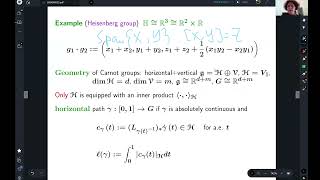
Dimension-Independent Functional Inequalities on Sub-Riemannian Manifolds
Explore gradient estimates and functional inequalities on sub-Riemannian manifolds, focusing on techniques used in absence of curvature bounds. Learn basics of sub-Riemannian geometry and metric structures.
Quantum Periods for Complements
Explore quantum periods for complements, focusing on polynomial-defined spectral curves and quantization of polynomial algebras. Gain insights into cohomological descriptions of WKB series.
Topological Invariants of Gapped States and 't Hooft Anomalies
Explore topological invariants of gapped ground-states in lattice systems, their interpretation as obstructions to gauging, and the role of locality in infinite-volume systems with rapidly decaying interactions.
Prime, Knots and the Adele Class Space
Explore geometric connections between primes and knots through scaling site theory, adele class space, and finite abelian extensions of Q, revealing insights into number theory and topology.