
Topological Perspectives on Networks
Explore algebraic topology tools for network analysis, focusing on their application in neuroscience to understand structure-function relationships.

Expanders in Higher Dimensions: From Local to Global Properties and Applications
Explore high-dimensional expanders, their local-to-global properties, and applications in coding theory, networking, and computational complexity.

Taming the Monster of Independence in Mathematics
Explore approaches to settling seemingly independent mathematical problems, focusing on Gödel's incompleteness theorem and the Continuum Hypothesis.

Computational Mathematics: Dynamics, Geometry, and Algebra in Numerical Integration
Explore computational mathematics at the intersection of dynamics, geometry, and algebra, focusing on geometric numerical integration and structure-preserving discretization of differential equations.
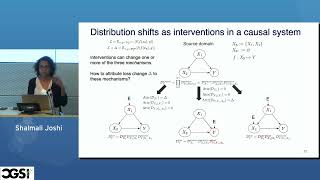
Observational Causal Inference for Improving and Auditing ML in Healthcare
Explore observational causal inference techniques to enhance and audit machine learning models in healthcare, focusing on distribution shifts, safe policy learning, and robust off-policy evaluation.
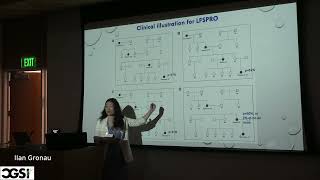
Statistical Methods for Cancer Risk Prediction Models - CGSI 2023
Explore statistical methods for cancer risk prediction models, focusing on Bayesian approaches and applications to Li-Fraumeni syndrome and personalized risk assessment for cancer survivors.
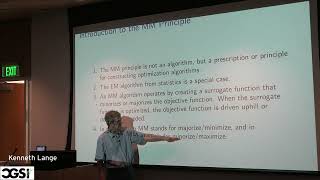
MM Principle of Optimization - CGSI 2023
Explore the MM Principle of Optimization in computational genomics, covering algorithms, applications in signal processing, and machine learning techniques.
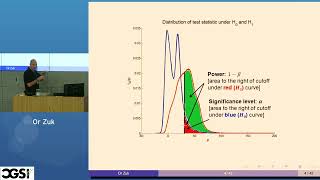
Independence Tests and Dependence Measures for Unbiased and Biased Samples
Explore independence tests and dependence measures for unbiased and biased samples. Learn statistical techniques to analyze relationships between variables in genomic data.
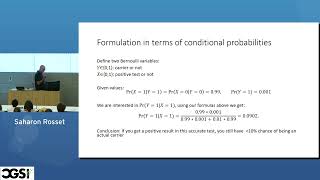
Intuition and Paradoxes in Probability and Statistics
Explore paradoxes and counterintuitive concepts in probability and statistics, enhancing understanding of complex statistical phenomena in computational genomics.
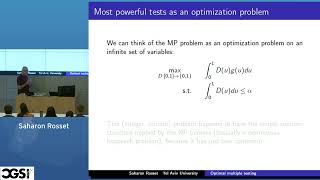
Multiple Testing Methods for Low and High-Dimensional Testing Problems in Biomedical Research
Explore multiple testing methods for biomedical problems, covering low and high-dimensional scenarios. Learn optimization techniques, hypothesis testing, and power analysis through practical examples.
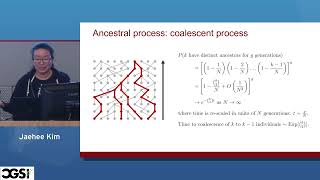
Bayesian Inference of Dependent Population Dynamics in Coalescent Models
Explore Bayesian inference techniques for analyzing dependent population dynamics in coalescent models, focusing on applications in genomics and evolutionary biology.
Causal Discovery and Representation Learning - Day 4
Explore causal discovery and representation learning in machine learning for drug discovery with Jason Hartford's insightful presentation.
Learning Geometry and 3D Symmetries - Day 1
Explore geometry and 3D symmetries in machine learning for drug discovery, covering key concepts like tensor products and network equivalence.
Identifying Representations for Intervention Extrapolation
Explore identifiable representations for intervention extrapolation, improving generalizability in machine learning. Learn theoretical foundations and practical applications through simulations and Q&A.
Everything to Know About Mellin-Barnes Integrals - Part 1
Explore Mellin-Barnes Integrals with Oleg Marichev: convert special functions, evaluate integrals, and understand existence conditions in this comprehensive mathematical deep dive.
Modeling X with Partial Differential Equations
Explore advanced PDE modeling techniques using NDSolve and finite element methods for engineering applications, including axisymmetric regions and hyperelastic solid mechanics.
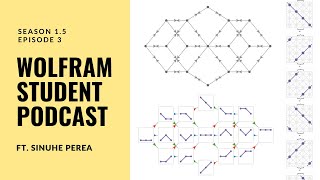
Using Graph Rewriting to Study Discrete Lattice Systems - Wolfram Student Podcast Episode 3
Explore graph rewriting techniques for studying topological invariants in finite lattice systems and their applications to physical phenomena.
Problem Solving in Elite STEM Programs - PROMYS, AIME, and SUMAC
Explore problem-solving techniques for elite STEM programs like PROMYS, AIME, and SUMAC with Shenghui Yang. Enhance your skills in tackling challenging mathematical problems.
High-Quality Graph Visualization - Styling, Layout, and Strategies
Explore graph visualization techniques, styling, layout adjustments, and strategies with Jaebum Jung in this livestream overview from Wolfram's R&D team.
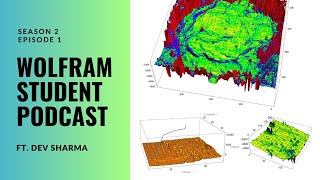
Recreating the Beresheet Lunar Crash - Wolfram Student Podcast S2 Ep1
Explore the recreation of the Beresheet Lunar Crash using telemetry data and rocket equations to model and predict landing locations in Mare Serenitatis.
Mathematical Games - Polygon Dissections - Episode 8
Explore mathematical games and puzzles involving polygon dissections with Ed Pegg Jr. Discover fascinating geometric concepts and their applications in this engaging presentation.