Linear Causal Representations from Interventions under General Nonlinear Mixing
Explore causal representation learning from latent interventions in nonlinear settings. Uncover geometric structures, analyze precision matrices, and evaluate a contrastive algorithm for identifying latent variables.
Causal Representation Learning via Soft Interventions
Explore causal representation learning through soft interventions, focusing on identifiability, prediction of intervention effects, and applications in single-cell biology using auto-encoding variational Bayes.
A Tutorial on Causal Representation Learning
Explore Causal Representation Learning: combining machine learning with causal assumptions to identify causal variables from low-level data. Gain insights into core problems and future directions in scientific discovery.
Identifiability of Causal Models and Applications to Perturb-Seq Data
Explore causal model identifiability, structure learning, and applications to Perturb-seq data. Delve into interventions, latent variables, and causal disentanglement for advancing AI in drug discovery.
Likelihood Training of Schrödinger Bridge Using Forward-Backward SDEs Theory
Explore likelihood training of Schrödinger Bridge using Forward-Backward SDEs theory for deep generative modeling, offering mathematical flexibility and optimization principles.
Causal Inference in Retail: An M&S Case Study
Explore causal inference techniques for understanding consumer behavior and improving customer lifetime value in retail, using Marks & Spencer as a case study.
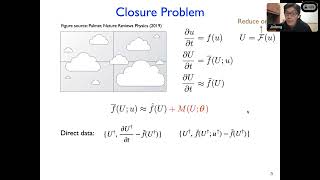
Data-Driven Closure Modeling Using Derivative-free Kalman Methods
Explore data-driven closure modeling for complex dynamical systems using derivative-free Kalman methods. Learn to improve predictions in turbulence and cloud dynamics with advanced machine learning techniques.
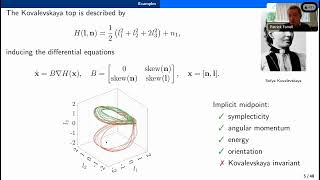
Designing Conservative and Accurately Dissipative Numerical Integrators in Time
Explore innovative framework for structure-preserving time steppers using finite elements and auxiliary variables. Discover applications in Kepler, Kovalevskaya, Navier-Stokes, and Benjamin-Bona-Mahony problems.
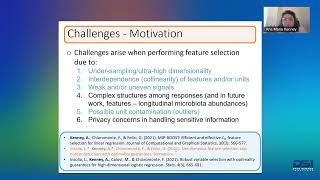
Simultaneous Feature Selection and Outlier Detection Using Mixed-Integer Programming
Explore mixed-integer programming for simultaneous feature selection and outlier detection in high-dimensional regressions, with applications to biomedical research and microbiome studies.
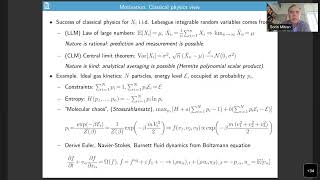
Data-Driven Information Geometry Approach to Stochastic Model Reduction
Explore data-driven information geometry for stochastic model reduction, extending least squares to curved statistical manifolds. Learn adaptive computation techniques for rapidly varying stochastic phenomena.
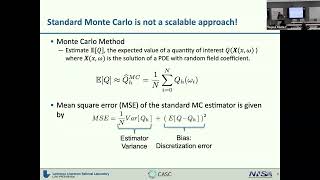
Uncertainty Quantification, Software Ecosystems, and Infrastructure Resilience - Technical Talk
Explore uncertainty quantification, exascale software ecosystems, and infrastructure resilience in this technical talk by Sarah Osborn at WiDS Livermore 2024.
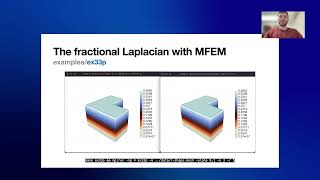
Stochastic Fractional PDEs: Random Field Generation and Topology Optimization - MFEM Workshop 2022
Explore stochastic fractional PDEs, Gaussian random fields, and topology optimization using MFEM. Learn numerical solutions and applications in scientific simulations and additive manufacturing.
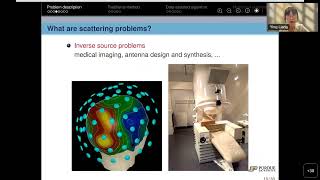
Data-assisted Algorithms for Inverse Random Source Scattering Problems - DDPS
Explore data-assisted algorithms for inverse random source scattering problems, enhancing reconstruction accuracy with fewer realizations and comparing performance of various data-driven methods.
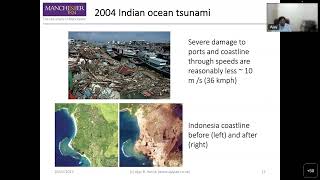
Uncertainty Quantification and Deep Learning for Water-Hazard Prediction
Explore uncertainty quantification and deep learning techniques for predicting water hazards, focusing on storm surge impacts and urban infrastructure damage assessment.
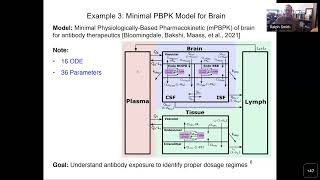
Parameter Subset Selection and Active Subspace Techniques for Engineering and Biological Models
Explore parameter subset selection and active subspace techniques for engineering and biological models, focusing on influential parameter isolation and uncertainty quantification in complex systems.

Virtual Origami: Mathematical Modeling and Computational Realization
Explore virtual origami using Mathematica, focusing on traditional techniques with mathematical formalism. Learn about fold rules, classical folds, and create a flying crane model.

Progress in Graphs and Networks
Explore advancements in graph theory and network analysis, uncovering applications in various fields and enhancing problem-solving skills.

A Family of Rational Zeta Series
Explore close formulas for computing rational zeta series, featuring unique insights not reproducible by current software.

New Algorithms: Numerical Solution of Large Systems of Nonlinear Equations Using Monodromy
Explore a novel algorithm using monodromy to solve large systems of analytic nonlinear equations, developed during a Wolfram internship.
Topological Perspectives on Networks
Explore algebraic topology tools for network analysis, focusing on their application in neuroscience to understand structure-function relationships.

Random Embeddings of Graphs in Surfaces - Lecture
Explore random 2-cell embeddings of graphs in surfaces, from basic concepts to recent developments in Random Topological Graph Theory.