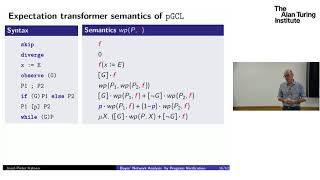
Bayesian Inference by Program Verification - Joost-Pieter Katoen, RWTH Aachen University
Explore Bayesian inference through program verification, learning how weakest precondition reasoning can be applied to exact inference and analyzing expected sampling times in Bayesian networks.
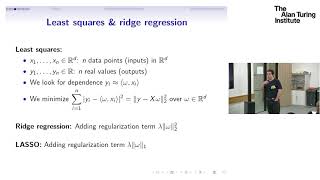
Ridge Functions, Their Sums, and Sparse Additive Functions – Jan Vybiral, Czech Technical University
Explores approximating high-dimensional functions using ridge functions, sums, and sparse additive functions to overcome the curse of dimensionality in complex scientific and engineering problems.

Recovery of Ridge Functions in the Uniform Norm - Sebastian Mayer, Universität Bonn
Explore mathematical techniques for reconstructing high-dimensional functions from limited data, focusing on ridge function recovery in uniform norm. Learn about overcoming the curse of dimensionality in complex processes.

Concentration of Tempered Posteriors and of Their Variational Approximations – Pierre Alquier
Explores concentration of tempered posteriors and variational approximations in high-dimensional function reconstruction, addressing challenges in approximation theory and non-parametric regression.
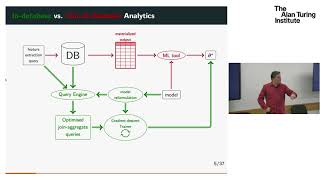
In-Database Factorised Learning - Professor Dan Olteanu
Explore in-database factorised learning techniques for efficient data analysis and machine learning, covering integration approaches, advantages, and practical applications in relational databases.

Understanding the Impact of the Pandemic: Challenges, Opportunities and Politics
Explore the statistical challenges and political implications of measuring COVID-19's global impact, including methodologies for calculating excess mortality and their consequences for international statistics.

Algorithmic Fairness and Individual Probabilities
Explore algorithmic fairness and the concept of individual probabilities, examining their implications for AI ethics and decision-making processes in machine learning applications.
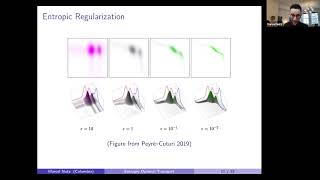
Entropic Optimal Transport
Explore entropic optimal transport with Prof. Marcel Nutz, delving into advanced mathematical concepts and their applications in economics and probability theory.
John M. Keynes and Treatise on Probability - Prof. Simon Blackburn
Explore Keynes's Treatise on Probability, its scholarly depth, Russell's influence, and skepticism about mathematical applications. Examine Ramsey's critique and Keynes's response.
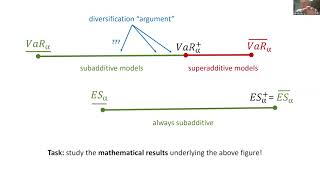
Dependence, Uncertainty, and Risk - Prof. Paul Embrechts
Explore quantitative risk management through extremal bounds for risk measures, focusing on uncertainty in interdependence between risk factors and its impact on portfolio analysis.
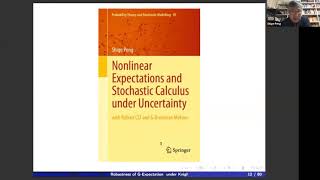
Robustness of G-Expectation under Knightian Uncertainty - Prof. Shige Peng
Explore G-Expectation's robustness in Knightian uncertainty, examining its applications in economics and probability theory. Gain insights into handling unpredictable outcomes in complex systems.

The Changing Role of National Statistics Offices in a Data-Driven Future - Professor Sir Ian Diamond
Exploring how national statistics offices innovate to meet modern data demands, utilizing new methods and sources for timely, accurate information to inform critical societal decisions.
Efficient and Effective Calibration of Spatio-Temporal Models - Dan Williamson & James Salter, Exeter
Explore efficient calibration techniques for spatio-temporal models, focusing on uncertainty quantification and Gaussian Process emulation in complex physical systems like climate and natural disasters.
Deep and Multi-Fidelity Learning with Gaussian Processes
Explore uncertainty quantification using Gaussian Process emulators for complex systems, focusing on deep learning and multi-fidelity approaches in climate, tsunami, and earthquake modeling.
High-Dimensional Hierarchical Models for Large-Scale Geophysical Applications
Explore high-dimensional hierarchical models for geophysical applications, focusing on uncertainty quantification and Gaussian Process emulation in complex physical systems.
Structured Dynamic Graphical Models & Scaling Multivariate Time Series
Explore advanced Bayesian methods for multivariate time series forecasting, focusing on scalability and model complexity. Learn about dynamic dependency networks and graphical dynamic linear models with real-world applications.
Probabilistic Numerical Computation - A New Concept?
Explore probabilistic numerics, a new field combining mathematics, statistics, and computer science to quantify uncertainty in numerical methods for complex data analysis and modeling.
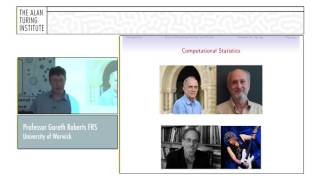
New Challenges in Computational Statistics
Explore cutting-edge computational statistics challenges and innovations in this lecture by Professor Gareth Roberts, focusing on complex data analysis and algorithm advancements in statistical science.
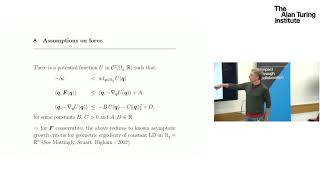
Stability and Inference for Position-Dependent Langevin Diffusions
Explore stability and inference in position-dependent Langevin diffusions, combining statistical inference, computation, and physical laws for complex systems modeling across various scientific domains.
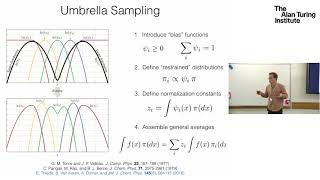
Stratification for Markov Chain Monte Carlo
Explore advanced Markov Chain Monte Carlo techniques, focusing on stratification methods for complex systems modeling and statistical inference in various scientific domains.

The Shape of Data
Exploring how topology can extract new insights from abundant data, focusing on innovative applications of abstract mathematics to deepen our understanding of complex datasets.