
Helmholtz Principle and Vortex Motion
Explore Helmholtz' Principle and vortex motion in 2D potential flow. Learn about complex potentials, velocity fields, and the Method of Images to understand fluid dynamics and vortex trajectories.

Oxford Calculus - Jacobians Explained
Comprehensive explanation of Jacobians in 2D coordinate changes, focusing on polar coordinates. Includes derivation of general formula and practical applications with interactive exercises.
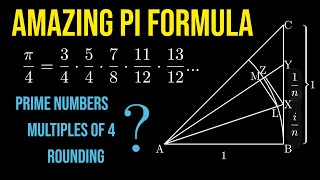
Amazing Pi Formula - Prime Numbers and Multiples of 4
Explore a fascinating pi formula involving prime numbers and multiples of 4. Learn step-by-step proofs, from geometric series to the Leibniz Formula, culminating in a remarkable relationship between pi and primes.

Prime Reciprocal Series - Oxford Maths Interview Question
Explore the divergence of prime reciprocal sums using advanced mathematical concepts in this Oxford University admissions interview question, featuring collaboration between mathematicians.
Potential Flow and Method of Images with 3Blue1Brown
Explore 2D incompressible fluid dynamics with Grant Sanderson, covering potential flow, common flow fields, and the method of images for various scenarios like sources near walls and in channels.
Koch Snowflake Fractal - Area and Perimeter Calculation
Explore the fascinating Koch Snowflake fractal, calculating its infinite perimeter and constant area. Suitable for ages 14+, with step-by-step construction instructions and in-depth mathematical analysis.
Oxford Mathematician Explains SIR Travelling Wave Disease Model for COVID-19
Explore the SIR Travelling Wave model for disease spread, focusing on COVID-19. Learn how population movement affects epidemic dynamics, including spread speed and severity, and the importance of social distancing measures.

Oxford Mathematician Explains SIR Disease Model for COVID-19
Explore the SIR disease model's application to COVID-19, covering its derivation, spread prediction, peak infection, and total cases. Learn how social distancing impacts these factors.
Number System - Divisibility Tricks - Quantitative Aptitude
Learn efficient divisibility tricks to quickly solve number system problems in quantitative aptitude tests, enhancing your problem-solving speed and accuracy.
Oxford Linear Algebra - Linear Transformations Explained
Explore linear transformations with Oxford mathematician Dr Tom Crawford, covering definitions, properties, and examples in R3, including matrix multiplication and differentiation.

Building the Multiverse Library
Explore complex mathematics behind the Multiverse Library, focusing on branch cuts and multifunctions. Learn about holomorphic branches of complex logarithms and square root functions in this engaging mathematical journey.

Oxford Linear Algebra - Direct Sum of Vector Spaces
Comprehensive explanation of direct sum of vector spaces with worked examples. Learn formal definitions, alternative representations, and how to verify direct sums through intersection and spanning checks.

Oxford Linear Algebra - Dimension Formula for Vector Spaces
Explore the dimension formula for vector spaces through worked examples and a complete proof. Learn to calculate dimensions of subspaces and their intersections in R^4.

Oxford Linear Algebra - Basis, Spanning and Linear Independence
Explore key concepts in linear algebra: basis, spanning, and linear independence. Learn through intuitive examples and formal definitions, with worked problems in vector spaces and Cartesian planes.

Oxford Linear Algebra - Subspace Test
Comprehensive explanation of subspace test in vector spaces, including definition, examples, and applications. Includes worked problems and links to additional resources for practice.

Oxford Linear Algebra - What is a Vector Space?
Explore vector space axioms with concrete examples, including addition and scalar multiplication maps, 8 key axioms, and proofs for 3D coordinate vectors. Gain insights into unique properties of vector spaces.

Pokémon Catch Rate Formula Explained
Explore the mathematics behind Pokémon's catch rate formula with Oxford mathematician Dr Tom Crawford. Learn how variables like HP, status effects, and ball types influence capture probability.

Oxford Linear Algebra - Spectral Theorem Proof
Comprehensive proof of the Spectral Theorem for real symmetric matrices, demonstrating real eigenvalues and diagonalization using eigenvector basis. Includes step-by-step explanation and mathematical reasoning.
Subshift Algebras
Explore subshift algebras in operator theory, focusing on symmetry and structure within operator algebras and their applications in mathematical research.
Crossed Product Equivalence of Quantum Automorphism Groups
Explore quantum automorphism groups and their crossed product equivalence in this advanced mathematics talk by Michael Brannan from the University of Waterloo.
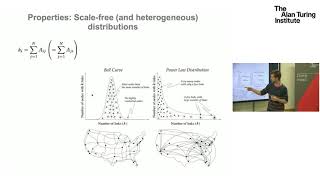
A Gentle Introduction to Network Science - Dr Renaud Lambiotte, University of Oxford
Explore key properties and modeling tools for real-life networked systems across various domains, from biology to sociology, with Dr. Renaud Lambiotte's comprehensive overview of network science.