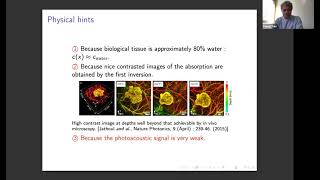
Hölder Stability in Quantitative Photoacoustic Tomography - Imaging and Inverse Problems Seminar
Explore Hölder stability in quantitative photoacoustic tomography, focusing on reconstructing diffusion and absorption coefficients from partial internal data near boundaries.
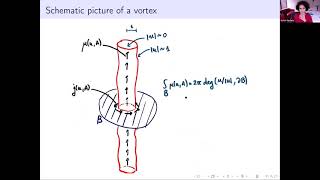
Ginzburg-Landau Model in Superconductivity - Old and New Results
Explore Ginzburg-Landau model of superconductivity, analyzing vortex patterns in 2D and 3D, energy minimizers, and vortex dynamics with expert Sylvia Serfaty from NYU's Courant Institute.
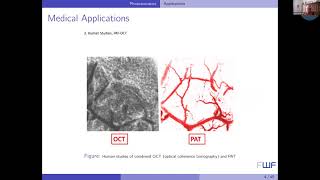
Reconstructions in Coupled Physics Imaging
Explore Coupled Physics Imaging with Otmar Scherzer, focusing on Photoacoustics and related mathematical inverse problems in this SIAM-IS virtual seminar on reconstructions in advanced imaging techniques.
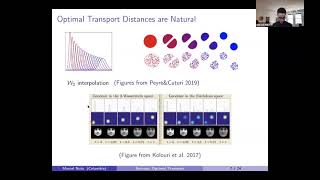
Entropic Optimal Transport - Eighteenth SIAM Activity Group on FME Virtual Talk
Explore entropic regularization in optimal transport with Marcel Nutz. Learn about convergence, local behavior, and applications in high-dimensional data problems.
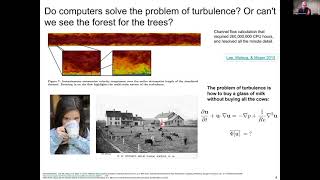
Auxiliary Functionals - A Path to Solving the Problem of Turbulence
Explore innovative approaches to solving turbulence in fluid dynamics using auxiliary functionals and sum-of-squares polynomial optimization, with applications to Kuramoto-Sivashinsky and Navier-Stokes equations.
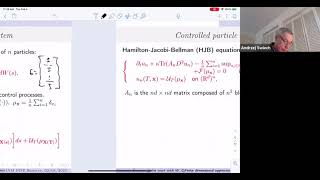
Finite Dimensional Approximations of Hamilton-Jacobi-Bellman Equations in Probability Measure Spaces - SIAM PDE Seminar
Explore finite dimensional approximations of Hamilton-Jacobi-Bellman equations in probability measure spaces, focusing on convergence of viscosity solutions and representation formulas for limiting equations.
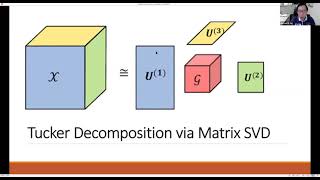
Low Rank Tensor Completion and Its Applications
Explore low rank tensor completion methods using framelet, dictionary coding, deep plug-and-play prior, and more. Gain insights into theoretical and numerical results for solving complex imaging problems.
Random Monomial Ideals - Seminar on Applied Geometry and Algebra
Explore probabilistic models of random monomial ideals, their properties, and applications in algebraic geometry. Gain insights into average behavior of ideals and potential for generating algebraic objects.
E-Bike Future Prediction Model - M3 Challenge Finalist Presentation
High school team presents mathematical modeling solution predicting the future of E-Bikes in the U.S., showcasing innovative problem-solving skills and STEM application in a prestigious competition.
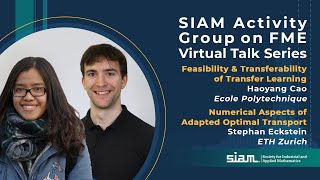
Mathematical Framework and Numerical Aspects of Adapted Optimal Transport
Explore mathematical frameworks for transfer learning and numerical aspects of adapted optimal transport in financial mathematics and engineering through expert talks from leading researchers.
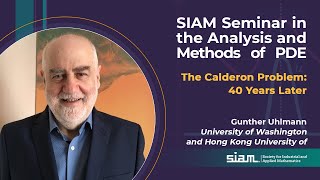
The Calderon Problem: 40 Years Later - Seminar in the Analysis and Methods of PDE
Explore Calderon's inverse problem, its applications in medical imaging and geophysics, recent developments, and open questions with expert Gunther Uhlmann in this insightful seminar.
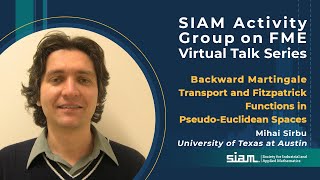
Backward Martingale Transport and Fitzpatrick Functions in Pseudo-Euclidean Spaces
Explore backward martingale transport and Fitzpatrick functions in pseudo-Euclidean spaces, focusing on a one-period multidimensional problem with quadratic objective and its applications in financial mathematics.
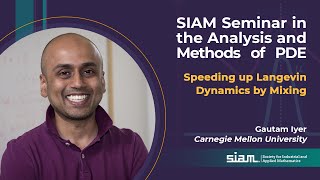
Speeding up Langevin Dynamics by Mixing
Explore a method to accelerate Langevin dynamics using mixing drift, improving convergence to stationary distribution in polynomial time for systems with multiple local minima.
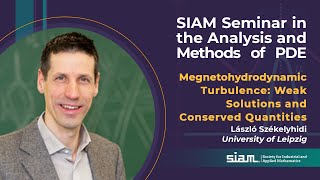
Magnetohydrodynamic Turbulence - Weak Solutions and Conserved Quantities
Explore magnetohydrodynamic turbulence, weak solutions, and conserved quantities in ideal systems. Analyze the mathematical structures behind Taylor-Woltjer relaxation theory and Faraday systems.
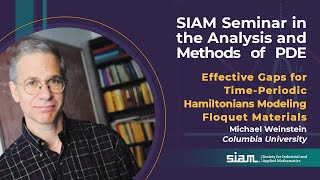
Effective Gaps for Time-Periodic Hamiltonians Modeling Floquet Materials
Exploration of Floquet materials and their energy transport properties, focusing on effective quasi-energy gaps in parametrically forced Schrödinger equations and their implications for band-limited Dirac wave-packets.
The Role of Mathematics in Solving the World's Main Challenges
Explore how mathematics and computation contribute to understanding climate, energy, the cosmos, and life itself through TED-style talks by renowned computational scientists.
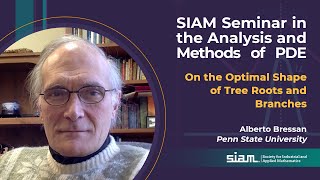
Optimal Shape of Tree Roots and Branches - Seminar in Analysis and Methods of PDE
Explore mathematical models for optimal shapes in nature, focusing on tree roots and branches. Examine functionals for sunlight capture and nutrient collection, combined with transportation costs.
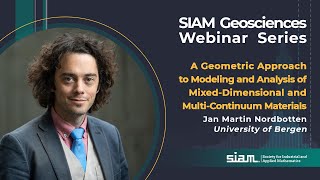
A Geometric Approach to Modeling and Analysis of Mixed-Dimensional and Multi-Continuum Materials
Explore geometric modeling of complex materials, unifying concepts from differential geometry and functional analysis to analyze fractured porous media and multi-continuum models.
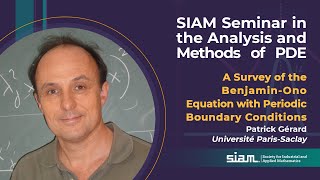
Survey of the Benjamin-Ono Equation with Periodic Boundary Conditions
Explore the Benjamin-Ono equation's dynamics, including explicit solutions, well-posedness, and long-term behavior, with insights from Lax pair analysis in periodic boundary conditions.
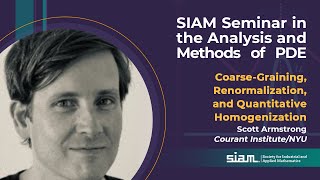
Coarse-graining, Renormalization, and Quantitative Homogenization in PDE Analysis
Explore quantitative homogenization in elliptic and parabolic equations, focusing on coarse-graining and renormalization techniques. Discuss applications to degenerate equations and mathematical physics models.
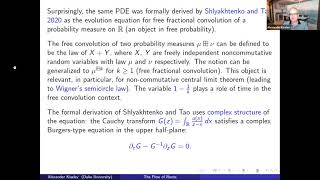
The Flow of Polynomial Roots Under Differentiation - SIAM PDE Seminar
Explores the movement of polynomial roots under differentiation, connecting it to a hydrodynamic PDE model similar to those in mathematical biology, with focus on global regularity and trigonometric polynomials.