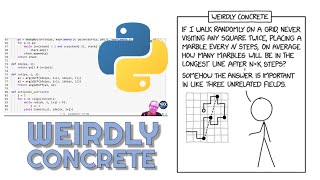
Weirdly Concrete Problem 1 - Exploring XKCD's Unsolved Math Problem
Explore XKCD's unsolved math problem through coding and simulation. Dive into a fascinating mathematical puzzle with practical applications and computational approaches.

Finite Differences and Successive Over Relaxation - Jupyter Notebook Assignment Development
Explore finite differences and successive over-relaxation methods in computational physics through a guided Jupyter notebook project, enhancing problem-solving skills in numerical analysis.
Numerical Integration Methods in Jupyter Notebook - Development Vlog 4
Explore numerical integration methods using Jupyter Notebook, comparing results and enhancing computational skills for physics research and problem-solving.

Jupyter Notebook Assignment - Runge-Kutta Method Development - Vlog 3
Explore the Runge-Kutta Method in computational physics, comparing it with Euler-Cromer. Develop skills in numerical analysis and scientific computing using Jupyter Notebooks.
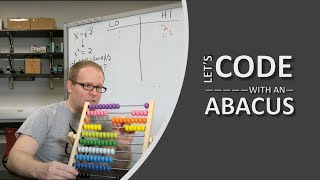
Square Roots with an Abacus
Explore the fascinating process of calculating the square root of 2 using an abacus, blending ancient techniques with modern mathematical concepts.

The Babylonian Spiral - Exploring Chaotic Patterns in Mathematics
Explore the evolution of a simple pattern into a chaotic masterpiece. Learn to create the mesmerizing Babylonian spiral using coding techniques in physics.

Numerical Modeling of the 2014 Oso, Washington, Landslide
Explore numerical simulations of the 2014 Oso landslide, examining factors behind its devastating runout. Learn how initial sediment conditions can dramatically influence landslide behavior and consequences.
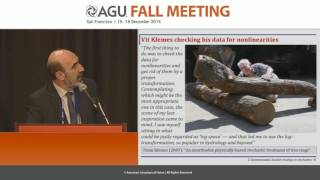
Random Musings on Stochastics - Lorenz Lecture
Explore stochastic processes in geophysics with insights on nonlinear dynamics, chaos theory, and their applications in climate and hydrology modeling.
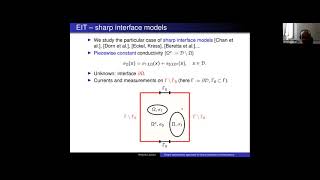
Shape Optimization Approach for Sharp-Interface Reconstructions in Inverse Problems
Shape optimization techniques for inverse problems: analyzing piecewise constant models, shape derivatives, and Lagrangian approaches. Applications in electrical impedance tomography and full waveform inversion.
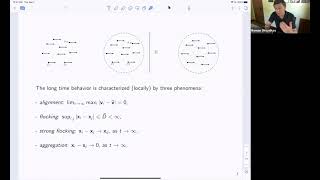
Analytical Aspects of Emergent Dynamics in Systems of Collective Behavior
Explore analytical aspects of emergent dynamics in collective behavior systems, focusing on alignment dynamics in disconnected flocks and new approaches using topological fractional diffusion and random fluctuations.
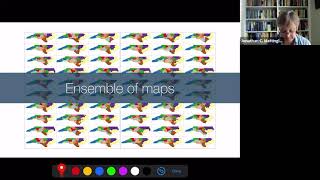
Can You Hear the Will of the People in the Vote? Assessing Fairness in Redistricting - 2021 I. E. Block Community Lecture
Exploring gerrymandering, fairness in redistricting, and the impact of geopolitical geometry on electoral representation through Monte Carlo sampling and mathematical analysis.
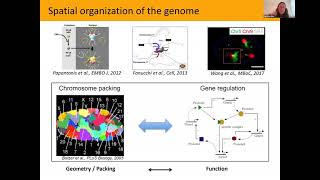
Mathematics of Genome Packing and Regulation
Explore the mathematics of genome organization and its impact on gene expression through geometric packing models and deep learning, with insights on 3D genome reconstruction and autoencoder applications in genomics.
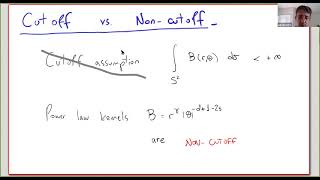
Gaussian Lower Bounds for the Boltzmann Equation Without Cut-off - SIAM PDE Seminar
Explore Gaussian lower bounds for the Boltzmann equation, examining particle density evolution in gases and conditional estimates for solving global well-posedness challenges in fluid dynamics.
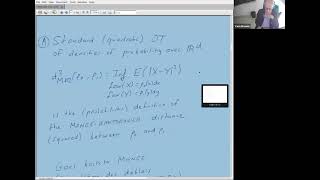
Optimal Transport of Matrix-Valued Measures - SIAM PDE Seminar
Explore optimal transport of matrix-valued measures, inspired by incompressible Euler equations. Discover a matricial analogue of Hellinger-Kantorovich metric spaces in this advanced mathematical seminar.
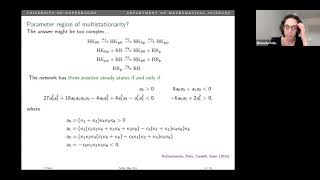
Parametric Polynomial Systems and Biochemical Reaction Networks
Explore parametric polynomial systems in biochemical reaction networks, focusing on multistationarity and the dual futile cycle. Gain insights into steady state analysis and parameter region determination.
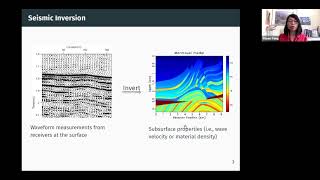
Optimal Transport for Inverse Problems and Implicit Regularization
Exploring optimal transport theory for inverse problems, addressing nonconvexity and noise sensitivity in least-squares methods, with applications in industry and broader data-fitting challenges.
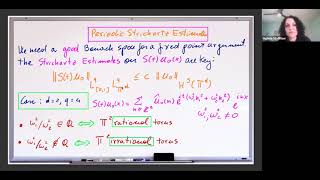
How Much Math Do You Need to Know to Solve an Initial Value Problem - SIAM PDE Seminar
Explore mathematical techniques for solving nonlinear Schrödinger equations, from harmonic analysis to dynamical systems, focusing on long-time dynamics and energy transfer in initial value problems.

MathWorks Math Modeling Challenge 2021 - Nueva School Winning Presentation
Winning presentation by Nueva School on their solution for the MathWorks Math Modeling Challenge 2021, showcasing innovative approaches to technical computing and problem-solving.
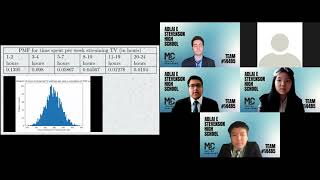
MathWorks Math Modeling Challenge 2021 - Adlai E Stevenson High School Finalist Presentation
Finalist team from Adlai E Stevenson High School presents their solution to the MathWorks Math Modeling Challenge 2021, showcasing innovative problem-solving skills in applied mathematics.

MathWorks Math Modeling Challenge 2021 - Julia R Masterman Middle High School Finalist Presentation
High school team presents innovative mathematical modeling solutions for the MathWorks Math Modeling Challenge, showcasing problem-solving skills and analytical thinking in a competitive environment.
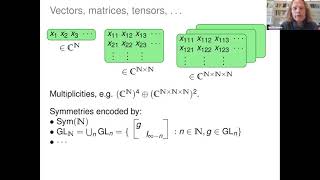
Infinite-Dimensional Geometry with Symmetry - SIAM SAGA Seminar
Explore infinite-dimensional geometry with symmetry, focusing on algebraic models and their applications in statistics, tensor decomposition, and combinatorics.