Symmetric Spaces by Pralay Chatterjee
Explore symmetric spaces in this advanced lecture on geometry, groups, and dynamics. Delve into modern research aspects and connect with cutting-edge theories in the field.
Crash Course in Riemannian Geometry by Harish Seshadri
Introductory lecture on Riemannian geometry, covering fundamental concepts and principles for graduate-level students in mathematics and theoretical physics.
Introduction to Classical and Quantum Integrable Systems by Leon Takhtajan
Explore classical and quantum integrable systems, from historical examples to modern developments. Learn about Hamiltonian mechanics, r-matrix formalism, and the quantum Yang-Baxter equation.
Probabilistic Generative Frameworks for Sampling 3D Complex Shapes and Images
Explore probabilistic frameworks for simulating 2D and 3D shapes, with applications in computational biology. Learn about sub-image selection and shape statistics in cellular imaging and primate mandibular molars.
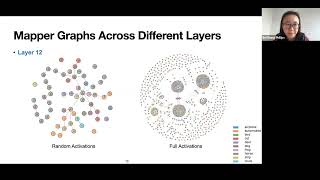
Topology of Artificial Neuron Activations in Deep Learning
Explore the topology of artificial neuron activations in deep learning, from image classification to natural language processing, with insights on convolutional neural networks and transformer-based models.
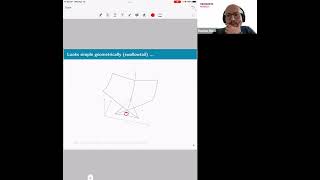
Two Methods of Efficiently Approximating Semi-Algebraic Sets Up to Homotopy
Explores efficient methods for approximating semi-algebraic sets, focusing on singly exponential complexity algorithms and their applications in algebraic geometry.
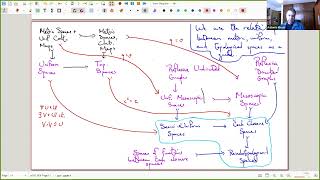
Antonio Rieser - Algebraic Topology for Graphs and Mesoscopic Spaces
Explore algebraic topology for graphs and mesoscopic spaces, covering homotopy, homology, and metric cohomology. Learn about pseudotopological spaces and their applications in various mathematical categories.
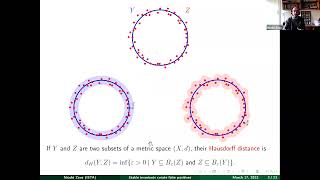
Every Stable Invariant of Finite Metric Spaces Produces False Positives
Explore stable invariants in computational topology, their limitations in approximating Gromov-Hausdorff distance, and the inevitability of false positives when using Hilbert space-valued invariants.
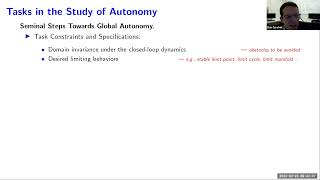
Wanted- Topologists for Autonomous Robots Community
Exploring topological complexity in robotics: from path planning to task spaces. Insights into rigorous formulations for robotic autonomy, emphasizing environment topology and combinatorics in cooperative motion.
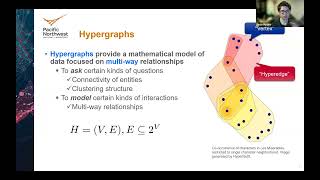
Applied Topology for Discrete Structures
Explore topological concepts applied to discrete structures modeling real data, bridging network science and applied topology for innovative analysis of complex systems.
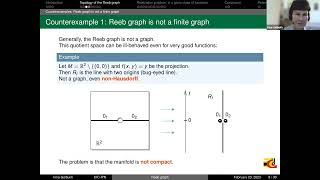
The Reeb Graph of a Smooth Function Encodes the Function Class and Manifold Type
Explore how Reeb graphs of smooth functions encode function class and manifold type, examining structures for Morse and Morse-Bott functions and their relationship to manifold properties.
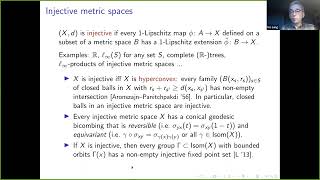
Urs Lang - Combinatorial Dimension and Higher-Rank Hyperbolicity
Exploration of (n,δ)-hyperbolicity in metric spaces, its relation to Gromov's δ-hyperbolicity, and applications in geometric group theory and hierarchically hyperbolic groups.
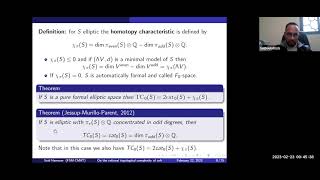
On the Rational Topological Complexity of Coformal Elliptic Spaces
Explore rational topological complexity bounds for elliptic spaces, focusing on coformal cases where it aligns with rational homotopy dimension.
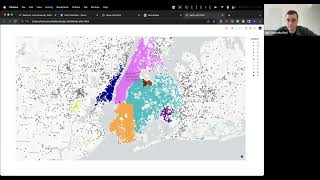
Recent Advances in Theory and Implementation of Multi-Parameter Persistence
Explores recent developments in multi-parameter persistence, covering stable filtrations and discrete descriptors. Includes interactive clustering software demo and discusses extensions of one-parameter persistence concepts.
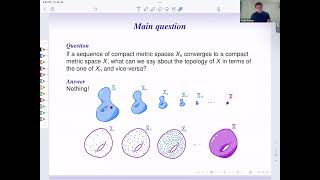
The Lower Semi-Continuity of Pi_1 and Nilpotent Structures in Persistence
Explore lower semi-continuity of π₁ in non-compact spaces, examining symmetries and nilpotent structures in persistence theory for compact geodesic space sequences.
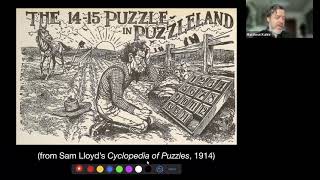
Configuration Spaces of Hard Squares
Exploring topology of configuration spaces with hard squares, focusing on Betti numbers' growth rate in confined regions. New insights into complex geometric arrangements.
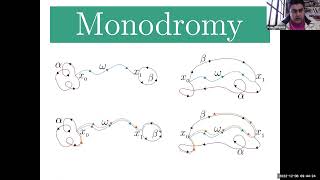
Symmetric and Symmetrized Topological Complexity of the Torus
Explore symmetric and symmetrized topological complexity of the torus, completing the description for closed surfaces using obstruction theory and explicit resolution of integers over full braid group.
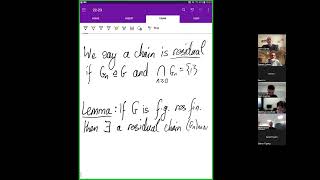
Torsion Homology Growth and Related Topics
Explore torsion homology growth in compact CW complexes, examining Betti number growth in finite covers and connections to amenable category and minimal volume entropy.
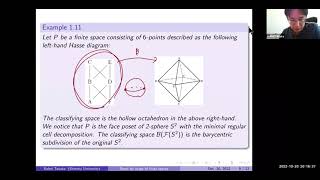
Kohei Tanaka - Sectional Category for Maps of Finite Spaces
Explore combinatorial approaches to sectional category in finite T_0 spaces, examining McCord maps, weak homotopy equivalences, and Fadell-Neuwirth fibrations through computational examples.
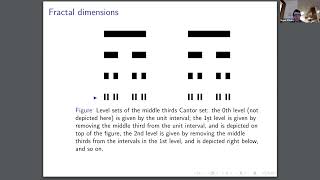
Alpha Magnitude
Explores alpha magnitude, a new metric space invariant, its properties, and potential for estimating fractal dimensions in real-world datasets, offering computational advantages over existing methods.
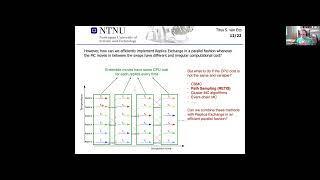
Exchanging Replicas with Unequal Cost, Infinitely and Permanently
Innovative replica exchange method for parallel simulations with varying computational costs, enhancing efficiency in Monte Carlo algorithms and path sampling techniques.