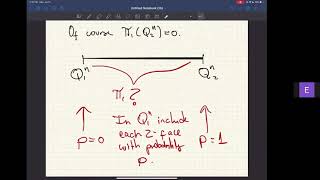
The Fundamental Group of 2-Dimensional Random Cubical Complexes
Explores fundamental groups in random 2D cubical complexes, analyzing their behavior and structure at different probability thresholds. Insights into topology and percolation theory.
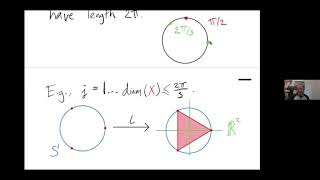
Borsuk–Ulam Theorems for Maps into Higher-Dimensional Codomains
Explore Borsuk-Ulam theorems for sphere maps to higher-dimensional spaces, examining topological properties and optimal diameter bounds for odd maps from S^n to R^k where k > n.
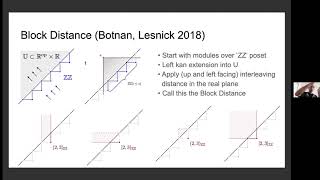
Comparative Stability of Two Zigzag Bottleneck Distances
Explores zigzag persistence in algebraic topology, comparing bottleneck distances for zigzag modules. Analyzes similarities and differences between approaches, focusing on Auslander-Reiten quiver perspective.
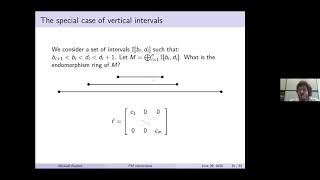
Every nD Persistence Module Is the Restriction of an (n+1)D Indecomposable Module
Explore a constructive process for building (n+1)D indecomposable modules from nD persistence modules, with insights on its implications and consequences.
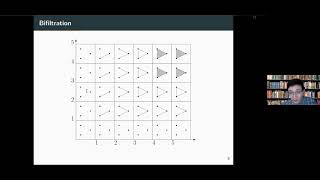
Efficient Approximation of the Matching Distance for 2-Parameter Persistence
Explore efficient algorithms for approximating matching distance in 2-parameter persistence modules, focusing on quad-tree refinement and local adaptive bounds for improved computational performance.
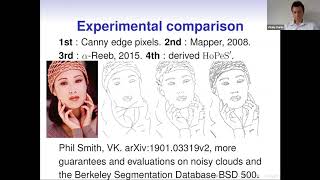
Persistence-Based Skeletonization of Images
Explores algorithms for splitting images into convex polygons using topological persistence, including Convex Constrained Mesh and Persistent Resolution-Independent Mesh for edge detection.
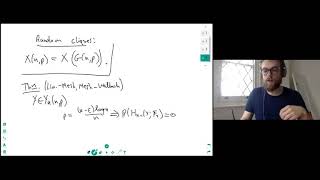
From Large to Infinite Random Simplicial Complexes
Explore two models of random simplicial complexes extending the Erdos-Renyi model, examining their Alexander duality relation and the unique infinite Rado simplicial complex.
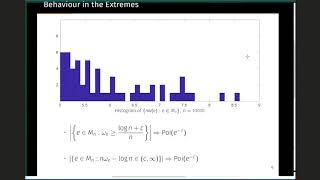
The Bulk and the Extremes of Online Minimal Spanning Acycles
Explores distributional properties of weights in random minimum spanning acycles, focusing on online settings. Examines bulk convergence to giant shadow measure and extremal convergence to inhomogeneous Poisson point process.

Geometry and Topology of Decision
Explore geometric and topological approaches to decision-making when faced with conflicting expert opinions, examining theoretical concepts and practical applications in various scenarios.
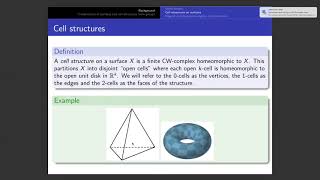
On a Canonical Construction of Tessellated Surfaces From Finite Groups
Explores a construction linking finite group multiplication tables to tessellated surfaces, discussing properties, group actions, and connections to classical mathematical constructions.
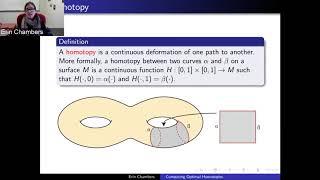
Computing Optimal Homotopies
Explore curve similarity measures and homotopy-based deformations in GIS, medical imaging, and graphics. Survey geometric and topological metrics, algorithms, and open questions in optimal homotopy computation.

Heather Harrington - Multi-Parameter Persistent Homology and Applications
Explore multi-parameter persistent homology and its applications in topological data analysis, uncovering complex patterns and structures in high-dimensional datasets.
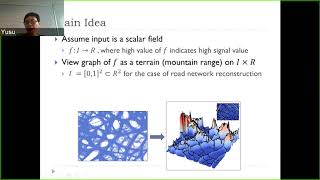
Graph Reconstruction via Discrete Morse Theory
Explore graph reconstruction using discrete Morse theory, focusing on geometric graphs and density data. Learn about theoretical guarantees and applications in road network reconstruction.
Bedlewo- On a Problem of Whitney and the Retract Theorem of Ważewski
Explores Whitney's inverted pendulum problem, its controversial solution, and the application of Ważewski's retract theorem to provide a rigorous mathematical argument for the original idea.
Topological Methods in Discrete Geometry - New Developments
Explores recent advancements in topological methods for discrete geometry, focusing on configuration spaces in cooperative game theory and their connections to embedding problems in Euclidean spaces.
Topological Complexity of Fibrations and Covering Maps
Explore topological complexity of fibrations and covering maps, examining their homotopy invariance and applications in robotics and mechanical device manipulation.
Solving Equations and Optimization Problems with Uncertainty
Explore algorithms for detecting zeros of imprecise continuous functions and approximating worst-case optima in optimization problems with uncertain feasible domains.
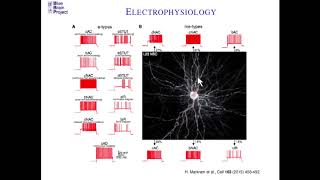
Kathryn Hess - Bedlewo: Topology Meets Neuroscience
Explore how topology applies to neuroscience across scales, from neurons to brain regions. Discover topological analysis of microconnectomes and neuron classification, with insights into brain imaging data.
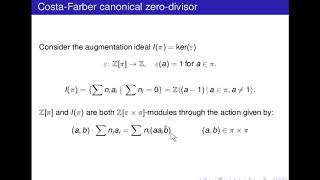
Bedlewo - Topological Complexity of the Klein Bottle
Explore the topological complexity of non-orientable surfaces, focusing on the Klein bottle and extending findings to surfaces of genus ≥2. Collaborative research insights shared.

A Physicist's Favorite Function
Explore a physicist's perspective on mathematical functions, blending humor and science to illuminate key concepts in continuity and piecewise functions.

Cosmological Simulations by R. Angulo
Explore cosmological simulations in this lecture, covering key concepts, techniques, and applications in modern cosmology research for understanding the universe's structure and evolution.