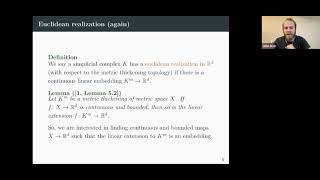
Johnathan Bush - Maps of Čech and Vietoris–Rips Complexes into Euclidean Spaces
Explore simplex-preserving maps in Čech and Vietoris–Rips complexes, their applications, and the challenge of finding such maps from various domains to Euclidean spaces.

Jürgen Jost - Geometry and Topology of Data
Explore geometric and topological approaches to data analysis, focusing on ball intersections, curvature concepts, and convexity in metric spaces.
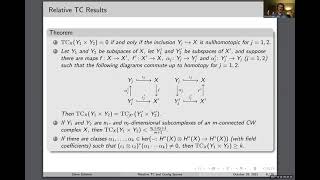
Steve Scheirer - Relative Topological Complexity and Configuration Spaces
Explore relative topological complexity and configuration spaces in this advanced algebraic topology talk, covering definitions, results, and applications.

Jamie Scott - Applications of Surgery to a Generalized Rudyak Conjecture
Exploring applications of surgery theory to Rudyak's conjecture, discussing generalizations to topological complexity, and examining cases for simply connected codomains.
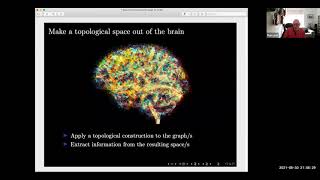
An Application of Neighborhoods in Directed Graphs in the Classification of Binary Dynamics
Explore graph theory applications in classifying binary dynamics, focusing on vertex neighborhoods and their use in analyzing neuronal network activity, with insights from the Blue Brain Project.
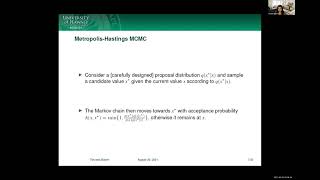
Farzana Nasrin - Random Persistence Diagram Generator
Explore a method for generating random persistence diagrams using parametric models and Markov chain Monte Carlo algorithms, with applications in material science and topology.
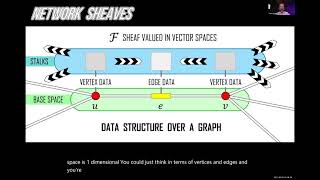
Robert Ghrist - Laplacians and Network Sheaves
Explore cellular sheaves, Laplacians, and network dynamics in algebraic topology. Learn about sheaf cohomology computation and applications in decentralized methods.
Role of Mathematics in Data Science and How to Learn - Data Science
Explore the essential mathematical concepts for data science, including statistics, probability, and normal distribution, with practical examples and problem-solving exercises.
Basic Homotopy Theory by Samik Basu
Explore fundamental concepts in homotopy theory, including maps, CW complexes, equivalences, and fibrations. Gain insights into key computations and sequences in this foundational area of topology.
Stability, Non-approximate Groups and High Dimensional Expanders by Alex Lubotzky
Explore stability, non-approximate groups, and high-dimensional expanders in this advanced mathematics lecture. Gain insights into residually finite and sophic groups, with a focus on recent breakthroughs and proofs.
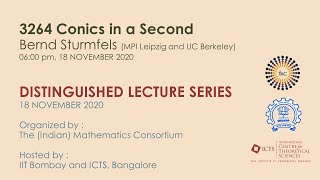
Conics in a Second by Bernd Sturmfels
Explore conics through historical and modern perspectives, from pentagon construction to applied algebraic geometry, with insights on Newton's method and enumerative geometry.
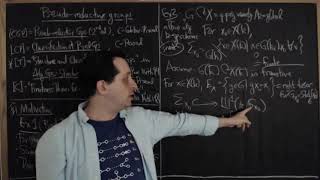
Pseudo-Reductive Groups by Brian Conrad
Explore pseudo-reductive groups with Brian Conrad, covering definitions, properties, and key theorems in this advanced mathematics lecture on algebraic group theory.
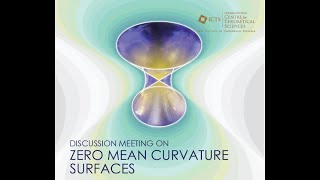
Zero Mean Curvature Surfaces in Euclidean and Lorentz-Minkowski 3-Space - Lecture 1
Explore zero mean curvature surfaces in Euclidean and Lorentz-Minkowski spaces, covering fundamental concepts, variations, stability, and examples of minimal surfaces with diverse properties and geometries.
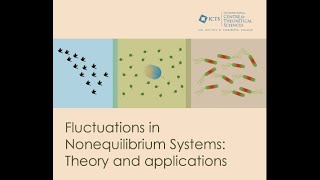
Persistence and First-Passage Properties of Stochastic Processes by Satya N Majumdar
Explore stochastic processes, focusing on persistence and first-passage properties. Covers applications in chemistry, finance, astrophysics, and more. Examines Markov processes and run-and-tumble particle models.
Additive Number Theory - Extremal Problems and the Combinatorics of Sumsets by M. Nathanson
Explore extremal problems and combinatorics of sumsets in additive number theory, covering density, lower bounds, Cauchy-Davenport theorem, and Erdos-Turan conjecture.
The Selberg Sieve and Large Sieve - Lecture 1
Explore the Selberg Sieve and Large Sieve in number theory, covering linear algebra, duality principles, and applications like the Bombieri-Vinogradov theorem in this advanced mathematics lecture.

The Selberg Sieve - Lecture 1
Explore the Selberg sieve method in number theory, covering heuristics, probability, and applications to twin primes. Learn about sieve techniques for detecting primes in sequences.
Quantitative Results on the Method of Averaged Projections
Quantitative analysis of averaged projections method in convex optimization, focusing on asymptotic regularity and weak convergence in CAT(0) spaces using proof mining techniques.
Harry Altman- Lower Sets in Products of Well Ordered Sets
Explore well partial orders, lower sets in products of ordinals, and weakly decreasing sequences. Gain insights into maximum linearizations and the surreal exponential.
Sam Sanders - Uniformity in Mathematics
Explore uniformity in mathematics, from historical examples to modern applications. Examine how uniform theorems challenge traditional logical systems and impact proof methods across various mathematical domains.
A Fibrational Framework for Modal Dependent Type Theories
Explore modal extensions of homotopy type theory, their frameworks, and applications in real-cohesive and differential-cohesive HoTT. Gain insights into fibrational frameworks for modal type theories.