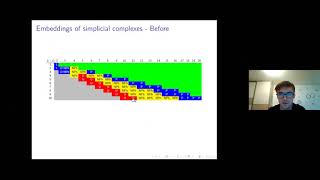
Embeddings and Tverberg-Type Problems: New Algorithms and Undecidability Results
Explore computational topology: algorithmic embeddability, undecidability in higher dimensions, and polynomial-time decidability of r-Tverberg problem in metastable range.

Convex Sunflower Theorems and Neural Codes
Explore convex sunflower theorems and neural codes, connecting neuroscience with discrete geometry to understand place cell encoding and cognitive mapping in rat hippocampus.
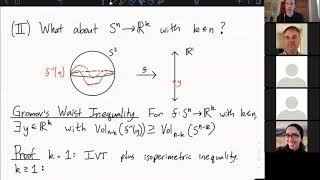
Borsuk-Ulam Theorems into Higher-Dimensional Codomains
Exploration of Borsuk-Ulam theorems in higher dimensions, generalizing results and discussing open questions related to optimal diameters and Schur polynomials.
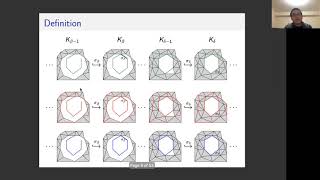
Computing Minimal Persistent Cycles - Polynomial and Hard Cases
Explores computing minimal persistent cycles in algebraic topology, discussing polynomial and NP-hard cases, and presenting algorithms for weak pseudomanifolds with applications to scientific data analysis.
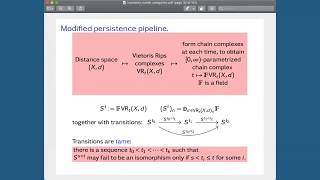
Wojciech Chachólski - TDA Invariants and Model Categories
Exploring TDA invariants and model categories in data analysis, focusing on simplification techniques from homotopy theory to extract meaningful summaries while balancing information retention.
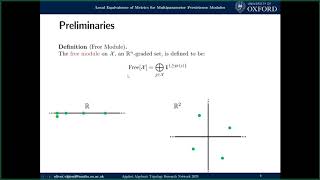
Oliver Vipond - Local Equivalence of Metrics for Multiparameter Persistence Modules
Explore local equivalence of metrics for multiparameter persistence modules, focusing on fibered bar codes' discriminative power and stability in topological data analysis.
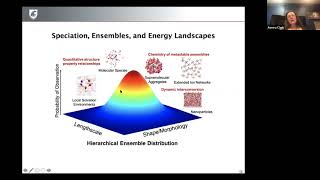
Topology in Chemistry Applications
Explore topological data analysis in chemistry, focusing on molecular relationships, graph theory, and network analysis to extract new insights from chemical data.
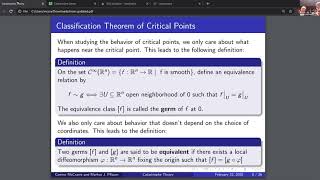
Catastrophe Theory
Explore catastrophe theory, covering critical points, germs, classification theorems, unfoldings, and elementary catastrophes. Visualize concepts and discover applications in chemistry.
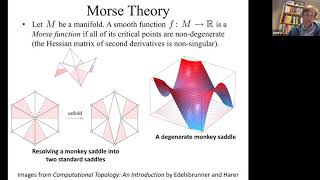
Henry Adams and Enrique Alvarado - An Introduction to Morse Theory
Explore Morse theory's applications in topology, including CW complexes, key theorems, and simplification techniques, with real-world examples in material science.
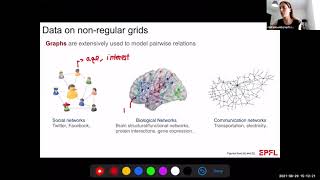
Simplicial Neural Networks
Explore simplicial neural networks, a generalization of graph neural networks for multi-dimensional data, and their applications in imputing missing data on coauthorship complexes.
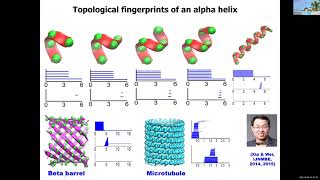
How Math and AI Are Revolutionizing Biosciences
Exploring how mathematics and AI revolutionize biosciences, focusing on tackling challenges in biological data complexity, dimensionality, and nonlinearity to enhance AI's capabilities in drug design and viral mutation prediction.
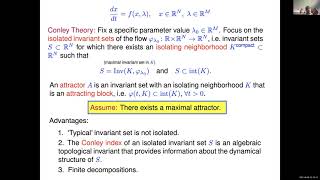
Solving Systems of ODEs via Combinatorial Homological Algebra
Exploring efficient computation of homological representations in dynamical systems, with applications to differential equations and parameter space analysis.
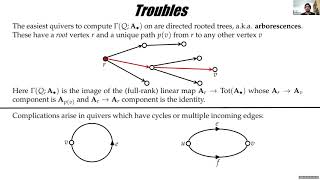
Vidit Nanda - Principal Components Along Quiver Representations
Principal components analysis for quiver representations: dimensionality reduction, comparison, and optimization techniques for vector-space valued representations across pure and applied mathematics.
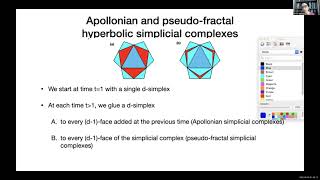
The Topological Dirac Operator and the Dynamics of Topological Signals
Explore topological signals, higher-order Laplacians, and the Dirac operator in network science. Learn about spectral properties, diffusion dynamics, and topological synchronization in simplicial complexes and multiplex networks.
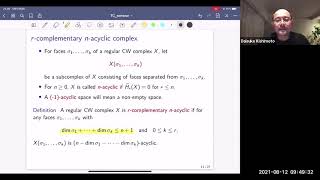
Tverberg’s Theorem for Cell Complexes
Explore Tverberg's theorem generalization, homotopy decomposition of discretized configuration spaces, and topological extensions in this advanced algebraic topology discussion.
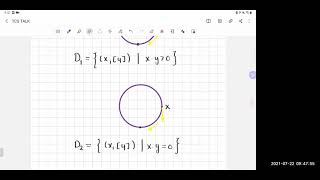
Effectual Topological Complexity
Explora la Complejidad Topológica Efectual, una nueva versión para G-Espacios. Aprende sus propiedades, relación con TC estándar y aplicación en superficies, especialmente en el toro.
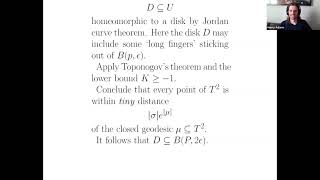
Mikhail Katz - Collapsing Surfaces
Exploring surface collapse in Riemannian geometry, focusing on critical points, intersection theory, and Toponogov comparison. Analyzes fiber homotopy and discrete integration against Euler characteristic.
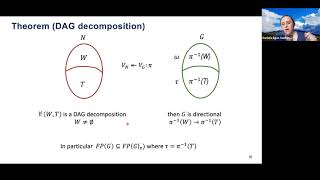
Nerve Theorems for Fixed Points of Neural Networks
Explore how network connectivity shapes neural activity using combinatorial threshold-linear networks. Learn about nerve theorems and their application in understanding fixed points of large neural networks.
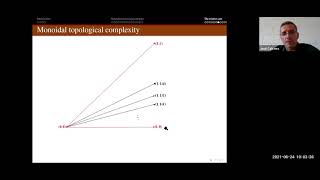
Topological Complexity Using Arbitrary Covers
Explore topological complexity using arbitrary covers, focusing on sectional category, ANRs, and generalized concepts. Gain insights into advanced algebraic topology techniques and applications.
Using Algebraic Geometry to Detect Robustness in Reaction Networks
Explore algebraic geometry techniques to detect robustness in reaction networks, focusing on absolute concentration robustness and its implications for biological systems.
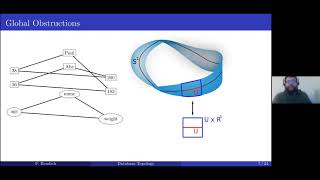
Data Complexes, Obstructions, Persistent Data Merging
Explore data complexes, topological obstructions in database JOIN operations, and persistence levels in data alignment. Learn about measure theory, homotopy, and homology in the context of data integration.