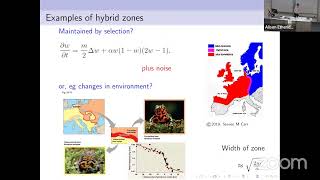
The Motion of Hybrid Zones - And How to Stop Them
Explore mathematical models of hybrid zones in population genetics, including deterministic approximations, curvature flow, and probabilistic proofs, with applications to invasions and blocking.
Variety of Fractional Laplacians
Explore various types of fractional Laplacians, their properties, and applications in mathematical analysis through proofs, comparisons, and counterexamples.
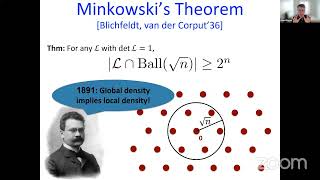
Oded Regev: The Reverse Minkowski Theorem
Explore the Reverse Minkowski Theorem, its applications, and open questions in lattice theory with mathematician Oded Regev in this insightful mathematical lecture.
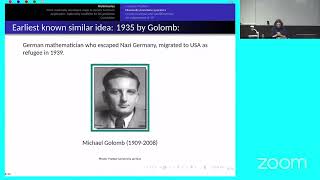
Enlargements - A Bridge Between Maximal Monotonicity and Convexity
Explore connections between maximally monotone operators and convex functions through enlargements, offering insights into variational problems and new distance measures for point-to-set maps.
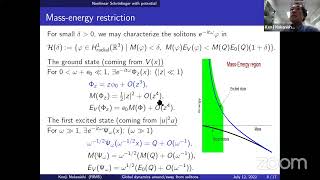
Kenji Nakanishi - Global Dynamics Around and Away From Solitons
Explore global dynamics of nonlinear dispersive PDEs, focusing on solitons in Klein-Gordon and Schrödinger equations. Analyze stability, multi-soliton interactions, and open questions in soliton behavior.
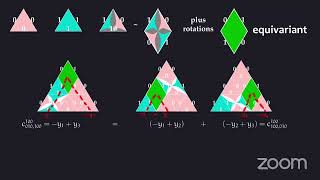
Allen Knutson- Schubert Calculus and Quiver Varieties
Explore Schubert calculus, quiver varieties, and their connections through puzzle rules, Yang-Baxter equations, and representation theory in this advanced mathematics lecture.
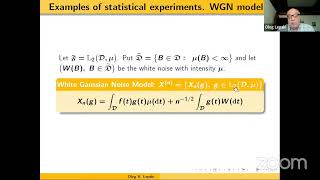
Theory of Adaptive Estimation
Introduction to modern adaptive estimation theory, focusing on universal estimation procedures and oracle inequalities. Explores commutativity properties, upper functions, and applications to various statistical models.
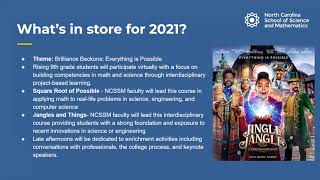
Step Up to STEM Summer Program Information Session 2021
Free summer program for underrepresented 9th graders in North Carolina, offering STEM and communication skills through real-world challenges. Includes campus living and enrichment activities in the Triangle area.
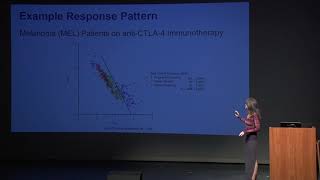
Teaching Contemporary Math - Modeling Cancer Treatment
Explore innovative approaches to teaching math through real-world applications in cancer treatment, data modeling, and error analysis with Helen Moore.
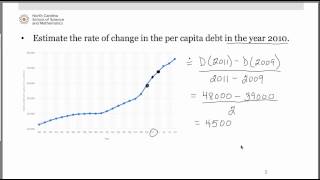
Rates of Change from Graphs - Calculus Concepts
Explore equations related to rates of change from graphs, including average, estimated, and instantaneous rates. Learn practical applications with an experienced mathematics instructor.
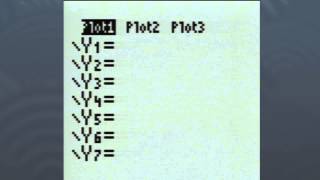
The Box Problem: Optimizing Volume in Rectangular Cardboard Boxes - Grades 8-9
Explore volume optimization through 'The Box Problem'. Investigate using models, tables, and graphs. Learn to define variables, write functions, and use graphing calculators for advanced analysis.
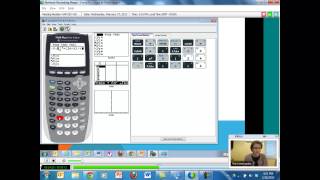
Using Functions to Build Models - Math Teacher Professional Development
Hands-on exploration of mathematical modeling using real-world problems, connecting concepts across Math I to Calculus. Focuses on function creation, domain analysis, and student engagement techniques.
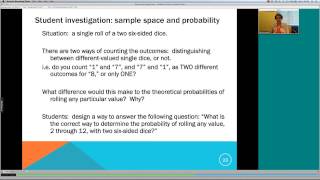
Probability Topics in Middle Grades - Simulation and Data Collection
Explore probability concepts through simulations and data collection, using various technologies to enhance understanding of middle-grade mathematics topics.
Distinguishing Between Linear and Exponential Growth in Mathematics - Real-World Applications
Explore real-world applications of linear and exponential growth through population and food production data, using calculators for analysis and modeling in mathematics.
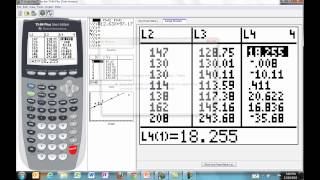
Linear Data Analysis for Math Common Core Standards - Part 3
Explore linear functions for real-world data modeling, focusing on slope and intercept interpretation, linear regression, and residual analysis using interactive tools and practical examples.
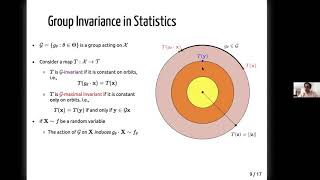
Statistical Invariance of Betti Numbers in the Thermodynamic Regime
Explore statistical invariance of Betti numbers in random topology, examining conditions for topological inference through parametric statistics lens. Investigates asymptotic behavior and group invariance concepts.
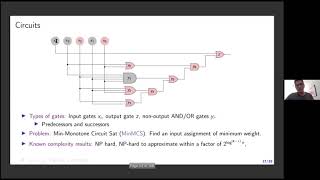
Hardness Results in Discrete Morse Theory for 2-Complexes
Explore inapproximability and parameterized complexity in discrete Morse theory for 2-complexes, focusing on minimizing critical simplices and presenting new hardness results and an approximation algorithm.
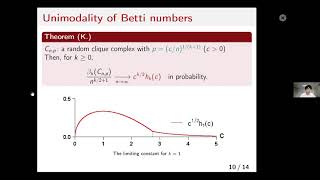
A Limit Theorem for Betti Numbers of Random Simplicial Complexes
Explore asymptotic behavior of Betti numbers in homogeneous and spatially independent random simplicial complexes, extending previous work on Linial-Meshulam complexes using local weak convergence.
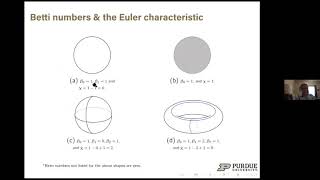
Andrew Thomas - Functional Limit Theorems for Euler Characteristic Processes
Explore functional limit theorems for Euler characteristic processes in Vietoris-Rips complexes, covering strong law of large numbers and central limit theorem in the thermodynamic regime.
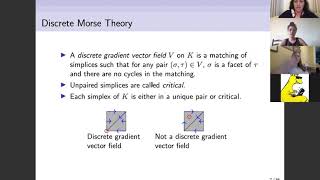
Morse-Based Fibering of the Rank Invariant
Explore multi-parameter persistence in data analysis using discrete Morse theory to compute rank invariants, partition parameter space, and deduce persistence diagrams for equivalent classes of lines.
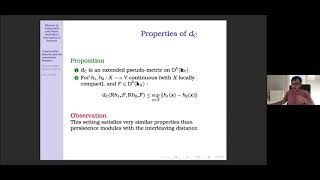
Sheaves as Computable and Stable Topological Invariants for Datasets
Explores sheaf theory in topological data analysis, connecting level-sets persistence with derived sheaves. Presents functorial equivalences, stability theorems, and barcode decompositions for continuous data analysis.