Projective Geometry - Math History - NJ Wildberger
Explore the origins and development of projective geometry, from Pappus to Desargues and Pascal, and its fundamental role in mathematics and 3D space understanding.
Analytic Geometry and the Continuum - Math History - NJ Wildberger
Explores Cartesian geometry's development, merging numbers and geometry, and discusses issues with the continuum, irrational numbers, and decimal expansions, including pi's continued fraction approximations.
Analytic Geometry and the Continuum - Math History - NJ Wildberger
Explore Cartesian geometry's development, merging numbers and geometry. Delve into conics, cubics, Bezout's theorem, and the continuum, discussing ancient Greek influences and challenges with irrational numbers and pi.
First Steps in Hyperbolic Geometry - Universal Hyperbolic Geometry
Explore fundamental concepts of universal hyperbolic geometry, including perpendicularity, quadrance, spread, and key theorems, with a focus on projective study of circles and relativistic geometry.
Apollonius and Harmonic Conjugates - Universal Hyperbolic Geometry 2 - NJ Wildberger
Explore harmonic conjugates in geometry, including their relation to circles, conics, and quadrangles. Learn about harmonic ranges, pencils, and vector combinations in this advanced mathematical discussion.
Apollonius and Polarity - Universal Hyperbolic Geometry
Explore Apollonius' polarity concept in hyperbolic geometry, focusing on the crucial role of circles and their relationship to points and lines in the projective plane.
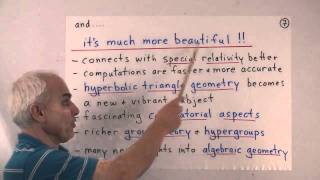
Universal Hyperbolic Geometry - NJ Wildberger
Discover a revolutionary approach to hyperbolic geometry, simplifying complex concepts using high school algebra and projective geometry, with connections to Einstein's special relativity theory.
Polynomial Equations - Math History - NJ Wildberger
Explore the Golden Age of European mathematics, focusing on polynomial equations, algebraic advancements, and key figures like Tartaglia and Cardano. Learn about historical developments in solving complex equations.
Number Theory and Algebra in Asia - Math History - NJ Wildberger
Explores number theory, algebra, and astronomy in ancient Chinese, Indian, and Arab mathematics, highlighting key figures and their contributions to mathematical development.
Polynomials and Sequence Spaces - Wild Linear Algebra - NJ Wildberger
Explore polynomials as sequences, introducing factorial powers and difference operators. Learn about forward/backward differences, Newton's theorem, and formulas for summing series, with practical examples and exercises.
Infinity in Greek Mathematics - Math History - NJ Wildberger
Explore ancient Greek mathematics, focusing on Eudoxus and Archimedes' groundbreaking work in calculus, geometry, and mechanics. Discover their ingenious formulas and principles that laid the foundation for modern mathematics.
Greek Number Theory - Math History - NJ Wildberger
Explore ancient Greek number theory, including primes, perfect numbers, and the Fundamental Theorem of Arithmetic. Learn about Euclidean algorithms, continued fractions, and Pell's equation.
Greek Number Theory - Math History - NJ Wildberger
Explore ancient Greek number theory, including squares, primes, and the Fundamental Theorem of Arithmetic. Learn about Euclidean algorithms, continued fractions, and Archimedes' Cattle Problem.
Greek Geometry - Math History - NJ Wildberger
Explore ancient Greek geometry, from Euclid's Elements to Apollonius' conics, covering key concepts, constructions, and the Platonic solids in this comprehensive lecture on mathematical history.
Bases of Polynomial Spaces - Wild Linear Algebra - NJ Wildberger
Explore polynomial spaces through linear algebra, focusing on bases, translations, and derivatives. Gain insights into calculus concepts from an algebraic perspective, emphasizing practical applications and theoretical foundations.
Pythagoras' Theorem - Math History - NJ Wildberger
Explore Pythagoras' theorem's historical significance, Greek mathematical thinking, and its connections to ancient Babylonian mathematics and modern geometry.
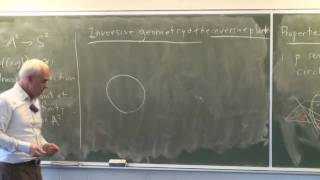
Two-Dimensional Surfaces - The Sphere - Algebraic Topology
Explore the two-dimensional sphere's significance in algebraic topology, including its relation to stereographic projection and the inversive plane in Euclidean geometry.
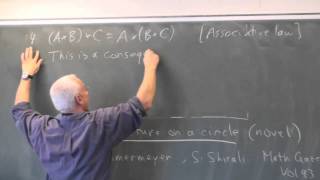
Homeomorphism and the Group Structure on a Circle - Algebraic Topology 2 - NJ Wildberger
Explore homeomorphisms, group structures on circles, and projective geometry in this algebraic topology lecture, blending fundamental concepts with novel approaches and historical insights.
More Row Reduction With Parameters - Wild Linear Algebra A
Explores advanced row reduction techniques with parameters, focusing on solving linear equations, vector representations, and applications in 2D and 3D spaces. Includes practical examples and exercises.
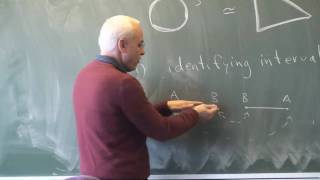
One-Dimensional Objects - Algebraic Topology
Explore one-dimensional objects in algebraic topology, focusing on lines and circles. Learn about their diverse representations and fundamental properties in this introductory lecture.
Introduction to Algebraic Topology - Algebraic Topology - NJ Wildberger
Explore the foundations of algebraic topology, its historical roots, and key concepts like homeomorphism and fundamental objects. Tackle challenging problems in this dynamic field of mathematics.