Pappus and Pascal - Elementary Mathematics Explained
Explore Pappus' and Pascal's theorems in projective geometry, learning key concepts and historical context. Gain insights into reading mathematics and appreciating these fundamental results.
Word Problems Using Addition - Elementary Mathematics Explained
Learn to solve word problems using addition with clear explanations and examples. Gain practical skills in elementary mathematics through step-by-step solutions and practice exercises.
Rational Trigonometry in Three Dimensions - Universal Hyperbolic Geometry
Extending rational trigonometry to 3D using vectors and dot products. Explores quadrance, spread, and key trigonometric laws. Introduces solid spread and determinants for three vectors.
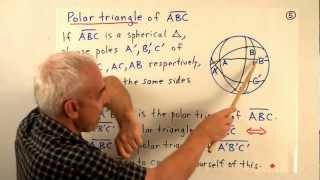
Perpendicularity, Polarity and Duality on a Sphere - Universal Hyperbolic Geometry
Explore perpendicularity, polarity, and duality on a sphere, including polar triangles and point-plane duality. Gain insights into elliptic geometry and the relationships between geometric elements.
Rational Trigonometry - An Overview - Universal Hyperbolic Geometry
Introduces rational trigonometry using vectors, replacing distance and angle with quadrance and spread. Covers key concepts, formulas, and laws, offering a purely algebraic approach to trigonometry and geometry.
Parametrizing and Projecting a Sphere - Universal Hyperbolic Geometry
Explore stereographic and gnomonic projections of a sphere, including rational parametrization, coordinate systems, and their applications in elliptic geometry.
Areas and Volumes for a Sphere - Universal Hyperbolic Geometry
Explore Archimedes' sphere formulas, rational turn angles, and Harriot's theorem. Learn key principles in spherical geometry and discover new ways to conceptualize angles and areas.
Spherical and Elliptic Geometries - Universal Hyperbolic Geometry
Explore spherical and elliptic geometries, from ancient Greek astronomy to modern concepts. Learn about longitude, latitude, measurement techniques, and key theorems in non-Euclidean spaces.
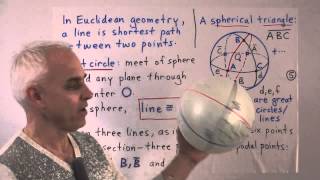
Spherical and Elliptic Geometries - An Introduction
Explore spherical geometry fundamentals: great circles, antipodal points, triangles, and circles. Learn key concepts and visualize ideas with physical models, connecting to 3D space and Euclidean geometry.
The J Function, SL(2) and the Jacobi Identity - Universal Hyperbolic Geometry
Explores connections between hyperbolic geometry, matrix algebra, and Lie theory, demonstrating how the Jacobi identity proves the concurrence of triangle altitudes in projective geometry.
Parallels and the Double Triangle - Universal Hyperbolic Geometry
Explores parallels, double triangles, and perspective centers in Universal Hyperbolic Geometry, offering new insights into Euclid's parallel postulate and its historical implications.
Medians, Midlines, Centroids and Circumcenters - Universal Hyperbolic Geometry
Explore triangle geometry in universal hyperbolic geometry, covering medians, midlines, centroids, and circumcenters. Discover unique properties and connections in this algebraic framework.
Reflections and Projective Linear Algebra - Universal Hyperbolic Geometry
Explore reflections in hyperbolic geometry through projective linear algebra. Learn about null points, reflection matrices, and the sl(2) Lie algebra. Gain insights into fundamental symmetries and their mathematical representations.
Midpoints and Bisectors - Universal Hyperbolic Geometry
Explore midpoints and bisectors in hyperbolic geometry, including reflections, perpendicularity, and geometric constructions. Learn key differences from Euclidean geometry in this advanced mathematical exploration.
Non-Euclidean Geometry - Math History - NJ Wildberger
Explore the complex history and modern interpretations of non-Euclidean geometry, challenging traditional narratives and proposing new perspectives on this fundamental mathematical concept.
Apollonius and Polarity Revisited - Universal Hyperbolic Geometry
Explores Apollonius' polarity in hyperbolic geometry, focusing on null points, quadrangles, and the relationship between poles and polars. Includes explicit formulas and computational examples.

Calculus - Math History - N J Wildberger
Explore the historical development of calculus, from ancient Greek origins to Newton and Leibniz's revolutionary work, covering key concepts and influential figures in mathematics.
Theorems Using Perpendicularity - Universal Hyperbolic Geometry
Explore perpendicularity in hyperbolic geometry, including duality, triangles, and the Base center point. Learn a general theorem approach and investigate concepts using Standard Triangle 1.
Orthocenters Exist - Universal Hyperbolic Geometry
Explores orthocenters in universal hyperbolic geometry, introducing key concepts like triangles, altitudes, and Desargues' theorem. Culminates in defining orthic line, orthostar, and ortho-axis in hyperbolic triangle geometry.
Duality and Perpendicularity - Universal Hyperbolic Geometry
Explore perpendicularity in universal hyperbolic geometry, including duality, altitudes, and key theorems. Learn about unique aspects like perpendicular points and their applications in geometric analysis.
Computations with Homogeneous Coordinates - Universal Hyperbolic Geometry
Explore algebraic definitions of points and lines in hyperbolic geometry, learn key theorems, and understand their applications in computational geometry and Cartesian coordinates.