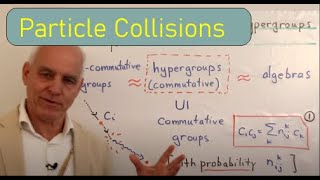
Particle Collisions, Hypergroups and Quadratic Residues - Diffusion Symmetry 3
Explore particle collision models, hypergroups, and quadratic residues in algebraic structures. Learn about fusion rule algebras, complete graphs, and primitive roots in prime fields.
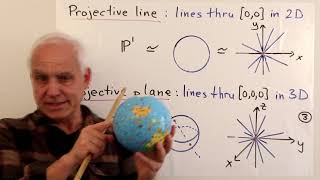
History of Geometry IV - The Emergence of Higher Dimensions - Sociology and Pure Maths
Explore the emergence of higher dimensions in 19th-century geometry, including projective geometry, cyclography, and spaces of lines and curves, revolutionizing our understanding of mathematical spaces.
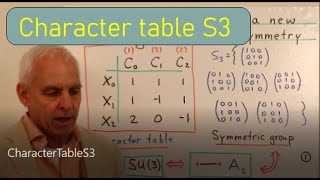
The S3 Character Table - A New Meaning - Diffusion Symmetry
Explore the S3 character table from a diffusion symmetry perspective, uncovering new interpretations in group theory, combinatorics, and algebraic structures.
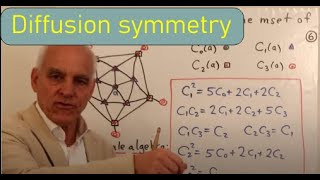
A New Paradigm for Mathematics and Physics - Diffusion Symmetry
Exploring diffusion symmetry as a new paradigm for understanding symmetry in mathematics and physics, offering insights into group theory, character tables, and fusion rule algebras.
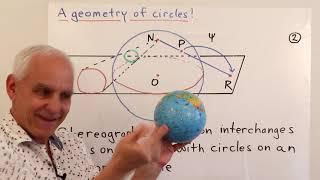
A Brief History of Geometry III - The 19th Century - Sociology and Pure Mathematics
Explore the golden age of geometry in the 19th century, covering inversive, projective, non-Euclidean, and complex geometries. Understand key developments and their impact on modern mathematics.
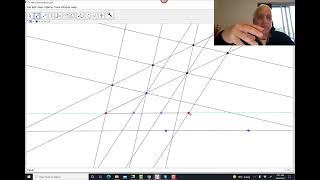
Calculus and Affine Geometry of the Magical Parabola - Algebraic Calc and DCB Curves 3 - Wild Egg
Explore affine geometry and the parabola's unique properties in algebraic calculus, focusing on parallelism and linear algebra concepts without relying on traditional Euclidean definitions.
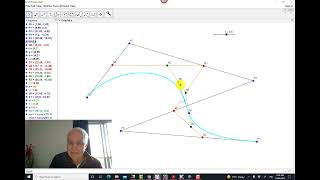
Polynumbers and De Casteljau Bezier Curves - Algebraic Calculus and DCB Curves - N J Wildberger
Explore polynumbers and de Casteljau Bezier curves in algebraic calculus. Learn new formulas for planar integration and use GeoGebra to visualize these remarkable curves, with applications in design and animation.
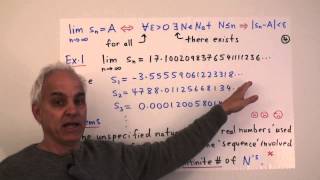
Logical Difficulties With the Modern Theory of Limits - Real Numbers + Limits Math Foundations
Explores logical issues with the modern theory of limits in mathematics, examining the formal definition and its problems through examples and historical context.
Relativistic Dot Products and Complex Numbers - Wild Linear Algebra B
Explore relativistic dot products, complex numbers, and chromogeometry in planar geometry. Discover the symmetry between Euclidean and relativistic geometries using 2x2 matrices, unit circles, and isometries.
Energy, Momentum and Linear Algebra - Wild Linear Algebra B
Explore conservation of momentum and energy in mechanics using linear algebra, featuring a geometric interpretation of elastic collisions and a butterfly collision diagram for particle interactions.
How to Write Mathematics at the College Level - Math Terminology
Learn effective techniques for writing clear, structured mathematical solutions at the college level, including defining terms, logical layout, complete sentences, and careful diagrams.

The Language of Calculus - Math Terminology
Explore fundamental calculus concepts, from position and velocity to differentiation and integration, with clear explanations and historical context. Gain insights into mathematical language and notation.
Sets, Logic and Graphs - Math Terminology - NJ Wildberger
Review of high school math language and notation for sets, logic, and basic graph theory. Covers key concepts like union, intersection, subsets, logical statements, and graph circuits, providing essential foundations for advanced mathematics.
Curves, Functions and Surfaces - Math Terminology - NJ Wildberger
Explore key mathematical concepts including curves, functions, and surfaces. Learn about conic sections, exponential and trigonometric functions, and their applications in calculus and three-dimensional geometry.
The Language of Algebra - Math Terminology
Essential algebra terminology and concepts for first-year university students, covering polynomials, sequences, series, and rational functions. Includes the Binomial theorem and an introduction to calculus with polynomials.
The Language of Geometry - Math Terminology
Comprehensive review of geometry terminology for university students, covering Euclidean concepts, shapes, transformations, 3D geometry, and coordinate systems. Includes subtitles and supplementary materials.
Numbers and Arithmetic - Math Terminology
A comprehensive review of fundamental mathematical concepts and terminology for university-level math, covering number systems, arithmetic operations, fractions, and basic number theory.
The Relativistic Dot Product - Wild Linear Algebra B
Explore the relativistic dot product in Einstein's Special Relativity, comparing it to the Euclidean dot product and examining its applications in geometry and physics.
Simple Groups, Lie Groups, and the Search for Symmetry I - Math History - NJ Wildberger
Explore the history of group theory, from simple groups to Lie groups, and their role in describing symmetry in geometry. Discover remarkable mathematical objects and the classification of finite simple groups.
Circles and Spheres via Dot Products II - Wild Linear Algebra A
Explore 3D Euclidean dot products, quadrance, linear functionals, and spheres. Learn about projections, Pythagoras' theorem, and perpendicularity in three-dimensional space.
Algebraic Number Theory and Rings I - Math History - NJ Wildberger
Explore algebraic number theory and rings, focusing on extension fields, Gaussian integers, and the development of abstract ring theory in 19th-century mathematics.