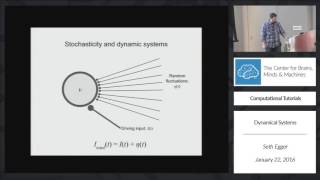
Dynamical Systems in Neuroscience
Explore cluster computing and OpenMind for brain and cognitive sciences, covering dynamical systems, models, and observation techniques in neuroscience research.
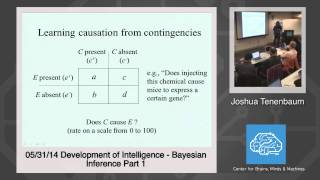
Development of Intelligence - Josh Tenenbaum: Bayesian Inference
Explore Bayesian inference and cognitive neuroscience with Josh Tenenbaum, delving into AI challenges, scene understanding, and advanced mathematical concepts for intelligence development.
Bayesian Inference in Generative Models
Explore approximate Bayesian inference methods, including sampling-based techniques and variational inference, with hands-on exercises in implementing algorithms and using probabilistic programming languages.
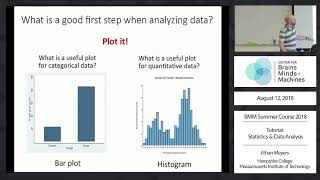
Statistics and Data Analysis
Learn essential statistics and data analysis concepts, including distributions, visualization techniques, correlation, regression, and hypothesis testing, to enhance your data interpretation skills.
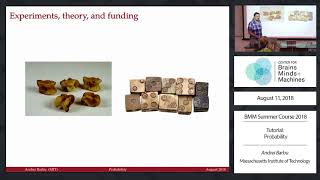
Probability Tutorial
Explore probability concepts, from uncertainty to Bayesian reasoning, with practical applications in graphical models and hidden Markov models.

Cryptanalysis 2
Explore cryptanalysis techniques, focusing on discrete logarithm problems in finite fields. Learn about L notation, historical developments, and computational complexity.
Proofs and Arguments
Explore witness indistinguishability and boosting variable computation on encrypted data in this advanced cryptography presentation.
Lattice Cryptanalysis
Explore lattice cryptanalysis techniques, barriers, and implementations with expert insights from leading researchers in the field.
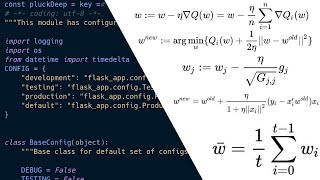
How to Read Math as a Software Engineer
Learn to interpret mathematical formulas as a software engineer, reducing anxiety and enhancing coding skills through practical examples and step-by-step guidance.
Reasoning About Conscious Experience With Axiomatic and Graphical Mathematics
Explore mathematical approaches to modeling consciousness using category theory and graphical calculus, examining key aspects like subjective experience and phenomenal unity.
The Big Mathematics Divide - Between "Exact" and "Approximate" - Sociology and Pure Maths
Explores the divide between exact and approximate theories in pure mathematics, challenging conventional views on arithmetic, algebra, topology, and number theory, including the Riemann Hypothesis.
The Mathematics of Scales and Modes - Maths and Music
Explore mathematical framework for scales and modes using 12-tone chromatic scale. Learn interval sequences, scale types, and connections to clock arithmetic and discrete calculus.
The Big Step from Polynumbers to Multinumbers - Math Foundations - N J Wildberger
Explore the transition from polynumbers to multinumbers, expanding arithmetic concepts using multisets. Learn new notations and operations for a more flexible algebraic framework.
A Multiset Approach to Arithmetic - Math Foundations
Explore a new framework for arithmetic using multisets, introducing natural numbers, polynumbers, and multinumbers. Learn innovative definitions and operations that offer profound insights into mathematical structures.
Is Pure Mathematics Logically Viable? Five Challenges - Sociology and Pure Maths
Exploring five challenges to pure mathematics' logical viability, this talk critically examines the field's foundations and encourages reevaluation of its core principles and practices.
Think Like a Babylonian - With Centimal Base 100 Arithmetic - Sociology and Pure Maths
Explore Babylonian arithmetic through base 100 system, comparing it to modern methods. Gain insights into ancient Mesopotamian mathematics and its innovative floating-point approach.
Number Systems Ancient to Modern - The Babylonians - Sociology and Pure Maths
Explore ancient Babylonian mathematics, including their base-60 system, arithmetic tables, and problem-solving techniques. Gain insights into historical mathematical practices and their relevance today.
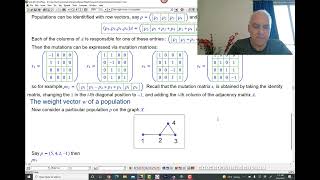
The Pentagon and Numbers Games - A Dualization of the Mutation Game
Explore the duality between the Pentagon Game and Numbers Game, examining their connections to graph dynamics and mathematical structures like ADE graphs and weight lattices.
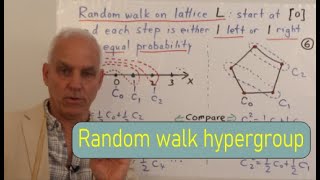
The One Dimensional Random Walk Hypergroup - Diffusion Symmetry
Explore affine transformations, representation theory, and random walks on a 1D lattice. Learn about hypergroups and calculate probabilities in this advanced mathematics lecture.

Curt Jaimungal Interview and Theories of Everything - Sociology and Pure Maths
Exploring diverse topics from physics and mathematics to consciousness and UFOs, this wide-ranging interview delves into theories of everything, sociological aspects of science, and the intersection of academic disciplines.
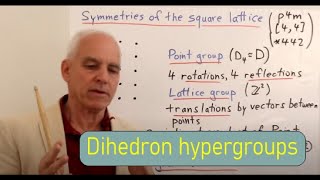
The Square Lattice via Group D4 and Its Hypergroups - Diffusion Symmetry
Explore hypergroups and their connection to symmetry in the square lattice, focusing on the D4 group and its character table. Learn about orthogonality relations in hypergroup character tables.