MTC and Twisted Hilbert Spaces
Explore twisted Hilbert spaces and their applications in topology, including Jones polynomials, torsion, and Gromov-Witten invariants. Gain insights into advanced mathematical concepts and their interconnections.
Algorithms for Rank-1 Bimatrix Games
Explore algorithms for solving rank-1 bimatrix games efficiently, including polynomial-time methods for finding Nash equilibria and path-following techniques. Discusses complexity, uniqueness, and parameterized approaches.
Terence Tao- The Circle Method from the Perspective of Higher Order Fourier Analysis
Explore higher order Fourier analysis and its application to the circle method, offering new perspectives on multilinear averages and complex mathematical problems.
Ciprian Demeter - Restriction of Exponential Sums to Hypersurfaces
Explore exponential sums on hypersurfaces, focusing on sharp moment inequalities and scale-independent results. Gain insights into critical exponents and Hardy-Littlewood lemmas.

Convergence in Hölder and Sobolev Norms for Galerkin Approximations of Generalized Whittle-Matern Fields
Optimal convergence rates for Galerkin approximations of generalized Whittle-Matern fields in Hölder and Sobolev norms, covering spectral and finite element methods for Gaussian random fields.
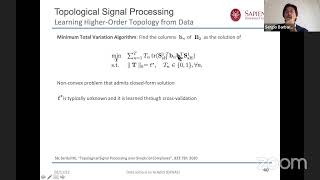
Topological Signal Processing and Learning
Explore advanced techniques in signal processing using topological methods, enhancing data analysis and learning algorithms for complex datasets.
Signal Processing on Graphs and Complexes
Explore advanced techniques for analyzing complex data structures using graph and simplicial complex-based signal processing methods.
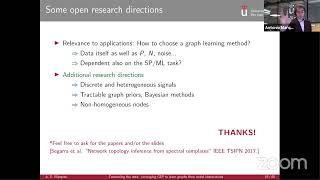
Connecting the Dots - Leveraging GSP to Learn Graphs From Nodal Observations
Explore graph signal processing techniques to infer network structures from node data, enhancing understanding of complex systems and their interconnections.

Deciphering Cancer's Code Through Computational Biology
Computational biology approach to decoding cancer growth and mutation patterns, offering innovative insights into understanding and combating the disease.
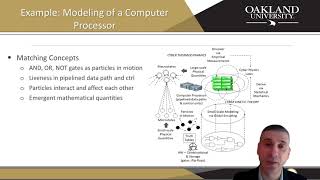
A Quest for the Physics of Cyberspace
Exploring the fundamental laws governing cyberspace dynamics through statistical physics and dynamical systems theory, with insights from hardware architectures and operating systems.
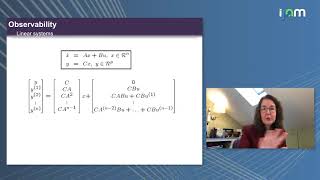
Analytical and Empirical Tools for Nonlinear Network Observability in Autonomous Systems
Explore nonlinear network observability in autonomous systems, covering analytical and empirical tools for sensor selection, network analysis, and applications in engineering and biology.

Learning-Based Model Predictive Control - Towards Safe Learning in Control
Explores integrating learning techniques with optimization-based control for safe, high-performance systems. Discusses methods for data-driven modeling, safety filters, and constraint satisfaction in robotics applications.
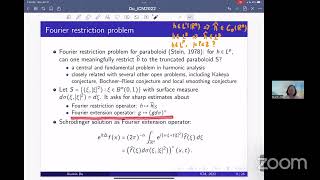
Weighted Fourier Extension Estimates and Applications
Explore weighted Fourier extension estimates and their applications in PDEs and geometric measure theory, covering topics like Fourier restriction, SME, and Falconer's distance set problem.
Private Learning of Gaussians and Their Mixtures
Explore private learning techniques for Gaussian distributions and mixtures, focusing on robust methods, hypothesis selection, and high-dimensional cases.
Misspecification, and Uncertainty Quantification in Differential Privacy
Explore differential privacy's theoretical guarantees, misspecification issues, and uncertainty quantification methods. Gain insights into designing mechanisms and addressing implementation challenges.
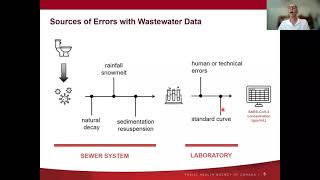
Wastewater-Based Modelling to Support COVID-19 Surveillance
Explore wastewater-based modeling for COVID-19 surveillance, covering viral concentration, error sources, data fitting, and practical applications in tracking pandemic waves.

What the Numbers Say - Endemicity - What’s Next?
Experts discuss COVID-19 endemicity, examining data-driven approaches to future outbreaks. Topics include variants, immunity, global perspectives, and policy challenges in transitioning to an endemic state.
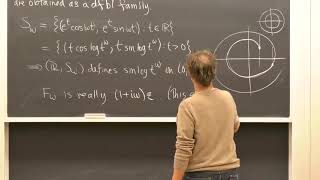
Tame Phenomena Over the Real Field - Lecture 6
Explore control theory concepts including flows, log spirals, limit cycles, and restricted analytic functions in this advanced graduate-level lecture on tame phenomena.

Modelling COVID-19 Vaccination and Immunity Panel Discussion
Expert panel explores COVID-19 vaccination strategies, immunity dynamics, and challenges in modeling the pandemic's long-term effects, offering insights for public health decision-making.
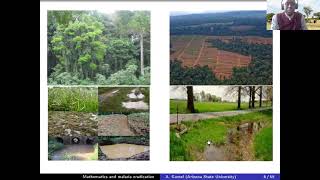
Mathematics of Malariology - The Renewed Quest for Eradication
Explore mathematical models for malaria eradication, covering vector-borne diseases, control methods, and innovative approaches like genetic epidemiology and biological control.
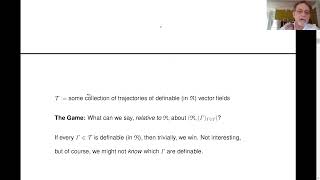
Tame Control Theory
Explore tame geometry in control theory, covering basic definitions, motivation, logic, and vector fields. Gain insights into descriptive set theory and generic structures.