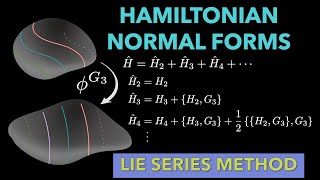
Hamiltonian Normal Forms, Lie Series Method for Transformations - Infinite-Dimensional Hamiltonians
Explore Hamiltonian normal forms, Lie series transformations, and infinite-dimensional systems. Learn to simplify complex dynamics and analyze PDEs like shallow water equations.
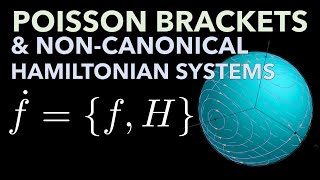
Poisson Brackets, Non-Canonical Hamiltonian Systems and Euler's Rigid Body Equations
Explore Poisson brackets, non-canonical Hamiltonian systems, and Euler's rigid body equations in this advanced dynamics lecture. Gain insights into abstract algebra, Lie algebra, and their applications in physics and mechanics.
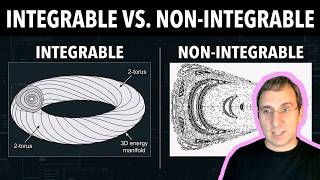
Integrable and Non-Integrable Hamiltonian Systems - KAM Tori - Poincare Sections - Poisson Brackets
Explore integrable and non-integrable Hamiltonian systems, KAM theory, Poincaré sections, and Poisson brackets in this advanced dynamics lecture, offering insights into complex nonlinear systems and their behavior.
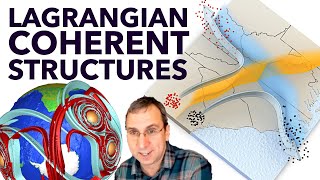
Lagrangian Coherent Structures Introduction
Explore Lagrangian coherent structures in fluid flows, revealing particle transport patterns. Learn theoretical foundations and applications in fluid mechanics, with insights on reduced order modeling.
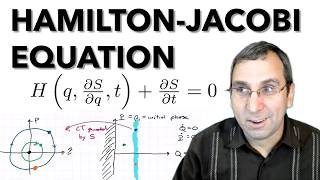
Hamilton-Jacobi Theory - Finding the Best Canonical Transformation + Examples
Explore Hamilton-Jacobi theory for optimal canonical transformations in Hamiltonian systems. Learn to solve the Hamilton-Jacobi equation and apply it to oscillators and central force problems.
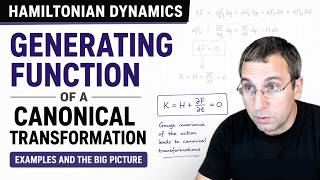
Generating Function of a Canonical Transformation - Examples and the Big Picture
Explore generating functions for canonical transformations in Hamiltonian systems. Learn about harmonic oscillator examples, near-identity transformations, and connections to quantum mechanics and gauge invariance.
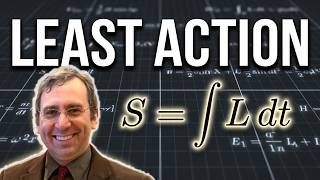
Principle of Least Action and Lagrange's Equations of Mechanics - Basics of Calculus of Variations
Explore variational principles in mechanics, including the Principle of Least Action and Lagrange's equations. Learn calculus of variations techniques and their applications in physics and engineering problems.
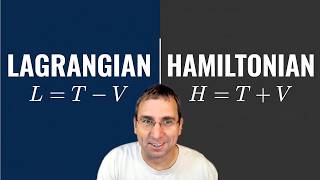
Hamiltonian Systems Introduction - Why Study Them?
Explore Hamiltonian systems and their advantages in mechanics. Learn about generalized momentum, canonical equations, and the transformation from Lagrangian to Hamiltonian formalism.
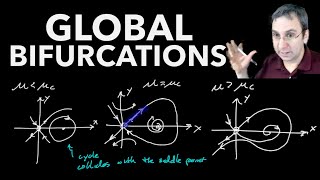
Bifurcations in 2D, Part 4 - Global Bifurcations, Limit Cycle Creation - Homoclinic Bifurcation
Explores global bifurcations in 2D systems, focusing on limit cycle creation through saddle-node, SNIPER, and homoclinic bifurcations. Examines universal behaviors and applications to biological systems.
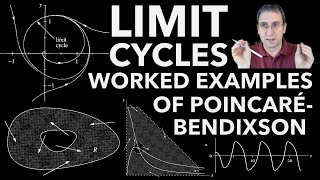
Limit Cycles - Poincare-Bendixson Worked Examples: Glycolysis
Explore Poincaré-Bendixson theorem applications in limit cycle analysis, including a glycolysis model. Learn to construct trapping regions using nullclines and understand parameter spaces for stable limit cycles.
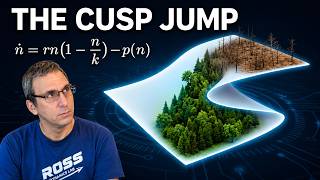
Insect Outbreak Model - A Cusp Catastrophe Population Dynamics Example
Explore insect outbreak modeling using cusp catastrophe theory, analyzing population dynamics, fixed points, and bifurcations in a budworm-fir tree ecosystem.
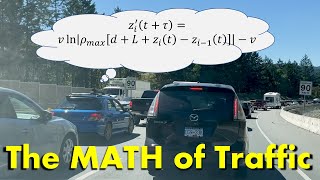
The Problem of Traffic: A Mathematical Modeling Journey
Explore mathematical modeling of traffic flow, from individual car behavior to stop-and-go patterns, using differential-delay equations. Learn about model building, assumptions, and solving complex real-world problems.

Basic Excel Business Analytics - Intro to Linear Programming Using Algebra, Pencil & Paper
Introduction to linear programming using algebra and graphing methods to solve manufacturing problems and maximize contribution margin, with focus on mathematical modeling and feasible region analysis.
Koopman Analysis
Explore advanced techniques in dynamical systems analysis, including Koopman theory, spectral analysis, and applications to control and chaos in various scientific domains.
Dynamical Systems
Explore advanced techniques in dynamical systems analysis, including SINDy, Koopman theory, and deep learning applications for modeling complex nonlinear systems.
Sparsity and Compression
Explore sparsity and compression techniques, from compressed sensing to robust regression, with practical applications in image processing, signal analysis, and machine learning.
Julia for Biologists - A Perspective on Speed, Abstraction, and Metaprogramming
Explore Julia's potential in biology: speed, abstraction, and metaprogramming for data analysis, modeling, and research. Learn practical examples and discover the Julia ecosystem for biologists.
Changing Physics Education with Julia
Revolutionizing physics education by integrating Julia programming, focusing on nonlinear dynamics. Demonstrates how coding enhances understanding, introduces interactive applications, and discusses benefits of real-world exercises.
Discrete and Continuous Mathematics - MIT Computational Thinking Spring 2021 - Lecture 14
Explore discrete and continuous mathematics, bridging concepts through indexing, function evaluation, area calculation, and random walks in computational thinking.
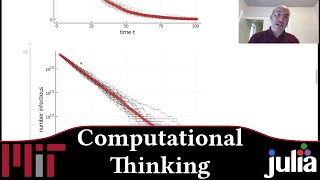
Macroscopic Models of Epidemic Dynamics - Week 6
Explore macroscopic epidemic models, transitioning from stochastic to deterministic approaches. Learn about SIR models, continuous-time dynamics, and differential equations in epidemiology.
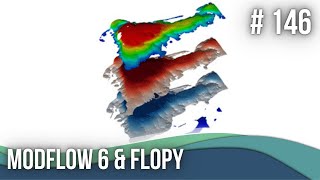
MODFLOW 6 and FloPy
Learn to create and analyze groundwater models using MODFLOW 6 and FloPy in Python. Covers model setup, visualization, water balance, pathlines, and transient simulations.