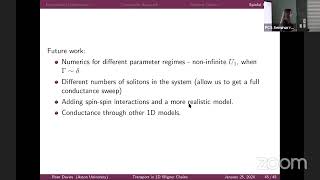
Resonant Fractional Conductance in 1D Wigner Chains
Explore resonant fractional conductance in 1D Wigner chains, focusing on quantum point contacts, fractionally charged solitons, and conductance patterns in spinless and spinful cases.
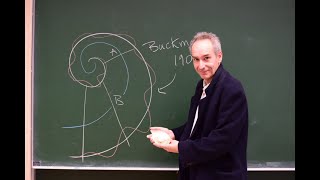
On Growth and Form and Mathematics: Reading D'Arcy Thompson 100 Years On - Rothschild Lecture
Explore the enduring impact of D'Arcy Thompson's "On Growth and Form" on modern science, examining its themes and relevance to understanding morphogenesis.
Evading Newton's Third Law to Set Patterns in Motion - Kirk Public Lecture
Explore how active matter systems evade Newton's third law, creating dynamic patterns in biological and synthetic systems. Gain insights into this cutting-edge field of physics.
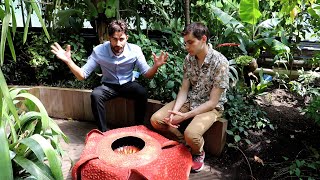
Plants and Mathematics - How Science Collaborates Through Botanical Research
Discover how mathematics and botany intersect in understanding the world's largest, smelliest flower through groundbreaking scientific collaboration and research methods.
Furstenberg Entropy Spectrum of Stationary Actions
Delve into advanced mathematical concepts of Furstenberg entropy spectrum, exploring ergodic stationary actions, Poisson bundles, and Nevo-Zimmer structure theorems in group dynamics.
Tipping Points in Cancer - Mathematical Oncology and Computational Biology
Explore the mathematical dynamics of cancer progression through computational analysis of fluid mechanics, biology, and critical transition points in tumor development.
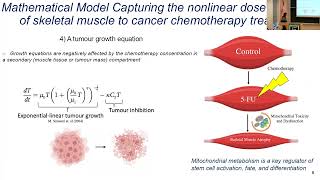
Chemotherapy-Induced Cachexia and Model-Informed Dosing to Preserve Lean Mass in Cancer Treatment
Explore mathematical modeling approaches for optimizing chemotherapy dosing to minimize muscle loss while maintaining effective cancer treatment strategies.
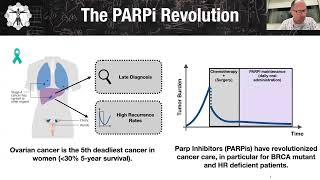
De-escalating PARP Inhibitor Maintenance Therapy in Ovarian Cancer Using Adaptive Therapy
Explore innovative approaches to PARP inhibitor maintenance therapy in ovarian cancer, focusing on adaptive treatment strategies and de-escalation methods for optimal patient outcomes.
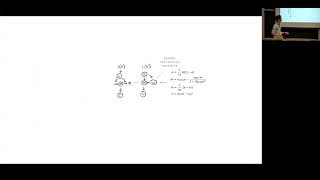
Balancing Interpretability and Predictive Accuracy in Mathematical Models of T Cell Activation
Explore mathematical modeling approaches for T cell activation, examining the trade-offs between model interpretability and accuracy in immunological systems.
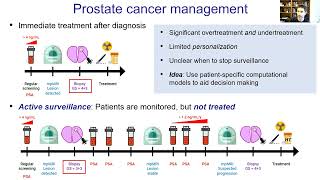
Prostate: Small Organ, Big Problems - Informing Clinical Decisions with Computational Models
Explore how computational models enhance clinical decision-making for prostate-related conditions through advanced mathematical and biological approaches.
Dynamical Systems and Reservoir Computing - Lecture 1
Explore dynamical systems and reservoir computing applications in climate network analysis, focusing on methods for understanding and predicting climate patterns and phenomena.
Dynamical Systems and Reservoir Computing - Lecture 2
Delve into dynamical systems and reservoir computing applications in climate networks, focusing on analysis methods, bifurcation behavior, and network characterizers for climate data organization.

A First-Principles Approach to Understanding Deep Learning
Delve into the fundamental principles of deep learning through statistical physics, exploring connections between neural networks, Gaussian processes, and scaling laws with insights from a DeepMind researcher.
Navigating, Restructuring and Reshaping Learned Latent Spaces
Explore advanced techniques for manipulating learned latent spaces in machine learning, focusing on navigation, restructuring, and reshaping methods for improved model performance and efficiency.
Python Physics: Numerical Modeling of a Chain Sliding Off a Table
Explore the physics of a sliding chain through numerical modeling in Python, demonstrating classical mechanics principles with practical code implementation and visualization.
Emerging Intelligence: From Neurons to Social Dynamics
Explore how internal psychological processes and social interactions shape collective behavior, from neural networks to group dynamics, through mathematical modeling and behavioral theory.
Towards Data-Driven Biological Physics: Learning the Dynamics of Pattern-Forming Systems - Class 1
Explore data-driven approaches in biological physics, focusing on pattern formation dynamics and learning systems through advanced analytical methods and real-world applications.
Towards Data-Driven Biological Physics: Learning the Dynamics of Pattern-Forming Systems - Class 2
Delve into data-driven biological physics principles and pattern formation systems, exploring dynamic learning approaches for understanding complex biological phenomena and their mathematical foundations.

Mathematical Modelling of Microtube Driven Invasion of Glioma
Explore mathematical modeling techniques for understanding glioma invasion through microtubes, featuring advanced research insights and theoretical frameworks for cancer progression analysis.
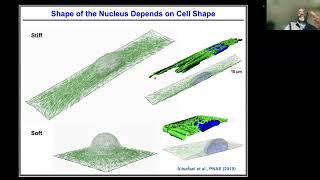
How Does the Tumor Microenvironment Regulate Genome Organization of Cancer Cells?
Explore the complex relationship between tumor microenvironments and cancer cell genome organization through mathematical modeling and cutting-edge research insights.
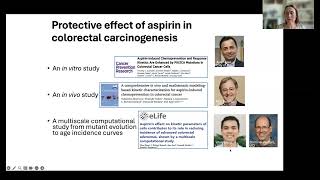
Protective Effect of Aspirin in Colorectal Carcinogenesis
Explore the mathematical modeling of aspirin's protective mechanisms in colorectal cancer development through advanced analytical approaches and research findings.