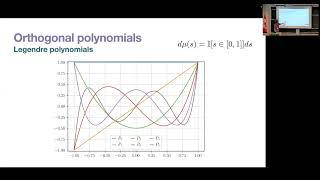
Anamnesic Neural Differential Equations with Orthogonal Polynomial Projections
Explore innovative neural differential equations using orthogonal polynomial projections for enhanced machine learning in dynamical systems.

Embedding Fairness into Pricing Algorithms for Vehicle Sharing Systems
Explore fairness in pricing algorithms for vehicle sharing, examining how different fairness notions impact rider surplus and access across various groups and locations.
Improved Precision Scaling for Simulating Coupled Quantum-Classical Dynamics
Explore advanced techniques for simulating quantum-classical dynamics, focusing on improved precision scaling methods and their applications in quantum information research.
Neural Networks - Lecture 1
Comprehensive introduction to neural networks, covering fundamental concepts, architectures, and applications in machine learning and artificial intelligence.
A Computational Framework for Solving Wasserstein Lagrangian Flows
Explore a computational framework for solving Wasserstein Lagrangian flows, covering optimal transport variations and applications in single-cell trajectory inference.
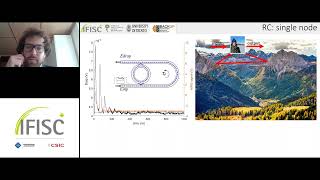
Experimental Investigation of a Microring-Based Time-Delay Reservoir Computing
Explore microring-based time-delay reservoir computing through experimental investigation, delving into advanced concepts and practical applications in photonic computing.
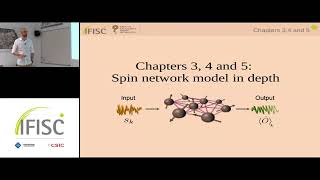
Reservoir Computing in Quantum Systems
Explore quantum reservoir computing, its applications, and potential for enhancing machine learning in quantum systems.
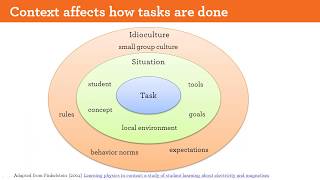
Teaching the Whole Physics Student
Practical strategies for integrating career-relevant skills into physics education, supporting students holistically as they pursue diverse 21st-century careers in industry and academia.
Fairness, Rankings, and Behavioral Biases
Exploring fairness in ranking systems, behavioral biases, and interventions to improve diversity and equity in selection processes through mathematical modeling and analysis.

Computation in the Brain Tutorial - Part 2
Explore neural computation models, focusing on assembly calculus and its applications in language processing, with insights from leading researchers in computational neuroscience.
Modelica - Component Oriented Modeling of Physical Systems
Explore component-oriented modeling of physical systems using Modelica, a language for simulating complex devices in various industries. Learn about compilation processes and algorithms.
Cyber Insurance - Technical Challenges and a System Security Roadmap
Explore cyber insurance's growth, challenges, and future directions. Discover how data-driven methodologies and automated tools can enhance risk assessment and management in this evolving field.

Using Maths to Save the Planet
Discover how mathematical modeling predicts ocean pollution patterns, enabling targeted cleanup efforts and environmental protection. Learn to apply these problem-solving techniques to various real-world challenges.
Programming Systems for Analog Hardware
Explore analog computing platforms and learn techniques for mapping programs to these substrates. Discover challenges, solutions, and potential applications in this emerging field of computational hardware.

Epidemics and the End of Humankind
Explore infectious disease modeling with Dr. Rosalind Eggo as she examines past pandemics, explains key concepts, and discusses the potential for future outbreaks using science and humor.
Analysis and Applications of Nonlocal Models
Explore nonlocal models in mathematics, their analysis, and applications. Learn about nonlocal vector calculus, operators, and numerical solutions for finite-range interactions.

Modeling of Viral Zoonotic Infectious Diseases from Wildlife to Humans
Explore mathematical modeling of zoonotic diseases, from wildlife reservoirs to human spillover. Learn about Markov chains, branching processes, and their applications in predicting disease transmission patterns.
Essentials of Math Modeling - Introduction to Regression and Statistical Ideas
Explore linear regression, data transformations, and statistical concepts in mathematical modeling. Learn MATLAB examples, sensitivity analysis, and problem-solving techniques for real-world applications.
Essentials of Math Modeling - Session 5 - Probabilistic Models
Explore probabilistic models, including Markov chains and Metropolis-Hastings algorithm, with practical exercises and problem-solving sessions using MATLAB for mathematical modeling applications.
Essentials of Math Modeling - Model for Disease Spread, Difference, and Differential Eqs
Explore mathematical modeling for disease spread using difference and differential equations. Learn stage-structured models, solution methods, and practical applications through examples and problem-solving sessions.
Essentials of Math Modeling - Intro to Data Analysis Using MATLAB and Excel
Learn data analysis techniques using MATLAB and Excel, covering SI models, plotting, data importing, and problem-solving with real-world examples from mathematical modeling challenges.