Quantum Chaos and Eigenstate Thermalization - Lecture 3
Explore quantum chaos, eigenstate thermalization, and their applications in various systems, including spin systems and classical limits.
Structural Instabilities of Ecosystem Dynamics
Explore ecosystem dynamics and structural instabilities with insights from mathematical modeling and ecological theory. Gain understanding of complex environmental systems.
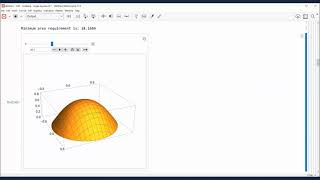
Ecological Release and Patch Geometry in Density-Area Relationships - Wolfram Guest Speaker Series
Explore ecological release and patch geometry's impact on density-area relationships through research findings, mathematical models, and real-world examples of species interactions.
The Open Toda Chain with External Forcing
Explore the open Toda chain with external forcing, examining stretching and compressing effects. Learn about complete integrability and Juergen Moser's observation in this mathematical analysis.
Direct and Inverse Scattering for the Ultradiscrete KdV Equation
Explore direct and inverse scattering methods for solving the ultradiscrete KdV equation, including the Takahashi-Satsuma Box & Ball system, using Darboux transformations and eigenfunctions.
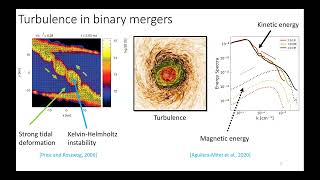
Modeling the Kelvin-Helmholtz Instability in BNS Mergers
Explore advanced modeling techniques for Kelvin-Helmholtz instability in binary neutron star mergers, enhancing understanding of gravitational wave sources and astrophysical phenomena.
Poisson-Lie Analogues of Spin Sutherland Models
Explore finite dimensional integrability in mathematical physics, focusing on Poisson-Lie analogues of spin Sutherland models.
Lifting Hamiltonian Torus Actions to Integrable Systems
Explore finite dimensional integrability in mathematical physics, focusing on lifting Hamiltonian torus actions to integrable systems.
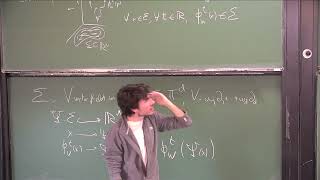
Quasiperiodicity and Chaos in the Incompressible Euler Equation
Explore quasiperiodicity and chaos in incompressible Euler equations through analytic techniques in dynamics and geometry.
Mechanisms of Offshore Solid and Liquid Freshwater Flux from the East Greenland Current
Explore mechanisms controlling freshwater export from East Greenland Current using numerical models and scaling theory. Analyze offshore ice flux, liquid freshwater flux, and key parameters influencing these processes.
Modeling Density-Driven Flows in the Presence of Chaotic Advection
Explore a hybrid kinematic-dynamic model for density-driven flows, combining traditional Stommel Box and chaotic advection approaches to study oceanic feedback processes.
Mathematical Fluid Dynamics of Atmospheric and Oceanic Flows
Explore mathematical fluid dynamics for atmospheric and oceanic flows, focusing on thin-shell approximation in rotating spherical coordinates and perturbation theory for atmospheric modeling.
Nonequilibrium: From Heat Conduction to Turbulence and Life - Rothschild Lecture
Explore nonequilibrium phenomena from heat conduction to turbulence, with insights on mathematical approaches and potential applications to life systems.
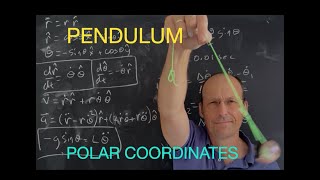
Classical Mechanics: Pendulum in Polar Coordinates - Python Modeling
Explore pendulum motion using polar coordinates and Newton's second law, with Python implementation for practical modeling.
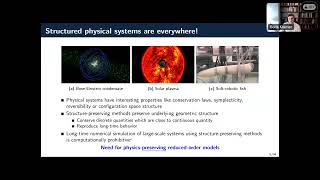
Structure-Preserving Learning of High-Dimensional Lagrangian and Hamiltonian Systems
Explore structure-preserving learning for high-dimensional Lagrangian and Hamiltonian systems, focusing on reduced-order models in mechanics, robotics, and wave propagation for enhanced stability and predictive accuracy.

Maximum Range Launch Angle for a Football - Python Simulation
Explore optimal football launch angles using Python, considering gravity and air resistance for maximum range.
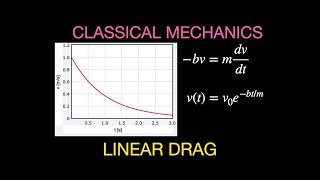
Classical Mechanics: Linear Drag without the Gravitational Force
Derive motion equations for objects with velocity-proportional drag, excluding gravity. Includes numerical modeling and Python code for practical application.
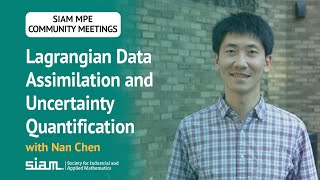
Exploring Lagrangian Data Assimilation: Methods and Uncertainty - SIAM MPE Community Meeting
Explore Lagrangian data assimilation methods and uncertainty in fluid dynamics. Learn about ensemble techniques, analytical solutions, and optimal tracer deployment for improved state estimation.
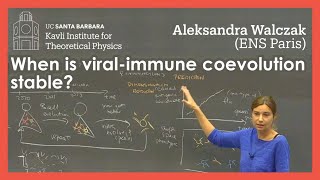
When is Viral-Immune Coevolution Stable?
Explore viral-immune coevolution stability through a theoretical physics lens, examining cross-disciplinary insights and implications for understanding complex biological systems.
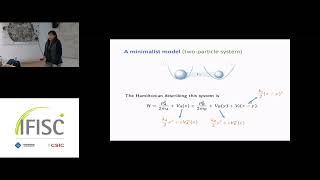
Modeling a Minimal Thermal Diode
Explore thermal diode modeling, energy transfer mechanisms, and rectification principles in interdisciplinary physics systems through simulations and practical examples.
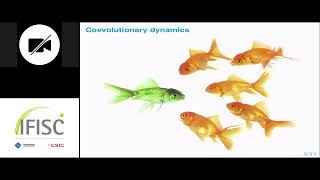
Beyond Simple Dynamics - Coevolutionary Dynamics
Explore coevolutionary dynamics in complex systems, advancing beyond simple dynamics to understand intricate interactions and emergent behaviors in interdisciplinary contexts.