Mesoscale and Submesoscale Ekman Pumping in a Turbulent Ocean - Lecture 2
Explores mesoscale and submesoscale Ekman pumping in turbulent oceans, examining dynamics, energy transfers, and interactions across scales in geophysical fluid systems.
A Spectral Framework for Constraining Anisotropic Eddy Viscosity - Lecture 2
Explores a spectral framework for constraining anisotropic eddy viscosity in geophysical fluid dynamics, focusing on advanced modeling techniques and their applications in understanding complex oceanic and atmospheric processes.
Diapycnal Mixing in the Coastal Ocean
Explore diapycnal mixing in coastal oceans: mechanisms, impacts, and latest research findings on this crucial process affecting ocean dynamics and climate.
Unraveling the Dynamical Interactions Between Mesoscales and Submesoscales in Geophysical Fluid Dynamics
Explore dynamical interactions across oceanic scales, focusing on energy transfers, turbulent mixing, and instabilities. Learn cutting-edge techniques in geophysical fluid dynamics and climate modeling.
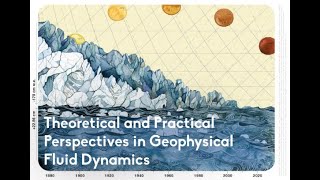
Meso- to Submesoscale Turbulence in the Ocean - Lecture 2
Explores meso- to submesoscale ocean turbulence, focusing on energy transfers, instabilities, and mixing processes. Examines theoretical frameworks and observational insights to enhance understanding of multi-scale oceanic dynamics.
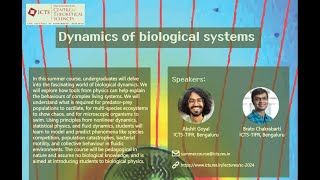
Dynamics of Biological Systems - Lecture 4
Explore biological dynamics using physics tools to model predator-prey oscillations, ecosystem chaos, and microbial swimming. Learn to predict species competition, population changes, and collective behavior in fluids.
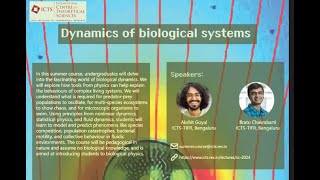
Dynamics of Biological Systems - Lecture 1
Explore biological dynamics using physics tools to model complex living systems, from predator-prey oscillations to bacterial motility, in this introductory course for undergraduates.
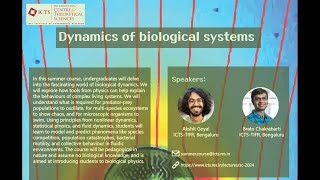
Dynamics of Biological Systems - Lecture 2
Explore biological dynamics using physics tools to model predator-prey oscillations, ecosystem chaos, and microbial swimming. Learn to predict species competition, population changes, and collective behavior in fluids.
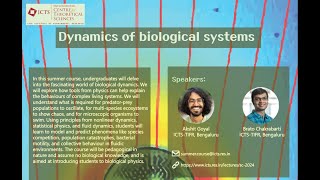
Dynamics of Biological Systems - Lecture 3
Explore biological dynamics using physics tools to model predator-prey oscillations, ecosystem chaos, and microbial swimming. Learn to predict species competition, population changes, and collective behavior in fluids.
Data Assimilation and Dynamical Systems in Earth Sciences - Lecture 2
Explore data assimilation in Earth sciences, focusing on dynamical systems and their applications in weather and climate modeling. Learn theoretical foundations and practical implementations.
Data Assimilation and Dynamical Systems in Earth Sciences
Explore data assimilation in Earth sciences, covering theory, methods, and applications in weather, climate, and environmental monitoring. Gain hands-on experience with various techniques and uncertainty estimation.
Data Assimilation - Basic Theory
Explore fundamental concepts and methods of data assimilation in weather and climate modeling, including uncertainty estimation and applications in atmospheric and oceanic sciences.
Data Assimilation and Dynamical Systems in Earth Sciences - Lecture 3
Explore data assimilation theory and applications in Earth sciences, focusing on dynamical systems. Gain hands-on experience with practical techniques for integrating observations and forecasts in weather and climate models.
Data Assimilation Experiments for Operational Weather Forecast in NARL
Explore data assimilation techniques for operational weather forecasting, focusing on experiments conducted at NARL. Learn about integrating observations and short-range forecasts to improve atmospheric state estimation.
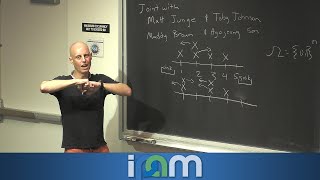
The Density Conjecture for Activated Random Walk
Explore self-organized criticality in activated random walk models, examining critical densities across various configurations and their implications for understanding energy release patterns in physical systems.
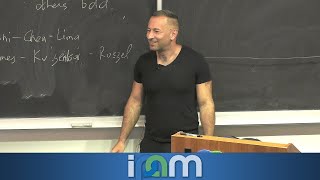
Interacting Polya Urns - Statistical Mechanics Beyond 2D
Explore interacting Polya urns on graphs, their asymptotic behavior, and convergence to equilibrium in this statistical mechanics presentation by Omer Angel at UCLA's IPAM workshop.
Data Assimilation - Basic Theory - Lecture 2
Explore advanced data assimilation theory, methods, and applications in weather and climate modeling. Gain insights into uncertainty estimation and remote sensing observation utilization.
Data Assimilation - Basic Theory - Lecture 1
Explore fundamental concepts and theory of data assimilation in weather and climate modeling, focusing on its applications in atmospheric and oceanic sciences.
The Balance Conundrum in Geophysical Fluid Dynamics
Explore geophysical fluid dynamics, covering eddies, waves, turbulence, and energy transfers in Earth's climate. Gain insights from theory, models, and observations, with tutorials on visualization and machine learning.
Exploring Internal Gravity Wave Interactions with Eddies and Waves
Investigación sobre interacciones entre ondas de gravedad internas, remolinos y otras ondas en fluidos geofísicos, examinando su impacto en la dinámica atmosférica y oceánica.
Impact of a Mesoscale Eddy on the M2 Internal Tide in 5km ICON-O
Explore the influence of mesoscale eddies on M2 internal tides using high-resolution ICON-O simulations. Gain insights into complex ocean dynamics and energy transfers in geophysical fluid systems.