
Oxford Calculus - Heat Equation Derivation
Comprehensive derivation of the Heat Equation from physical principles, including Liebniz Rule and Fourier's Law. Extends to 2D and 3D applications with interactive exercises for practice.

Oxford Mathematician Explains SIR Travelling Wave Disease Model for COVID-19
Explore the SIR Travelling Wave model for disease spread, focusing on COVID-19. Learn how population movement affects epidemic dynamics, including spread speed and severity, and the importance of social distancing measures.

Oxford Mathematician Explains SIR Disease Model for COVID-19
Explore the SIR disease model's application to COVID-19, covering its derivation, spread prediction, peak infection, and total cases. Learn how social distancing impacts these factors.
What's the Point of Mathematics? - Mathematical Modeling Applications
Explore the real-world applications and significance of mathematics with Dr. Nira Chamberlain, a renowned expert in mathematical modeling across various industries.
Fractals and Multifractals in Geophysics - Lorenz Lecture
Explore fractals and their applications in geophysics with renowned mathematician Benoit Mandelbrot in this historic AGU Fall Meeting lecture from 2001.

Modelling Embryo Elongation and Somitogenesis
Explore embryo elongation and somitogenesis modeling, focusing on developmental biology concepts and computational approaches to understand early vertebrate embryo formation.
Stability of Amenable Groups - Uncountably Many Examples and Connections to Dynamical Systems
Explore amenable group stability, uncountable examples, and dynamical systems connections in this advanced mathematics talk by Itamar Vigdorovich from the Weizmann Institute of Science.
Cancer - Introduction and Clinical Challenges by Sudha Sundar
Comprehensive overview of cancer, exploring its clinical challenges and introducing potential applications of machine learning in oncology research and patient care.
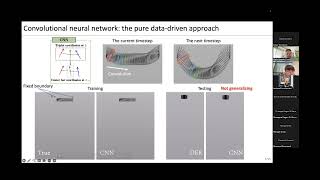
Promoting Data-Efficiency of Deep Learning for Dynamical Systems
Exploring data-efficient deep learning for dynamical systems using Euclidean symmetric neural networks, demonstrated on a 3D Slinky model for accelerated simulation and generalization.
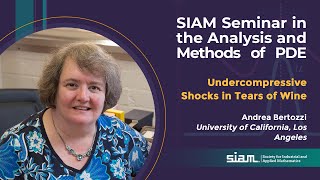
Seminar in the Analysis and Methods of PDE - Andrea Bertozzi
Explore the physics behind "tears of wine" phenomenon, examining undercompressive shocks in thin films and their role in the formation of wine tears using mathematical modeling and analysis.
The Most Fundamental Problem in Mathematics - Famous Math Problems 19a
Explore the fundamental problem of modeling the continuum in mathematics, examining its historical significance, practical applications, and implications for various mathematical areas.
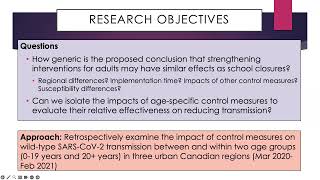
Retrospective Modelling Analysis on the Effects of Control Measures on COVID Transmission in Canada
Explore the impact of COVID-19 control measures in Canada through retrospective modeling analysis, examining transmission patterns and effectiveness of interventions.
Understanding Tumour Responses to Radiotherapy Using Mathematical Models - Lecture 2
Explores mathematical modeling of tumor responses to radiotherapy, focusing on theoretical approaches to understand and predict treatment outcomes in cancer progression.
Mathematical and Computational Modelling to Explore Various Potential Cancer Treatments
Explore mathematical and computational modeling approaches for cancer research, covering topics from age-structured populations to machine learning techniques for understanding disease progression and treatment.
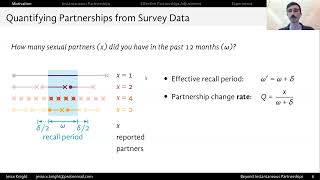
Re-examining the Force of Infection Equation in Compartmental HIV Transmission Models
Explore innovative approaches to HIV transmission modeling, focusing on the force of infection equation and its implications for public health strategies and interventions.
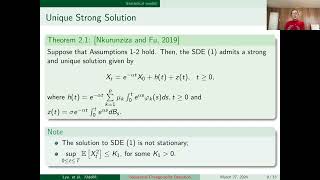
Sequential Change-point Detection in Stochastic Differential Equations
Explore advanced techniques for detecting change-points in stochastic differential equations, focusing on sequential methods and their applications in statistical analysis.
Well Posedness for Hamilton-Jacobi Equations for Linearly Controlled Gradient Flows
Explore well-posedness of Hamilton-Jacobi equations for linearly controlled gradient flows, examining mathematical foundations and applications in optimization and control theory.
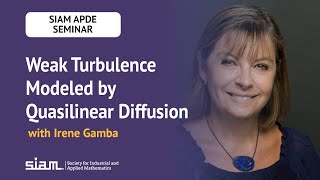
Decoding Plasma Turbulence Dynamics with Irene Gamba
Explore quasilinear diffusion models for plasma systems, focusing on their emergence from equilibrium states and the validity of ergodic approximations. Gain insights into instabilities and analytical solutions.

Chance to See Life - Expressing the World Through Probability
Exploring mathematical models and probability to interpret the world, blending quantitative analysis with human nature insights for a unique perspective on life and investment.
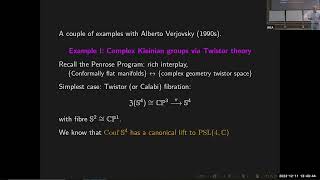
Discrete Group Actions on the Complex Projective Plane CP^2
Explore discrete group actions on CP^2, extending classical Kleinian group theory to higher dimensions. Gain insights into complex geometry and holomorphic dynamics.
The Random Friend Tree by Serte Donderwinkel
Explore the Random Friend Tree model in network science, examining its structural properties, dynamics, and applications in social networks and complex systems.