Convex Optimization I - Lecture 12
Explore advanced convex optimization techniques with Stanford's Stephen Boyd. Delve into complex mathematical concepts and their practical applications in engineering and data science.

Convex Optimization I - Lecture 11
Explore advanced convex optimization techniques with Stanford's Professor Stephen Boyd, focusing on practical applications and theoretical foundations in electrical engineering.
Underactuated Robotics - Spring 2009
This course discusses nonlinear dynamics and control of underactuated mechanical systems, with an emphasis on machine learning methods.
Evolutionary Game Theory: Fighting and Contests - Lecture 33
Explore how game theory applies to evolution and behavior, analyzing encounters between organisms as mathematical games to infer fitness payoffs and strategy proportions in populations.
Engineering Mathematics
Explora matemáticas avanzadas en ingeniería mecánica, desde ODEs y sistemas dinámicos hasta transformadas de Fourier y Laplace, con aplicaciones prácticas en Matlab y análisis de sistemas no lineales.

The Mechanical Universe
Comprehensive exploration of physics principles, from classical mechanics to quantum theory, using visual aids and mathematical concepts to illuminate the workings of the universe.
Topics in Nonlinear Dynamics
Explore nonlinear dynamics through critical points, Hamiltonian systems, bifurcations, limit cycles, discrete-time dynamics, and stochastic processes. Gain insights into complex system behaviors and analysis techniques.
Topics in Nonlinear Dynamics
This is a basic course in classical mechanics at the senior undergraduate/ master's level. It covers the standard topics in this subject, including the Lagrangian and Hamiltonian formalisms. It also places the subject in the broader context of classical…
Nonlinear Dynamics and Chaos
Explore nonlinear dynamics and chaos through analytical methods, examples, and applications in physics, biology, and engineering. Develop mathematical theory and gain insights into complex systems behavior.
Sidney Redner on Statistics and Everyday Life
Explore everyday phenomena through statistical analysis, revealing hidden patterns in parking, elevators, and sports. Learn how complex systems research uncovers universal principles in daily life.
Collective Behavior of Honeybees & Fireflies
Explore collective behavior in honeybees and fireflies, revealing how diversity and self-organization lead to emergent intelligence and adaptive swarm dynamics in insect communities.
Exponentials, Economics, and Ecology with David Krakauer
Explore exponential changes, nonlinear dynamics, and interconnected systems in ecology and economics. Gain insights on aligning individual and public good in a complex world.

Environment X Everything Interactions - From Evolution to Epidemics and Beyond
Explore environment-actor interactions across various fields, from evolution to epidemics, using mathematical frameworks and simulations to understand complex systems and their impacts.
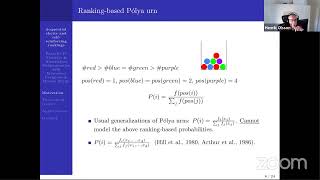
Sequential Choice and Self-Reinforcing Rankings
Explore the mathematical consequences of choice systems where option rankings influence selection probabilities, and popularity determines rankings, leading to potential convergence and unpredictability.
The Science of Pandemics - C4 Public Lecture
Explore global pandemics, influenza threats, and the role of mathematical modeling in disease surveillance and control through advanced computing techniques.
Demonology - Intelligence in Physics & Biology
Explore the historical role of intelligence in physics and biology, from Laplace's demon to modern information theory, and its implications for understanding natural phenomena.
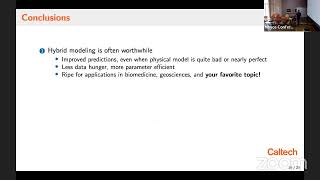
A Framework for Machine Learning of Model Error in Dynamical Systems
Explore a framework for machine learning to model error in dynamical systems, focusing on linear oscillators, partial information, and hybrid modeling techniques.
Transient Dynamics - The Key to Ecological Understanding - Alan Hastings, SFI + UC Davis
Explore transient dynamics in ecology, challenging classical theory focused on long-term behavior. Examine implications for modeling, management, and understanding complex ecological systems.
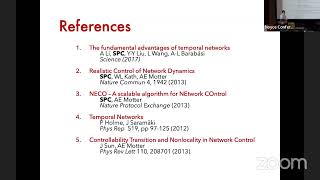
The Power of Temporal Networks
Explore how time-varying networks offer advantages in controllability, cooperation, and synchronization, challenging traditional views on network analysis and dynamics.
Using Curvature to Understand the Structure of Dynamics
Explore curvature's role in understanding attractor dynamics and its application in time-series data reconstruction, focusing on optimal time-delay parameter selection for delay-coordinate embeddings.
The Swine Flu and You: Predicting and Controlling the H1N1 Pandemic
Explore the H1N1 pandemic: its impact, control strategies, and mathematical modeling for prediction and prevention. Learn about public health responses and the science behind epidemic management.