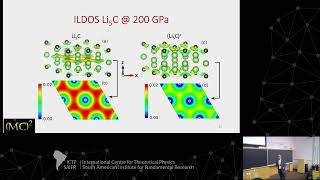
Search for New Electride High Temperature Superconductors
Explore cutting-edge research on electride high-temperature superconductors, focusing on the search for novel materials with potential technological applications.
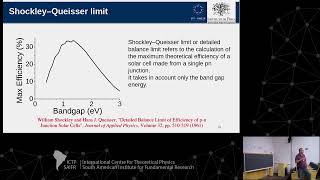
2D Materials for Photovoltaic Energy Harvesting
Explore 2D materials for photovoltaic energy harvesting, focusing on semiconductors, TMDCs, excitons, and computational parameters for maximum efficiency in solar technology.
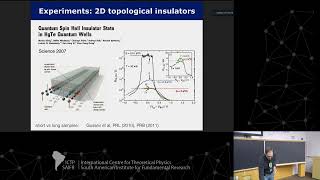
Topological Phase Transitions in Strongly Disordered and Amorphous Systems
Explore topological phase transitions in disordered systems, focusing on graphene, spinless models, and experimental insights. Gain understanding of mechanisms and disorder effects.
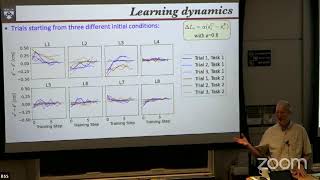
Autonomous Learning Metamaterials III - July 26, 2024
Explore advanced concepts in autonomous learning metamaterials, focusing on cutting-edge developments and future applications in materials science.
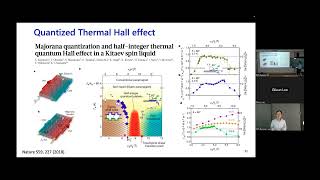
Structure and Magnetic Anisotropy of Alpha-RuCl3
Explore alpha-RuCl3's structure and magnetic properties, focusing on Kitaev interactions and quantum spin liquid states. Gain insights into recent experimental findings using high-quality samples.
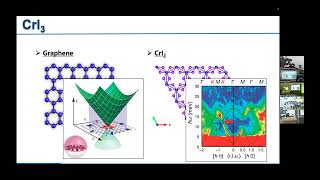
Magic Angle of Moire Magnetic Materials
Explore the emergence of flatbands in twisted bilayer magnetic materials and their impact on magnon behavior, contrasting with electronic flatbands in graphene.
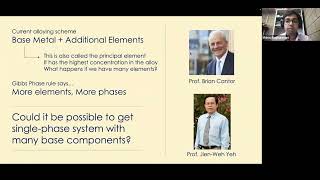
An Introduction to High Entropy Alloys
Explore alloy phases and high entropy alloys in this beginner-friendly introduction, covering fundamental concepts and applications.
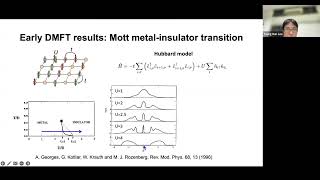
An Efficient and Accurate Approach to Strongly Correlated Materials
Explore an enhanced method for simulating strongly correlated materials using ghost-rotationally-invariant slave-boson (g-RISB) approach, improving accuracy in describing material properties with realistic parameters.
New Platforms for Two-Dimensional Electron Gases in Quantum Computing - Quantum Today
Explore new platforms for two-dimensional electron gases in quantum computing, focusing on Indium Antimonide's potential for topological quantum computing applications.
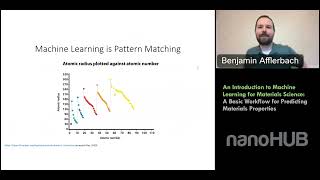
Introduction to a Basic Machine Learning Workflow for Predicting Materials Properties
Learn a basic machine learning workflow for predicting material properties, covering data cleaning, feature engineering, model training, and optimization using decision trees to forecast material bandgaps from compositions.
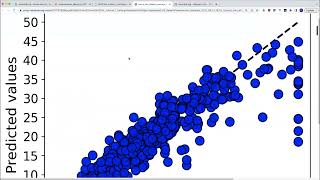
The Materials Simulation Toolkit for Machine Learning (MAST-ML): Automating Development and Evaluation of Machine Learning Models for Materials Property Prediction
Automate machine learning model development for materials property prediction using MAST-ML. Learn data import, feature engineering, model evaluation, and uncertainty quantification through hands-on activities.
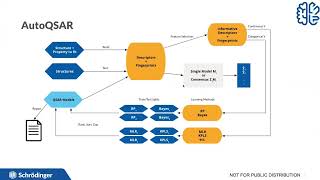
Machine Learning Models for Ionic Conductivity with Schrödinger's AutoQSAR - Hands-On Workshop
Explore machine learning for ionic conductivity prediction using Schrödinger's AutoQSAR tool. Gain hands-on experience with MS Maestro interface to create and implement models for materials science applications.
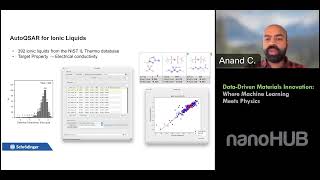
Data-Driven Materials Innovation: Where Machine Learning Meets Physics
Explore how machine learning and physics-based methods synergize to revolutionize materials science, addressing challenges in data-driven design across various technology fields with Schrödinger's innovative tools.
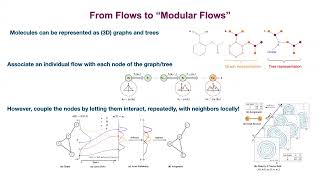
New Frontiers for AI-assisted Design and Discovery in Molecular Generation
Explore AI-assisted design for generating molecules with desired properties. Learn about overcoming challenges in combinatorial search, modeling interactions, and segregating representations for improved drug and material discovery.
New Frontiers for AI-assisted Design and Discovery in Molecular Generation
Explore AI-assisted design and discovery for generating molecules with desirable properties. Learn about overcoming challenges in combinatorial space, modeling interactions, and segregating representations for improved drug and material development.

Statistical Rule Learning for Materials Science
Explore statistical rule learning for materials science, focusing on interpretable modeling and data-driven knowledge discovery to improve machine learning models and drive hypothesis formulation.
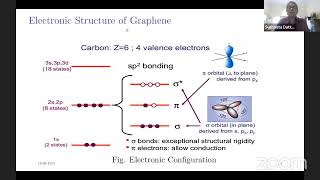
Spin-Boson Model for Nonlinear Optical Conductivity of Graphene
Explore graphene's quantum properties and nonlinear optical conductivity using spin-boson model. Analyze electronic configuration, hybridization, and optical absorption beyond linear regime through quantum mechanics and statistical mechanics.
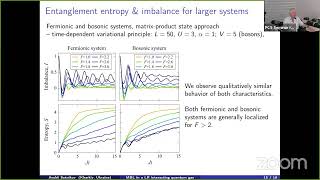
Many-Body Localization in Wannier-Stark Ladders with Long-Range Interactions
Explore many-body localization in quantum lattice systems with long-range interactions and linear external potential. Analyze phase diagrams and system dynamics using numerical approaches.
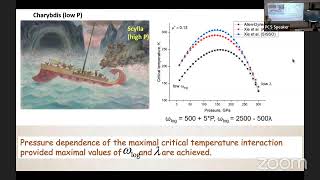
Electron-Phonon Interaction in Metals: Limits and Implications
Explore the limits of electron-phonon interaction in metals, its impact on superconductivity, and potential metal-insulator transitions through advanced theoretical analysis.
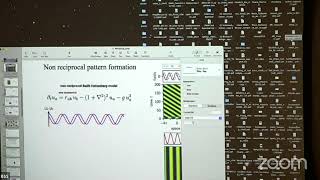
Odd Elasticity and Non-Reciprocal Phase Transitions - Lecture 3
Explore odd elasticity and non-reciprocal phase transitions in advanced physics, delving into complex theoretical concepts and their applications.
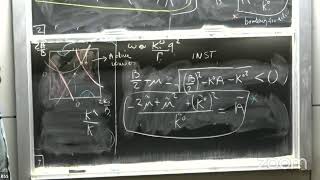
Odd Elasticity and Non-Reciprocal Phase Transitions - Part II
Explore odd elasticity and non-reciprocal phase transitions in advanced physics, delving into complex theoretical concepts and their applications.