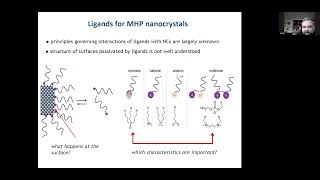
Нанокристали свинцево-галогенідного перовскіту як колоїдні наноточки: теорія, комп'ютерні симуляції та застосування
Dive into the theoretical physics and computer simulations of lead-halide perovskite nanocrystals as colloidal quantum dots, exploring their properties and practical applications.
Identification of Building Thermal Model Using Data Science Tools
Discover how to create building thermal models using data science tools instead of complex mathematical approaches, streamlining the process for efficient control algorithm implementation.

New Developments in Wolfram Chemistry
Explore upcoming Wolfram Language chemistry features, including enhanced molecular visualization, crystal structures, and biomolecule representation. Learn about ChemistryFunctions paclet for dynamic manipulation and analysis.
Zentropy Theory: Predicting Macroscopic Properties and Emergent Behaviors in Materials
Explore zentropy theory's integration of statistical and quantum mechanics to predict emergent behaviors in magnetic and ferroelectric materials, including critical point singularities and cross-phenomena coefficients.
Designing the Morphology of Separated Phases in Multicomponent Liquid Mixtures
Explore algorithms for constructing phase diagrams and predicting morphology in multicomponent liquid mixtures, with applications from industry to cellular biology.
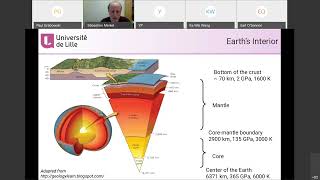
Materials Microstructures in High Pressure Experiments
Explore materials microstructures under extreme pressure conditions, gaining insights into their behavior and properties in high-energy-density states.
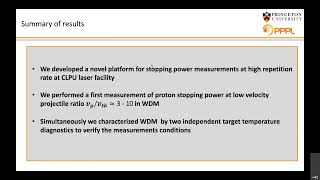
Low-Velocity Proton Stopping Power Measurement in Warm Dense Matter
Explore low-velocity proton stopping power in Warm Dense Matter through cutting-edge measurements and analysis techniques.
Ontologies, Graph Deep Learning, and AI in Materials Science
Explore ontologies, graph deep learning, and AI in materials science, focusing on advanced manufacturing and synchrotron science. Learn about innovative approaches for multimodal analysis and decision-making.
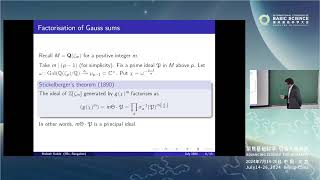
Mathematical Theories for Metamaterials: From Condensed Matter Theory to Subwavelength Physics
Explore mathematical theories for metamaterials, bridging quantum and classical physics to revolutionize nanotechnology and subwavelength wave manipulation.
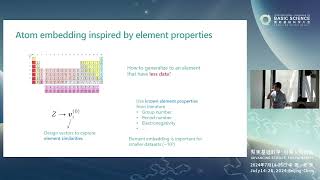
Accelerating Materials Design with Crystal Graph Neural Networks
Explore Crystal Graph Convolutional Neural Networks for predicting material properties and their impact on graph neural networks and transformers in materials design.
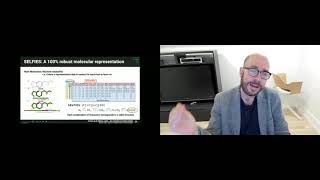
Artificial Intelligence for Molecular Design and Self-Driving Labs
Explore AI and automation for designing functional molecular materials, focusing on recent advancements in the field.
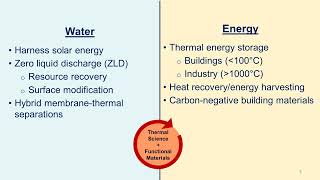
Composite Materials for Energy-efficient Buildings: Thermal Energy Storage and Sustainable Construction
Explore composite materials for energy-efficient buildings, focusing on thermochemical energy storage and wood-based structures to reduce carbon emissions and enhance thermal performance.
Towards QMCPACK v4
Explore advancements in quantum Monte Carlo simulations with QMCPACK v4, focusing on new features and improvements for computational materials science research.
Accurate Electronic and Magnetic Properties of 2D Materials Using Quantum Monte Carlo Methods
Explore quantum Monte Carlo methods for precise electronic and magnetic property calculations in 2D materials with Daniel Wines from NIST.
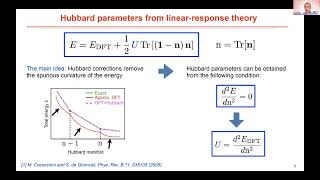
First-Principles Calculation of Hubbard Parameters Using Linear-Response Theory - Tutorial 2022
Learn advanced techniques for calculating Hubbard parameters using linear-response theory in DFT+U(+V) approach. Explore applications in materials science, including battery voltages and vacancy formation energies.
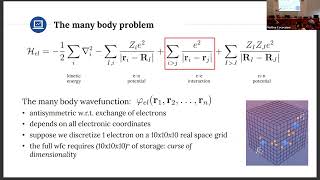
Introduction to Density-Functional Theory - QE School 2023 Lecture 1.2
Explore density-functional theory fundamentals, focusing on Hubbard and Koopmans functionals from linear response in advanced quantum calculations.
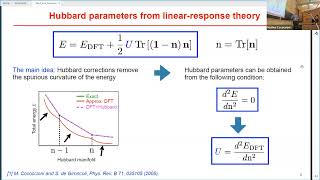
First-Principles Calculation of Hubbard Parameters Using Linear-Response Theory - QE School 2023
Explore first-principles calculation of Hubbard parameters using linear-response theory in advanced Quantum ESPRESSO applications for materials science.
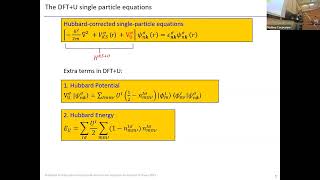
Phonons and Electron-Phonon Coupling Using DFPT+U - QE School 2023 Lecture 3.5
Explore phonons and electron-phonon coupling using DFPT+U in Quantum ESPRESSO, focusing on Hubbard and Koopmans functionals from linear response.
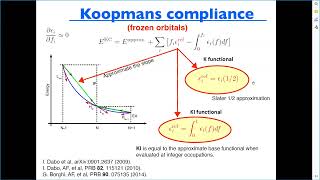
Koopmans Compliance: Towards a Functional Theory of the Spectral Density - Lecture 4.2
Explore Koopmans compliance and its role in developing a functional theory of spectral density, advancing understanding of Hubbard and Koopmans functionals in quantum systems.
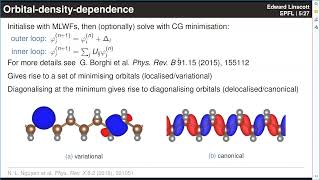
Koopmans Functionals in Practice: Minimisation and Screening Coefficients - Lecture 4.3
Explore Koopmans functionals in quantum calculations: minimization techniques, screening coefficients, and practical applications for advanced materials modeling.
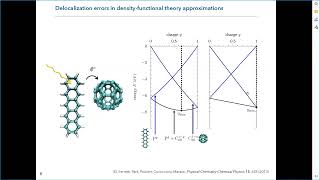
Koopmans Functionals: Basic Concepts - QE School 2023 - Lecture 4.1
Explore Koopmans functionals in quantum mechanics, covering fundamental principles and applications in advanced Quantum ESPRESSO calculations.