Monoclinic Nano-Colloidal Nematic Fluids and Condensed Matter Systems - Ivan Smalyukh
Explores monoclinic nano-colloidal nematic fluids and condensed matter systems, focusing on nanoparticle assembly for functional materials. Discusses recent developments and future directions in this interdisciplinary field.
Collective X-ray Diffraction and Photoluminescence in Perovskite Nanocrystal Superlattices
Explore collective X-ray diffraction and photoluminescence in perovskite nanocrystal superlattices. Gain insights into nanoparticle assembly and its applications in functional materials at the mesoscale.
Next Steps in Patchy Particle Assembly Engineering - Sharon Glotzer
Exploring advancements in nanoparticle assembly engineering, focusing on patchy particles and their potential for creating complex, functional materials with unique structural properties.
Electron Videography of Nanoparticles in and Out of Equilibrium - Qian Chen
Explore electron videography techniques for studying nanoparticle behavior in equilibrium and non-equilibrium states, offering insights into their dynamic properties and assembly processes.
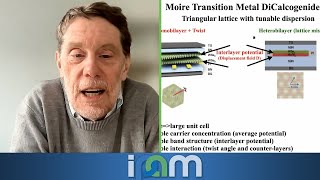
Twisted Transition Metal Dicalcogenides - Tests of Quantum Embedding and Theories
Explore quantum embedding theories and their application to twisted transition metal dicalcogenides, focusing on the Hubbard model and its relevance to experimental observations in materials science.
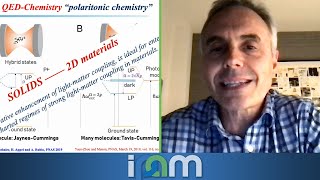
Polaritonic Quantum Materials: A First Principles QEDFT Perspective
Explore the potential of light-matter hybrid states to create new phases of matter, focusing on cavity-QED in 2D materials and introducing QEDFT as a predictive framework for light-matter interactions.
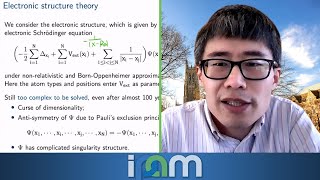
Mathematical Models of Electronic Structure - IPAM at UCLA
Explore mathematical models of electronic structure, focusing on quantum mechanics applications in materials science and chemistry, presented by Duke University expert Jianfeng Lu.
Nonlocal Theories for Free Crack Propagation in Brittle Materials - Lecture 2
Explores mathematical upscaling of nonlocal fracture models, focusing on weak convergence, compactness, and Gamma-convergence for bridging mesoscopic and macroscopic scales in brittle material dynamics.
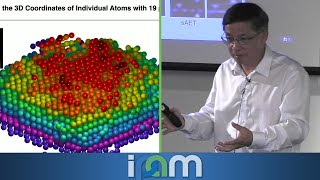
Capturing the 3D Atomic Structure of Non-Crystalline Materials - IPAM at UCLA
Explore advanced techniques for capturing 3D atomic structures of non-crystalline materials, presented by UCLA's John Miao at IPAM's Computational Microscopy Tutorials.
AI-Driven Workflows for the Discovery of Novel Superconductors
Explore AI-driven methods for discovering novel superconductors, including data augmentation, ultra-fast machine-learning potentials, and symbolic regression to improve predictive equations for superconducting transition temperatures.
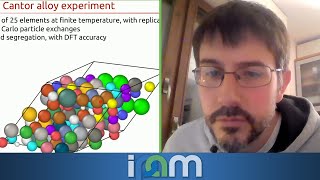
Machine Learning for Atomic-Scale Modeling - Potentials and Beyond - IPAM at UCLA
Explore machine learning techniques for atomic-scale modeling, addressing challenges in chemical diversity and integrating functional properties beyond interatomic potentials for advanced materials simulation.
Catalysis - Automated Multiscale Modeling and Active Exploration of Chemical Space
Revolutionizing catalysis through automated multiscale modeling and active exploration of chemical space, accelerating material discovery and optimizing processes from first principles to reactor scale.
From Electrons to the Simulation of Materials - IPAM at UCLA
Explore computational workflows for predicting complex materials properties, from phase diagrams to nanostructures, using density functional theory and machine learning potentials.
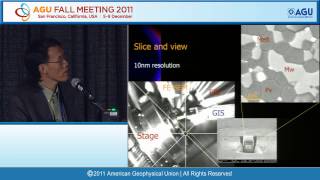
50 Years of High-Pressure Studies of the Earth - Part 2
Explore 50 years of high-pressure Earth studies, examining groundbreaking research and advancements in geophysics and geochemistry at extreme conditions.
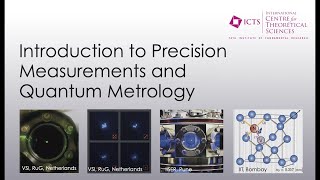
Metamaterials for Quantum Technologies
Explore metamaterials' applications in quantum technologies, covering precision measurements, quantum metrology, and emerging quantum systems for enhanced accuracy and control.

Brownian Colloids and Structured Light - Quo Vadis by GV Pavan Kumar
Explore the intersection of Brownian colloids and structured light, examining current research and future directions in this fascinating field of soft matter physics.

The Smart Light Reflectors of the Scarab Beetle Chrysina Gloriosa
Explore the fascinating light-reflecting properties of the Chrysina gloriosa scarab beetle, uncovering nature's ingenious optical adaptations and their potential applications in material design.

Electronic Learning Metamaterials - Lecture 3
Explore electronic learning metamaterials in this advanced lecture, covering cutting-edge concepts in soft matter physics and their applications in emerging technologies and material design.
Experiments in Stochastic Thermodynamics - Short History and Perspectives by Sergio Ciliberto
Explore stochastic thermodynamics through experiments, tracing its history and future prospects. Gain insights into this interdisciplinary field's applications in soft matter physics and complex systems.
Physics of Charged Macromolecules - Structure - Lecture 1
Explore the structure of charged macromolecules in this lecture, delving into fundamental concepts and their applications in soft matter physics and related fields.

Polymer Material Design for Gas Separations by Sanat Kumar
Explore innovative polymer design strategies for efficient gas separation, focusing on material properties and molecular interactions to enhance selectivity and permeability in industrial applications.