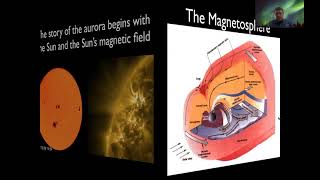
Auroral Currents
Explore the science behind auroral currents, from solar magnetic fields to Earth's magnetosphere, and their impact on navigation and technology. Gain insights from historical discoveries to modern space missions.
Astrophysical Neutrinos and How to Find Them - With Jenni Adams
Explore the fascinating world of neutrinos and their detection using the IceCube telescope in Antarctica. Learn how these elusive particles could unlock secrets of high-energy cosmic sources and their role as cosmic messengers.
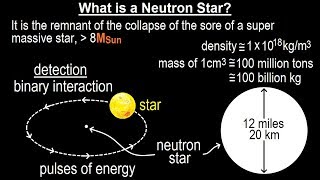
Astronomy - Neutron Stars & Pulsars
Explore neutron stars and pulsars, covering their formation, structure, properties, and behavior. Learn about key concepts like neutron degeneracy, quark pressure, and synchrotron radiation in pulsars.
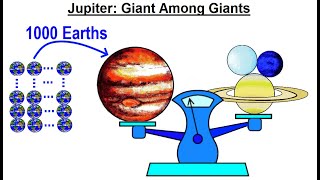
Astronomy - Jupiter
Comprehensive exploration of Jupiter's characteristics, including composition, atmosphere, interior structure, magnetic field, rings, and moons, with detailed explanations of its unique features.
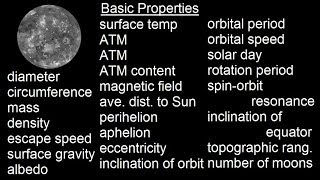
Astronomy - Mercury
Comprehensive exploration of Mercury's properties, orbit, geology, atmosphere, and space missions, including detailed analysis of Mariner 10 and MESSENGER missions and their discoveries.
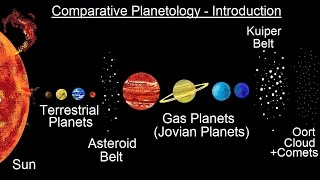
Astronomy - The Solar System - Comparative Planetology
Comprehensive exploration of solar system planets, comparing their physical properties, orbits, atmospheres, and compositions. Includes discussions on moons, asteroids, comets, and water distribution.
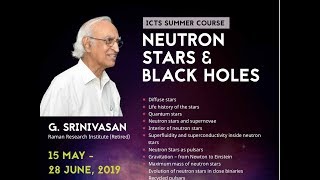
Neutron Stars and Black Holes - Recycled Pulsars - Lecture 10
Explore recycled pulsars, neutron star spin-up, and magnetic field evolution in binary systems. Gain insights into the Hulse-Taylor pulsar, accretion processes, and the physics of neutron star interiors.
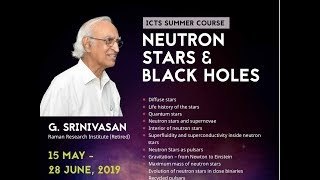
Neutron Stars and Black Holes - Radiation from Relativistic Particles - Lecture 5
Explore radiation from relativistic particles, covering Maxwell's equations, synchrotron radiation, and applications to astrophysical phenomena like pulsars and supernova remnants.
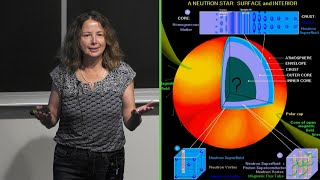
Realistic Binary Neutron Stars Collisions Simulations - Challenges and Opportunities
Explore challenges and opportunities in simulating binary neutron star collisions, focusing on realistic models, electromagnetic counterparts, and remnant properties using open-source codes and parametrized equations of state.
Magnetic Feshbach Resonances Between a Single Ion and Ultracold Atoms - Michal Tomza
Explore magnetic Feshbach resonances between single ions and ultracold atoms. Discover the latest research in few-body physics, focusing on unitarity and its implications across various scientific disciplines.
Tiny but Powerful- Hunting for Extreme White Dwarfs - KITP Chalk Talk by Ilaria Caiazzo
Explore extreme white dwarfs: their unique properties, recent discoveries, and implications for stellar evolution. Learn about cutting-edge research using advanced telescopes and instruments to uncover mysteries of these dense stellar remnants.
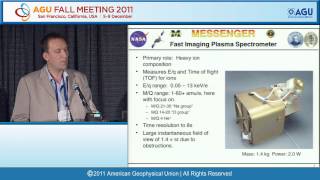
Mercury - The View from Orbit III
Explore the latest findings from Mercury's orbit, including geological insights and planetary observations from recent space missions.
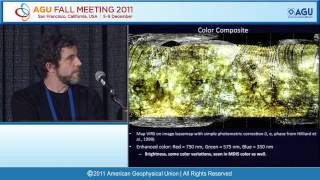
Mercury - The View from Orbit II
Explore the latest findings from Mercury's orbit, including new data and insights from recent space missions. Discover the planet's unique features and geological history.

Black Hole Formation Explained by Prize-Winning Astrophysicist Steven Balbus
Renowned astrophysicist Steven Balbus discusses his award-winning work on black hole formation, focusing on accretion disks and magnetic fields. Includes insights into his career and quick-fire questions on mathematics.
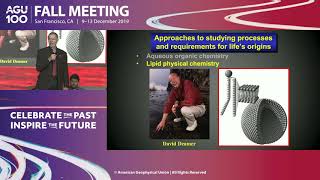
Ingredients for Life - Early Earth Evolution and Habitability
Explore Earth's early evolution from accretion to habitability, covering the Moon's formation, magma oceans, planetary differentiation, magnetic field creation, and the emergence of life-sustaining conditions.
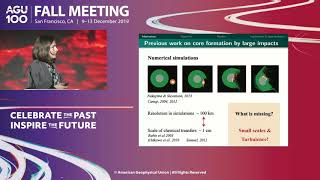
Core and Dynamo - Earth's Magnetic Field Formation and Evolution
Explore Earth's core formation, composition, and magnetic field evolution through cutting-edge research and open questions in geodynamo modeling and data-based constraints.
Graphing Electric Fields - Computational Electromagnetism
Explore computational techniques to visualize electric fields using derivatives of electric potential, enhancing understanding of electromagnetic phenomena through practical coding examples.
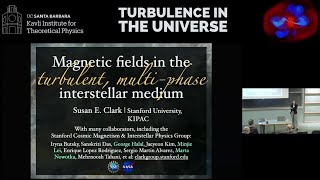
Magnetic Fields in the Multi-Phase Interstellar Medium - Susan Clark
Explore magnetic fields in the multi-phase interstellar medium with Susan Clark's conference talk, part of KITP's "Turbulence in the Universe" event, covering astrophysical turbulence and its impacts.
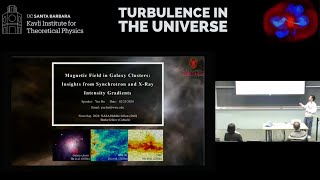
Magnetic Fields in Galaxy Clusters - Insights from Synchrotron and X-Ray Intensity Gradients
Explore magnetic fields in galaxy clusters through synchrotron and X-ray intensity gradients. Gain insights into astrophysical turbulence and its impact on various cosmic environments.
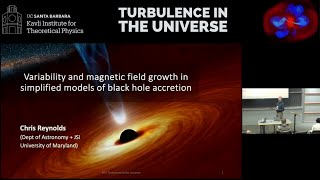
Variability, Dynamos & Large-Scale Field Growth in Simplified Models of Black Hole Accretion Disks
Explore simplified models of black hole accretion disks, examining variability, dynamos, and large-scale magnetic field growth in astrophysical turbulence contexts.
Neutron Star Cooling, Magnetic White Dwarfs Polarization, and Axion-Photon Conversion in Neutron Stars
Explore neutron star cooling, magnetic white dwarf polarization, and axion/photon conversion in neutron stars in this advanced astrophysics lecture by Ben Safdi.