
Operational Excellence for LLMs Using Amazon Bedrock - Conf42 LLMs 2024
Explore operational excellence for LLMs using Amazon Bedrock. Learn design principles, LLMOps, model lifecycle, customization, and architectural patterns for effective implementation and evaluation.

Getting AI to Do the Unexpected - Exploring LLM Vulnerabilities and Defenses
Explore LLM vulnerabilities, attacks, and defenses. Learn about prompt injections, output handling, and jailbreaking. Discover secure practices for AI implementation and see real-world examples.

AI Chats: The Conundrums of Business Integration
Explore challenges and solutions for integrating AI chatbots in business, focusing on practical implementation and overcoming common obstacles.

Building Chatbots with Retrieval-Augmented Generation Techniques
Explore advanced techniques for building chatbots using retrieval-augmented generation, focusing on biomedical applications and improving search capabilities.
DevOps to MLOps: Scaling ML Models to 2 Million+ Requests per Day
Explore scaling ML models to handle millions of daily requests, covering MLOps fundamentals, cloud-agnostic architecture, and real-world production challenges in eKYC SaaS APIs.
Mastering the Maze: Navigating Complexity in Distributed Systems
Explore distributed systems complexities, challenges, and strategies. Learn about architecture, consistency, availability, and SRE principles for navigating complex systems effectively.
Using Quix, Hugging Face, and InfluxDB for Anomaly Detection
Explore anomaly detection using Quix, Hugging Face, and InfluxDB. Learn about data pipelines, time series databases, and MLOps for effective machine learning implementation.
A Beginner's Guide to Adversarial Machine Learning
Explore adversarial machine learning attacks, their impact on AI systems, and effective mitigation strategies. Gain insights into poisoning, inference, extraction, and evasion attacks with real-world examples.

The Rise of AI Agents - Understanding Trust and Expectations
Explore the emergence, functionality, and future implications of AI agents, focusing on trust, problem-solving capabilities, and their potential impact on individuals and society.
AI and Disability: Inclusion or Exclusion?
Explorez l'impact de l'IA sur l'inclusion des personnes handicapées, ses biais potentiels, et les innovations prometteuses pour améliorer l'accessibilité et la représentation dans le domaine technologique.
MLOps: From Jupyter to Production - Conf42 ML 2024
Learn to transition machine learning projects from Jupyter notebooks to production environments, covering MLOps best practices and real-world implementation strategies.

Building a Serverless GenAI Platform
Explore building a serverless GenAI platform, from architecture to adoption strategies, and learn its impact on various industries.

Practically Engaging with AI - Bridging Aspirations and Actionable Strategies
Explore actionable strategies to bridge the gap between AI aspirations and real-world integration, focusing on practical implementation techniques.
The Continuous Language of Protein Structure
Explore a novel approach to protein structure generation using continuous autoregressive language models. Learn about innovative techniques for in silico protein design and their potential applications.

Integrating -omic Data Across Datasets and Layers
Explore techniques for integrating -omic data across datasets and layers, focusing on redundancy, neural networks, and genetic associations in cancer research.
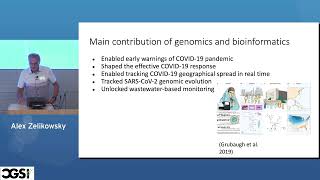
Analysis of SARS-CoV-2 Sequencing Data
Explore advanced techniques for analyzing SARS-CoV-2 sequencing data, including haplotype assembly, phylogeny reconstruction, variant identification, and network representation of genomic information.
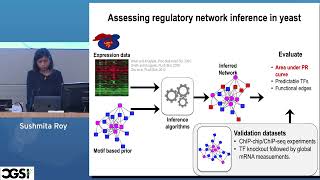
Inference of Gene Regulatory Networks from Bulk and Single Cell Omic Datasets
Explore gene regulatory network inference techniques using bulk and single-cell omic datasets. Learn about integrative approaches, predictive models, and applications in cellular reprogramming and single-cell genomics.
Large Language Models for Computational Biology - A Primer
Explore large language models in computational biology, covering transformers, pretraining, and applications in genomics and single-cell analysis.
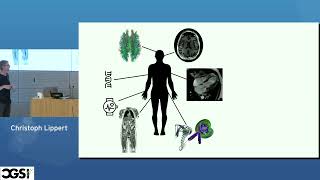
Performing GWAS of Images by Combining Deep Transfer Learning with Statistical Testing
Explore innovative techniques for genome-wide association studies of images, combining deep transfer learning with statistical testing for advanced computational genomics research.
Methods for Disease Analysis Using Multiomic Data
Explore advanced methods for analyzing diseases using multiomic data, focusing on clustering algorithms, cancer subtyping, and driver gene prioritization.

From Rock-Paper-Scissors to BabyAGI - Harnessing LLMs with the Wolfram Language
Explore LLMs through rock-paper-scissors, then implement BabyAGI in Wolfram Language. Discover AI's decision-making and autonomous agent capabilities.