
Deep Generative Modeling
Explore deep generative modeling, including autoencoders, VAEs, and GANs. Learn about latent variables, representation learning, and applications in debiasing and image synthesis.

Convolutional Neural Networks
Explore convolutional neural networks for computer vision, covering feature extraction, convolution operations, and applications in autonomous navigation and medical imaging.
Recurrent Neural Networks and Transformers
Comprehensive exploration of recurrent neural networks, LSTMs, and attention mechanisms in deep learning, covering theory, implementation, and applications for sequence modeling tasks.
MIT Introduction to Deep Learning
Comprehensive introduction to deep learning fundamentals, covering perceptrons, neural networks, loss functions, gradient descent, backpropagation, and regularization techniques for building effective models.

Taming Dataset Bias via Domain Adaptation
Explore techniques to address dataset bias in deep learning, including adversarial domain alignment, pixel space alignment, and consistency enforcement for improved model generalization.
AI Bias and Fairness
Comprehensive exploration of AI bias and fairness, covering types, sources, and mitigation strategies. Examines interpretation-driven and data-driven biases, feature bias, and advanced debiasing techniques for ethical AI development.
Deep Learning New Frontiers
Explore deep learning limitations and new frontiers, including expressivity, generalization, failure modes, uncertainty, adversarial attacks, and emerging areas like graph learning and AutoML.
Reinforcement Learning
Comprehensive exploration of deep reinforcement learning, covering Q-functions, policy gradients, and real-world applications like AlphaGo. Ideal for understanding RL fundamentals and advanced concepts.

Convolutional Neural Networks
Explore convolutional neural networks for computer vision, covering feature extraction, convolution operations, and applications like object detection and self-driving cars.
Introduction to Deep Learning
Comprehensive introduction to deep learning fundamentals, covering perceptrons, neural networks, loss functions, gradient descent, backpropagation, and regularization techniques for building effective models.
Machine Learning for Scent
Explore machine learning applications in digitizing scent, from understanding olfactory processes to predicting odor descriptors using graph neural networks and interpreting molecular fragrance data.
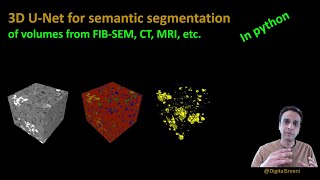
3D U-Net for Semantic Segmentation
Learn to implement 3D U-Net for semantic segmentation on volumetric data like FIB-SEM, CT, and MRI. Covers data preparation, model architecture, training, and multichannel image processing using Python libraries.
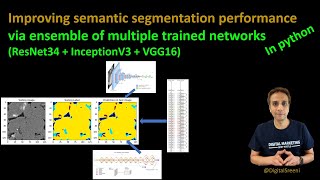
Improving Semantic Segmentation - U-Net Performance via Ensemble of Multiple Trained Networks
Enhance U-Net performance for semantic segmentation using ensemble methods with ResNet34, Inception V3, and VGG16 networks. Includes code, dataset, and practical implementation tips.
Generalizable Autonomy for Robot Manipulation
Explore generalizable autonomy in robot manipulation through imitation learning, visuo-motor policies, and reinforcement learning techniques. Discover innovative approaches for achieving adaptable and efficient robotic systems.
Deep Learning New Frontiers
Explore deep learning limitations and new frontiers, including expressivity, generalization, adversarial attacks, uncertainty, and AutoML. Gain insights into cutting-edge developments in neural networks.

Reinforcement Learning
Explore deep reinforcement learning concepts, from Q-functions to policy gradients, with applications in Atari games, real-world scenarios, and groundbreaking AI like AlphaGo.

Multi-Class Language Classification With BERT in TensorFlow
Learn to build a multi-class language classification model using BERT and TensorFlow. Covers data preprocessing, model architecture, training, and prediction with transformers for NLP tasks.
How to Detect Malware in Encrypted Traffic Without Decryption
Explore machine learning techniques for detecting malware in encrypted traffic without decryption. Learn about AI applications in cybersecurity and innovative approaches to network threat monitoring.
How to Build a Quokkabot
Learn to create a chatbot that identifies quokkas using Twilio APIs and Microsoft's Custom Vision, combining machine learning with engaging communication channels.
Beyond Sentiment Analysis - Object Detection with ML NET
Explore object detection using ML.NET Model Builder, overcoming resource limitations. Learn image labeling tools, practical examples, and use cases for efficient computer vision implementation in .NET solutions.
Machine Learning in the Real World
Explore real-world challenges in IoT and big data, focusing on data quality, precision, and practical considerations before diving into machine learning algorithms.