Reproducible Molecular Simulations with Python
Explore molecular dynamics simulations using Python's scientific ecosystem, focusing on OpenMM and its tools. Learn how AI and machine learning are revolutionizing this field.
Transforming a Jupyter Notebook into a Reproducible Pipeline for ML Experiments
Learn to transform Jupyter Notebooks into reproducible ML pipelines using Git and DVC. Explore techniques for experiment tracking, modularization, and result comparison in a text2image project with Stable Diffusion.
Unit Testing con Pytest
Aprende a escribir pruebas unitarias efectivas con pytest, incluyendo buenas prácticas, mocks y características avanzadas para mejorar la calidad del código.
Charlas: Resolviendo crimenes con Python mediante el Procesamiento del Lenguaje Natural (NLP)
Descubre cómo el procesamiento del lenguaje natural y el aprendizaje automático con Python ayudan a resolver crímenes como el grooming, agilizando el análisis forense de conversaciones digitales.
Modern, Typed Python for Multimodal ML - From Training to Deployment
Explore the benefits of Python type hints in machine learning, from improving code quality to organizing multimodal data and bridging the gap between training and deployment.
Using Python to Power Serverless Applications
Explore best practices for building serverless solutions with Python, focusing on API calls, streaming data, and ML inference. Learn techniques for production-grade systems with observability.
Building a Model Prediction Server
Learn to create a FastAPI application that serves real-time predictions from a trained scikit-learn model, bridging the gap between model development and production deployment.
Feature Engineering is for Everyone
Explore feature engineering techniques for data visualization, automation, and machine learning. Learn to create and select features from various data types using encodings, vectorization, and date manipulation.
Introduction to Machine Learning Using Python Tools
Explore machine learning fundamentals using Python, covering key concepts and practical tools for data analysis and predictive modeling.
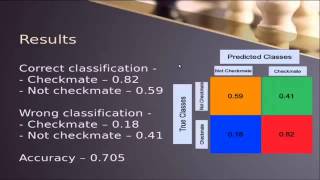
Learning Chess from Data
Discover chess rules and gain insights through Machine Learning and Hadoop analysis of game data. Explore feature importance, representation, and sample size for understanding complex systems.
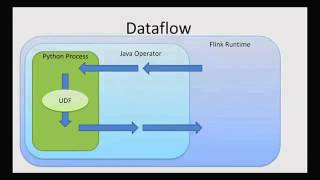
Big Data Analytics with Python Using Stratosphere
Learn to perform advanced big data analytics using Stratosphere's Python interface. Explore key concepts, operators, data flows, and iterative algorithms for efficient distributed data processing.
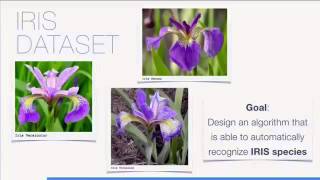
Scikit-learn to "Learn Them All"
Overview of Scikit-learn for machine learning in Python, covering supervised and unsupervised techniques, with code examples and insights on implementation. Includes comparison to other ML libraries and scaling to big data.
Teaching Python
Effective strategies for teaching Python, including rapid feedback and supervised learning. Insights from OpenTechSchool's successful workshops for beginners and experienced programmers.
Probabilistic Programming in Python
Learn probabilistic programming in Python using PyMC3 for flexible statistical modeling, automated parameter estimation, and uncertainty quantification in data science and scientific research.
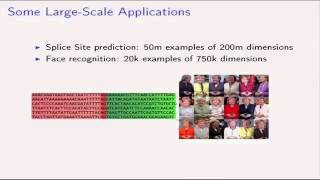
The Shogun Machine Learning Toolbox
Explore the Shogun Machine Learning Toolbox, a powerful framework for data analysis and prediction. Learn key ML concepts, algorithms, and practical applications through intuitive visualizations and Python examples.
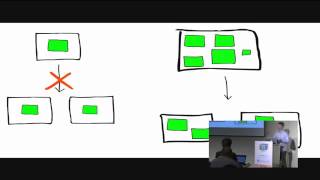
Elasticsearch from the Bottom Up
Explore Elasticsearch and Lucene architecture, focusing on inverted index structure, index terms, text analysis, segment-based indexing, caching, and distributed search processing across shards.
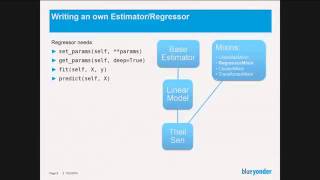
Extending Scikit-Learn with Your Own Regressor
Learn to extend Scikit-Learn by implementing a robust Theil-Sen estimator, exploring its advantages over ordinary least squares and understanding Scikit-Learn's design and contribution process.
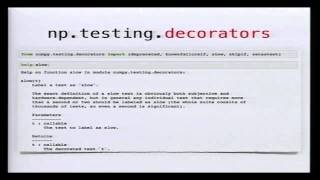
Machine Learning Under Test
Explore testing strategies for machine learning algorithms, focusing on code quality, domain-specific challenges, and practical implementation techniques for more robust and reliable ML models.
Yak Shaving a Good Place to Eat Using Non Negative Matrix Factorization
Explore data handling techniques to analyze restaurant reviews, group users with similar tastes, and find personalized dining recommendations using non-negative matrix factorization.
Using Scikit-Learn's Interface for Turning Spaghetti Data Science into Maintainable Software
Learn to structure data science code using Scikit-Learn's estimator and meta-estimator interfaces. Discover how to transform spaghetti code into maintainable, testable, and reusable machine learning models.
Speeding Up Search With Locality Sensitive Hashing
Explore locality sensitive hashing for faster search and similarity comparisons, with practical Python implementations and real-world applications in image search and collaborative filtering.