Taming the Beast - Managing the Day 2 Operational Complexity of Kubeflow
Explore strategies for managing Kubeflow's operational complexity, covering deployment, configuration, and maintenance. Learn tips and lessons from experienced practitioners to streamline ML workflows on Kubernetes.
ML Ops Design Patterns with Kubeflow Pipelines
Explore ML Ops design patterns using Kubeflow Pipelines to transition from notebook exploration to production, addressing challenges and implementing effective solutions.
Securing the Software Supply Chain with the In-toto and SPIRE Projects
Explore securing software supply chains using in-toto and SPIRE projects. Learn about cryptographic attestation, automated certificate issuance, and building trust in software releases.
Building and Managing a Centralized ML Platform with Kubeflow at CERN
Explore CERN's centralized ML platform using Kubeflow, covering data preparation, model training, and serving. Learn about resource optimization, integration challenges, and cloud expansion possibilities.
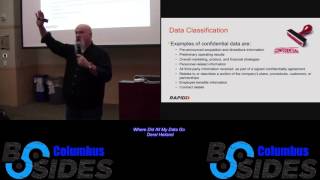
Where Did All My Data Go
Explore data classification, security risks, and best practices for protecting sensitive information in various environments, including FTP, PCI, and databases.
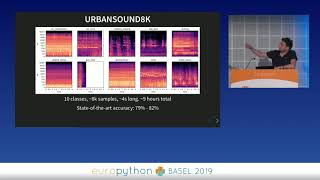
Audio Classification with Machine Learning
Learn practical techniques for audio classification using machine learning, including spectrograms, CNNs, and transfer learning. Explore applications in speech, music, medical diagnostics, and more using Keras and TensorFlow.
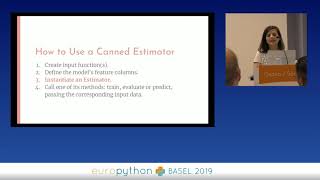
Tensorflow Estimators
Explore Tensorflow's simplified API, including Estimators, Datasets, and Tf-hub. Learn to design efficient neural networks using best practices and pre-trained modules.
Histogram-based Gradient Boosting in scikit-learn 0.21
Explore the new Histogram-based Gradient Boosting implementation in scikit-learn 0.21, offering competitive performance with XGBoost and LightGBM for efficient machine learning on tabular data.
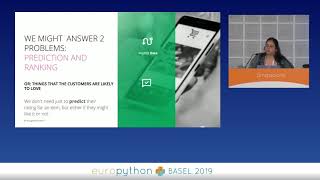
What About Recommendation Engines
Explore recommendation engines: their importance, components, algorithms, and implementation in companies like Netflix and Amazon. Learn to build your own system using basic statistics and practical examples.
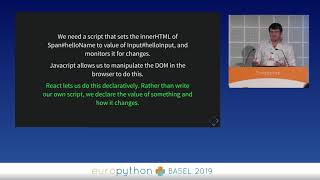
Dash - Interactive Data Visualization Web Apps with No Javascript
Explore interactive data visualization web apps using Dash, a Python framework that eliminates the need for JavaScript. Learn best practices, pitfalls, and when to transition to traditional web development.
Bringing AI to the Edge - On Premise Azure Cognitive Services - Open Source
Explore Azure Cognitive Services containers for on-premise AI, with demos of local Face and Text services. Learn to configure and implement edge AI solutions.
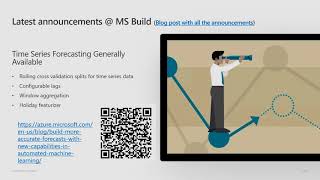
Overview of Automated ML June 2019
Explore automated machine learning for accelerating AI development, with demos on Azure ML Service and Databricks, focusing on Python implementation and recent Azure technologies.
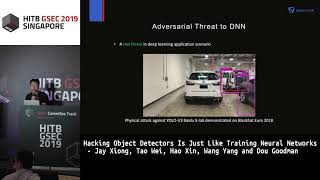
Hacking Object Detectors Is Just Like Training Neural Networks
Explore techniques for deceiving object detectors by comparing the attack process to neural network training. Learn how applying training techniques can improve adversarial attacks on state-of-the-art systems.
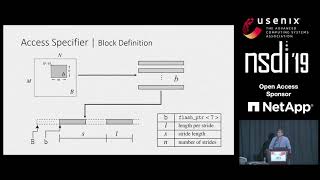
BLAS-on-Flash - An Efficient Alternative for Large Scale ML Training and Inference
Efficient alternative for large-scale ML tasks using SSD-resident matrices, enabling near in-memory performance on a single workstation. Outperforms distributed systems for complex algorithms like eigensolvers.
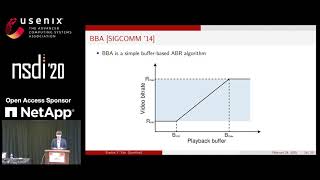
Learning in Situ - A Randomized Experiment in Video Streaming
Randomized trial of video-streaming algorithms reveals challenges for sophisticated schemes in real-world settings. New algorithm developed using in situ learning outperforms others.
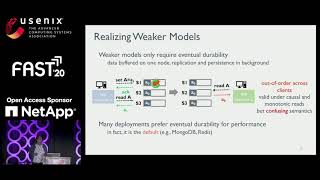
Strong and Efficient Consistency with Consistency-Aware Durability
Introduces consistency-aware durability for strong consistency in distributed storage. Demonstrates cross-client monotonic reads in ORCA, a modified ZooKeeper, offering improved performance over strongly consistent systems.
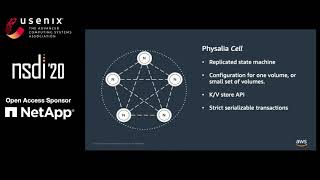
Millions of Tiny Databases
Innovative database system for cloud storage, optimizing availability and consistency through distributed architecture. Explores Physalia's design and applications in AWS, offering insights for distributed systems.
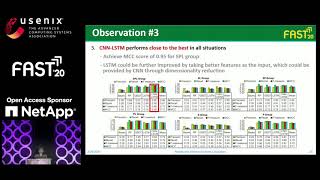
Making Disk Failure Predictions SMARTer
Explore advanced machine learning techniques for predicting disk failures in large-scale data centers, improving reliability and reducing downtime in IT infrastructure.
Moose v. Woodchuck
Exploring machine learning limitations in computer security, this talk introduces a framework for understanding AI problem-solving and discusses privacy implications of large datasets.
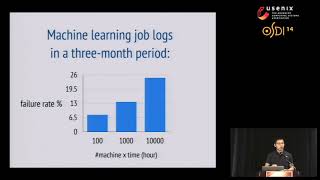
Scaling Distributed Machine Learning with the Parameter Server
Explore a framework for distributed machine learning using parameter servers, enabling scalable processing of petabyte-scale data with billions of examples and parameters across various algorithms.
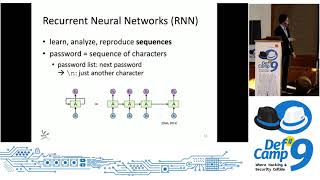
Tailored, Machine Learning-Driven Password Guessing Attacks and Mitigation
Explore machine learning-driven password guessing attacks and mitigation strategies in this DefCamp 2018 presentation, enhancing your cybersecurity knowledge and defense capabilities.