
ADR-X: ANN-Assisted Wireless Link Rate Adaptation for Compute-Constrained Embedded Gaming Devices
Innovative ANN-based rate adaptation technique for gaming consoles, reducing packet loss 10x while running 100x faster than existing solutions, enhancing wireless connectivity for controllers and headsets.
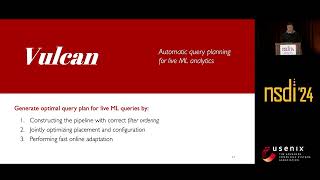
Vulcan: Automatic Query Planning for Live ML Analytics
Vulcan: Automatic system for optimizing live ML query plans. Determines best pipeline, placement, and configuration with low profiling cost and fast online adaptation, outperforming existing systems.

MadEye - Boosting Live Video Analytics Accuracy with Adaptive Camera Configurations
Adaptive camera system that automatically adjusts orientations to maximize accuracy in live video analytics, improving performance or reducing resource costs for diverse workloads.

Self-Driving Cars and the Human Brain - The Missing Link to Intelligence
Explore the connection between self-driving cars and human cognition, uncovering insights into AI decision-making and the future of autonomous vehicles with Minus Zero's CEO.
THC - Accelerating Distributed Deep Learning Using Tensor Homomorphic Compression
Accelerates distributed deep learning with Tensor Homomorphic Compression, enabling direct aggregation of compressed values and compatibility with in-network aggregation for faster training of vision and language models.

CASSINI: Network-Aware Job Scheduling in Machine Learning Clusters
Innovative network-aware scheduler for ML clusters, improving job completion times and reducing network congestion through strategic communication pattern interleaving.

OPPerTune - Post-Deployment Configuration Tuning of Services
Automated configuration tuning for deployed applications, reducing latency by 50% over expert choices. OpperTune determines parameters, manages scope, and uses reinforcement learning for efficient optimization.
Secure AI: Integrating OWASP Principles in Machine Learning Model Development
Explore integrating OWASP principles into machine learning model development to address vulnerabilities, ensure data privacy, and safeguard AI systems from potential threats, ensuring robustness and confidentiality.

Machine Learning and Symbolic Reasoning - Integrating AI Technologies
Explore the synergy of Machine Learning and Symbolic AI, combining data-driven insights with human-readable rules for transparent, explainable, and powerful AI applications.
AI in Electronics: Quilter's Journey in PCB Design - Automating Layout with Reinforcement Learning
Explore how Quilter revolutionizes PCB design using reinforcement learning, automating complex processes and addressing real-world challenges in electronic design automation.
Bring the Power of AI to Your Application
Explore integrating AI capabilities into applications, focusing on practical implementation strategies and leveraging AI's potential to enhance functionality and user experience.
Deep Reinforcement Learning Agent for Snake Game
Explore deep reinforcement learning as an AI agent masters the classic snake game, with code review and optimization techniques for Python-based machine learning projects.

Avoid the Top 5 Web Data Pitfalls When Developing AI Models
Explore strategies to overcome common challenges in AI model development, including data bias, insufficient variety, overfitting, poor quality, and data drift. Learn to create more robust and effective AI models.

The Fundamentals of Modern Deep Learning with PyTorch
Learn PyTorch for deep learning: train neural networks for image and text classification, explore tensor operations, automatic differentiation, and modern libraries like PyTorch Lightning for efficient GPU training.
No Data? No Problem: Zero-Data Model Training with Foundational Models
Explore zero-data model training using foundational models to create task-specific models without new data. Learn techniques for leveraging open-source tools in your projects.

The Modern Trolley Problem - Responsible AI Principles
Explore ethical challenges in AI-driven vehicles, from decision-making algorithms to object recognition. Delve into Responsible AI Principles and their crucial role in shaping autonomous technology's future.

Real-World PyTorch: From Zero to Hero in Deep Learning and LLMs - Tensors, Operations, Model Training
Comprehensive PyTorch tutorial covering tensors, operations, GPU usage, datasets, neural networks, and model training. Hands-on examples for mastering deep learning and LLMs.
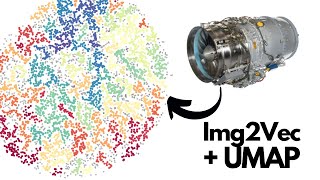
Img2Vec and UMAP for High-Dimensional Data Visualization
Learn to visualize high-dimensional image data using Img2Vec for embeddings, UMAP for dimensionality reduction, and Bokeh for interactive exploration. Ideal for vision classification projects.
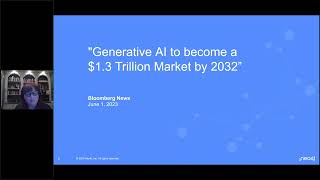
Navigating the GENAI Frontier: Empowering Data Scientists as Ethical Innovators
Explore ethical innovation in GenAI with Alison Cossette. Learn about algorithmic literacy, transparency, and bias mitigation to become a responsible data scientist shaping AI's future for societal benefit.
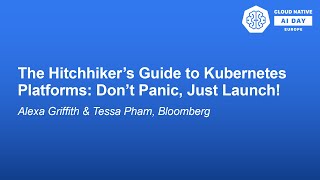
The Hitchhiker's Guide to Kubernetes Platforms - Building AI Development Platforms
Explore building a robust AI platform on Kubernetes, featuring modular APIs for efficient management and deployment. Learn from Bloomberg's implementation using open-source projects as guides.

Beyond the Clouds - Charting the Course for AI in the Cloud Native World
Explore AI's integration with cloud-native tech: OCI registries, distributed architecture, telemetry, MLOps collaboration, supply chain practices, GPU optimization, and resource utilization for enhanced AI performance.