
Creating an AI Agent with LangGraph, Llama 3, and Groq - Advanced Tutorial
Learn to create an advanced AI agent using LangGraph, Llama 3, and Groq. Explore key concepts, workflow, and implementation steps for building sophisticated language models and graph-based agents.
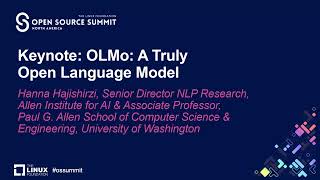
OLMo: A Truly Open Language Model - Keynote
Explore OLMo, a competitive open-source language model, empowering researchers with full access to training data, code, and evaluation tools for advanced NLP studies and innovation.
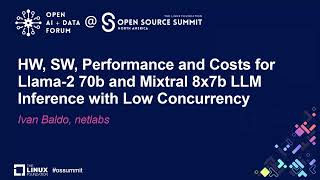
Hardware, Software, Performance and Costs for Llama-2 70b and Mixtral 8x7b LLM Inference with Low Concurrency
Explore hardware, software, performance, and costs for running Llama-2 70b and Mixtral 8x7b LLM inference. Compare on-premises and cloud options, with insights on speed, cost, and setup for small organizations.
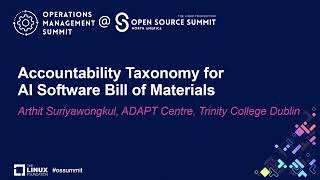
Accountability Taxonomy for AI Software Bill of Materials
Explore AI accountability through SBOM concepts, focusing on EU AI Act requirements and related US bills. Learn about a taxonomy for system trustworthiness and its practical application in MLOps.

Machine Learning News: Devin AI Exposed and NeurIPS High School Track
Explore AI news: Devin AI debunked, NeurIPS high school track, Opus as Turing machine, AI propaganda, outsourced AI labor, and ChatGPT's impact on academic writing.
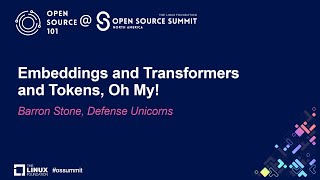
Embeddings, Transformers, and Tokens - Introduction to Modern Generative AI Concepts
Demystify AI jargon and history, from Turing to ChatGPT. Learn key concepts like tokens and transformers, and discover open-source projects to run generative AI models on your own computer for learning and productivity.
Guarding the ML Galaxy - Beyond Accuracy to Privacy and Security
Explore privacy and security challenges in machine learning systems, including attack types, protection techniques, and regulatory compliance to ensure stakeholder trust.
Flyte - Production-Grade Data and Machine Learning Orchestration
Explore Flyte, an open-source platform for scalable, repeatable, and maintainable data and machine learning orchestration, addressing key challenges in MLOps and data processing.

Influence of Natural Systems on AI in Autonomous Driving
Explore bio-inspired AI's role in revolutionizing autonomous driving, reshaping transportation, and redefining decision-making systems with Minus Zero CEO Gagandeep Reehal.
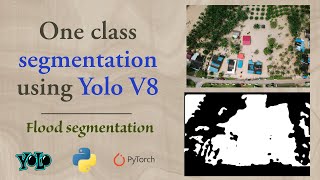
Flood Detection with YOLO V8 Segmentation - One-Class Image Segmentation
Learn to detect floods using Yolo V8 image segmentation. Covers dataset preparation, model training, and testing on new images to generate segmentation masks highlighting flooded areas.

Advanced RAG with Llama 3 in LangChain - Building a PDF Chat System
Learn to build an advanced RAG system using LangChain, Llama 3, and open models. Parse PDFs, create embeddings, use vector databases, and implement reranking for intelligent question-answering.
Top AI and LLM News: KANs, Gemma 10M Context, OpenAI Updates, and More
Explore latest AI advancements: KANs, Gemma's 10M context window, automatic prompt engineering, consistency in LLMs, tokenizer comparisons, and evaluation techniques. Stay updated on cutting-edge developments in language models.

Deep Generative Modeling - MIT 6.S191 Lecture 4
Explore deep generative modeling, including autoencoders, VAEs, GANs, and recent advances. Learn about latent variables, training techniques, and applications in AI-driven content creation and data analysis.
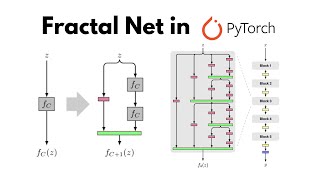
FractalNet Deep Neural Network Explained
Explore FractalNet, an alternative to residual networks, through paper analysis and PyTorch implementation. Learn about fractal expansion, drop path, and performance comparisons with ResNet.

Google's RAG Experiment - NotebookLM Overview and Demo
Explore Google's NotebookLM, an AI-powered tool for document analysis and interaction. Learn about its features, interface, and capabilities through demonstrations and blog post insights.

Reinforcement Learning - MIT 6.S191 Lecture 5
Comprehensive exploration of deep reinforcement learning, covering Q-functions, policy gradients, and real-world applications like AlphaGo. Ideal for understanding RL fundamentals and advanced concepts.
The Challenges of Training Infinitely Large Neural Networks
Explore challenges in training infinitely large neural networks, including feature learning incorporation and scaling kernel machines to large datasets, with Professor Mikhail Belkin.
LLM News: xAI Series B, Codestral, LLM Guide, AutoGen Course, and Symbolic Chain-of-Thought
Explore latest AI developments: xAI funding, Codestral, LLM guide, AutoGen, and Symbolic Chain-of-Thought. Gain insights on cutting-edge research, tools, and applications in machine learning and natural language processing.
Testing Assumptions of Learning Algorithms
Explore how property testing can mitigate reliance on distributional assumptions and no distribution shift in supervised learning algorithms, ensuring more reliable theoretical guarantees.
Coresets and Their Applications to Design Sublinear Algorithms
Explore coresets and their role in designing efficient sublinear algorithms, enhancing computational performance for large-scale data analysis and machine learning tasks.
Adversarially Robust Streaming Algorithms
Explore techniques for designing streaming algorithms that maintain accuracy under adversarial data manipulation, enhancing resilience in data processing systems.