
Query Lower Bounds for Log-Concave Sampling
Explores complexity lower bounds for sampling from log-concave distributions, using modified Perron's sprouting construction for Kakeya sets to establish tight bounds in low dimensions.
OpenAI's New Embedding Models: Performance and Usage - Text-Embedding-3-Small and Text-Embedding-3-Large
Explore OpenAI's new embedding models, their performance gains, dimensionality options, and practical applications in semantic search and AI development.
Using Reinforcement Learning to Hedge Derivatives
Explore reinforcement learning applications in derivative hedging strategies, presented by experts from the University of Toronto in this quantitative finance seminar.
Deploying Trustworthy Generative AI - Ethical Considerations and Best Practices
Explore ethical considerations and best practices for responsible deployment of generative AI, focusing on real-world use cases, robustness evaluation, and strategies to build reliable AI applications.
Bloomberg's Journey to a Multi-Cluster Workflow Orchestration Platform
Explore Bloomberg's evolution in cloud-native workflow orchestration, addressing challenges of rapid growth and discussing solutions for efficient multi-cluster resource deployment and management.
Strategies for Efficient LLM Deployments in Any Cluster
Explore strategies to optimize LLM deployments in Kubernetes clusters, focusing on reducing model size, improving resource utilization, and balancing performance with efficiency for cloud-to-edge scenarios.
Kubernetes AI Edge Deployment Patterns - Choosing the Best for Your Use Case
Explore AI edge deployment patterns using Kubernetes and Open Data Hub. Learn to manage distributed architectures, handle edge data, and select optimal deployment strategies for various industries and use cases.
Training and Optimisation of Large Transformer Models - An ATLAS and CERN Use Case
Explore CERN's implementation of transformer models for Jet Flavour Tagging, utilizing Kubeflow for machine learning and Katib for hyperparameter optimization in large-scale particle physics data analysis.
Resource-Aware Scheduling for Production GenAI with RAG on Multicluster Cloud Kubernetes
Optimizing GenAI and RAG deployment on multi-cluster Kubernetes: resource-aware scheduling for efficient, scalable, and cost-effective production environments across geographies.

Effortless Scalability - Orchestrating Large Language Model Inference with Kubernetes
Explore automating deployment of large AI models on Kubernetes, leveraging CRDs for seamless management and optimizing GPU utilization through preset configurations and auto-provisioning.
Navigating the Processing Unit Landscape in Kubernetes for AI Use Cases
Explore specialized processing units for AI/ML workloads in Kubernetes. Learn about GPUs and TPUs, their strengths, and effective implementation strategies for parallel processing in AI applications.

AutoML and Training Working Group Updates - Kubeflow Developments
Explore AutoML and Training Working Group updates for Kubeflow, including Katib's V1 API graduation, advanced parameter distribution, and LLM tuning, plus Training Operator's roadmap for enhanced ML framework support.
Efficient Integration of Kubeflow Tools - ISS Data Case Study on Anomaly Detection
Explore Kubeflow's integrated tools for ML workflows through an ISS anomaly detection case study, showcasing Dask, Katib, PyTorch Operator, and KServe in a unified KFP pipeline.
Make Descheduler Smarter and Safer - Applying Reinforcement Learning in Descheduling Strategies
Explore how Reinforcement Learning enhances descheduling strategies for complex workload environments, improving resource management and addressing fragmentation without disrupting production services.
Argo for ML: Achieving Scalability and User Experience in Machine Learning Platforms
Explore how Argo Workflows enables scalable ML platforms across industries. Learn from experts about balancing high-scale operations with user-friendly interfaces for efficient ML team workflows.
ChatNMI and Beyond: Pushing the Easy Button in Home-based AI Deployment
Explore home-based AI deployment with ChatNMI, focusing on easy implementation and advanced techniques. Learn to push the boundaries of AI integration in personal environments.
Using EEG and Machine Learning to Perform Lie Detection - YOW! 2017
Explore EEG-based lie detection using Azure Machine Learning. Learn about data collection, model building, and limitations in this innovative experiment combining neuroscience and AI.
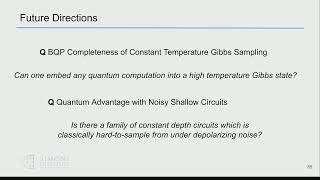
Quantum Computational Advantage With Constant-Temperature Gibbs Sampling
Explore quantum computational advantage through constant-temperature Gibbs sampling, examining thermalization processes and their implications for quantum systems and classical algorithms.
How AI is Revolutionizing Science
Explore how AI is transforming scientific research, particularly in life sciences, and its potential impact on the scientific method. Gain insights into the revolutionary changes AI brings to various fields.

MIT Introduction to Deep Learning - Foundations of Deep Learning - Lecture 1
Comprehensive introduction to deep learning fundamentals, covering perceptrons, neural networks, loss functions, gradient descent, backpropagation, and regularization techniques for effective model training.
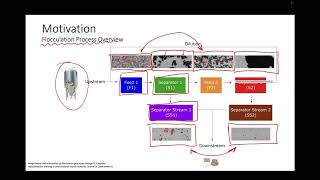
Convolutional Neural Networks for Visual Inspection in Industrial Processes
Explore CNNs for industrial visual inspection, learning how to train robust networks with limited datasets using PLS-inspired constraints. Gain insights for effective implementation in downstream processes.