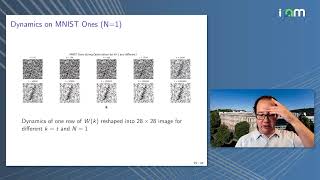
Learning Deep Matrix Factorizations Via Gradient Descent - Implicit Bias Towards Low Rank
Explores implicit bias in gradient descent algorithms for deep matrix factorizations, analyzing convergence to low-rank matrices and discussing implications for tensor decompositions.
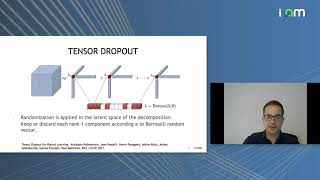
Efficient Tensor Representation for Deep Learning with TensorLy and PyTorch
Explore tensor methods for deep learning, improving performance, speed, and robustness. Learn practical implementation using TensorLy-Torch for video and image classification tasks.
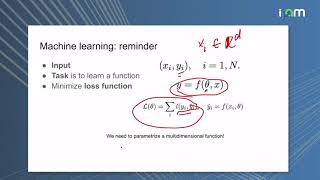
Tensor-Train Decomposition and Its Applications in Machine Learning
Explore tensor-train decomposition and its applications in machine learning, including neural network compression, high-dimensional distribution approximation, and deep neural network analysis.
Introduction to the Geometry of Tensors
Explore tensor geometry and its applications in physical and data sciences through a gentle introduction, emphasizing how geometric perspectives advance practical implementations.

Stabilizer Formalism & Quantum Error Correction Through the Lens of Tensors - Part 1
Explore stabilizer formalism and quantum error correction using tensor methods. Learn about many-body systems, error correction challenges, and connections to finite symplectic geometries.

Interpreting Deep Neural Networks Towards Trustworthiness
Explores methods for interpreting complex neural networks, introducing ACD and AWD techniques. Advocates for a quality-controlled data science lifecycle to ensure trustworthy model interpretation.

Deep Learning Algorithm for Core-Collapse Supernova Detection
Explore deep learning algorithms for detecting gravitational waves from core-collapse supernovae, enhancing multi-messenger astronomy and uncovering insights into extreme cosmic events.
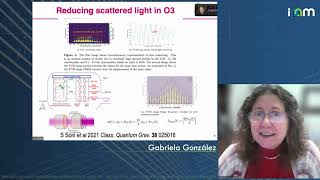
Non-Astrophysical Transients in LIGO Detectors: Help With Machine Learning
Explore machine learning techniques for diagnosing non-astrophysical transients in LIGO detectors, enhancing gravitational wave detection and analysis in multi-messenger astrophysics.
Non Asymptotic Analysis of L1 Support Vector Machines
Explores non-asymptotic analysis of l1 support vector machines for sparse classification in high-dimensional data, providing error guarantees applicable to real-world scenarios.

LaMini-LM - Mini Models Maxi Data
Explore LaMini-LM: mini language models trained on diverse, large-scale instruction data. Learn about dataset creation, model training, and practical applications through paper analysis and code demonstrations.
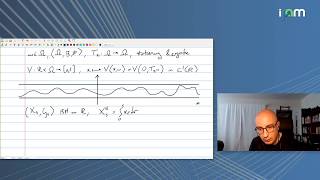
Nonconvex Homogenization for 1D Controlled Brownian Motion in a Random Potential
Explores stochastic control of Brownian motion in random potentials, analyzing optimal payoff growth and Bellman equation homogenization. Discusses effective Hamiltonians and distinct control regimes.
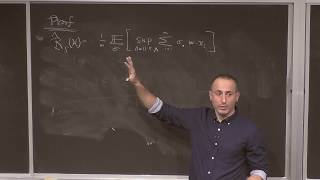
Gradient Descent, Stochastic Gradient Descent, and Acceleration - Part 2
Explore advanced gradient-based optimization methods for large-scale machine learning, including stochastic gradient descent and accelerated versions, with convergence analysis and ODE connections.
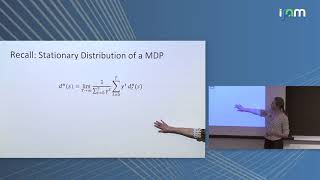
Curbing Our Enthusiasm - Constraining Decision Policies Learned from the Past to Ensure Good Futures
Explore batch off-policy reinforcement learning challenges and solutions, including structural minimization for future performance and algorithms for personalized policies using historical data.
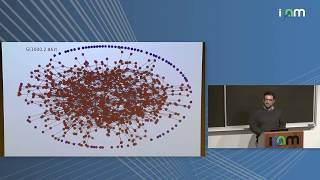
Quantifying the Topology of Coma
Explore a novel graph distance measure based on non-backtracking cycles, its relation to network features, and its application in distinguishing brain networks of healthy and comatose patients.

Braids and Machine Learning
Explore the fascinating intersection of braids and machine learning, uncovering innovative applications and insights in mathematics and data science.
Computationally Tractable and Near Optimal Design of Experiments
Explore near-optimal experimental design strategies that balance computational efficiency with statistical power, enhancing machine learning outcomes in complex systems.

Computational Challenges and the Future of ML Panel
Experts discuss computational challenges in machine learning, exploring open problems and future directions in the field with insights from leading researchers.

Embedding as a Tool for Algorithm Design
Explore embedding algorithms for structured data prediction, combinatorial optimization, and dynamic network processes. Learn innovative approaches to algorithm design using latent variable models and mean field techniques.
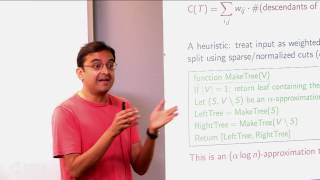
A Cost Function for Similarity-Based Hierarchical Clustering
Explore a novel cost function for similarity-based hierarchical clustering, examining its theoretical properties and practical implications for machine learning algorithms.
Unbiased Estimation of the Spectral Properties of Large Implicit Matrices
Explore techniques for estimating spectral properties of large implicit matrices, focusing on unbiased methods and their applications in machine learning and computational challenges.

Composing Graphical Models with Neural Networks for Structured Representations and Fast Inference
Explore structured representations and fast inference by combining graphical models with neural networks, enhancing machine learning capabilities.